


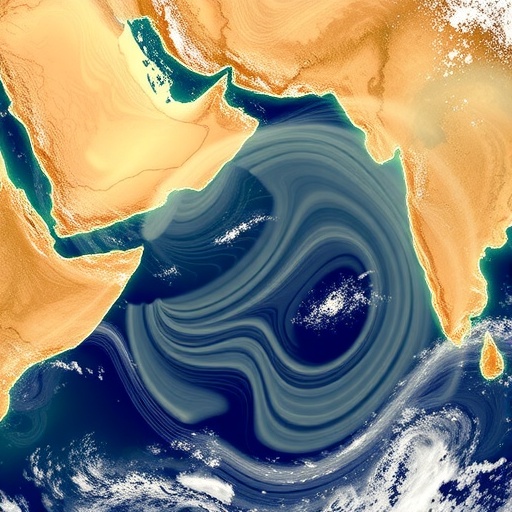
In a groundbreaking new study published in Nature Communications, researchers Liu, Xie, Hansen, and colleagues have uncovered a previously underestimated climatic influencer: dust originating from the Middle East. This atmospheric phenomenon is now being recognized as a critical external driver of the Indian Ocean Dipole (IOD), a climate oscillation that profoundly impacts weather patterns across the Indian Ocean rim, including East Africa, South Asia, and Australia. As climate variability becomes increasingly complex to predict, this discovery provides pivotal insights into the intricate web of factors that govern regional and global climate behavior.
The Indian Ocean Dipole is marked by oscillating sea surface temperatures between the western and eastern parts of the Indian Ocean, influencing monsoons, precipitation, and even drought occurrences. Traditionally, research has focused largely on oceanic and atmospheric conditions intrinsic to the Indian Ocean basin or related global phases like El Niño-Southern Oscillation (ENSO). However, the role of dust aerosols transported across continents and continents-to-ocean interactions had remained elusive, until this study meticulously explored the atmospheric composition and circulation patterns interlinking the Middle East and the Indian Ocean.
Delving into climate models integrating observed aerosol concentrations and atmospheric circulation data, the researchers uncovered that dust emissions emanating from arid regions in the Middle East can significantly modulate the surface radiative balance over the Indian Ocean. The aerosols absorb and scatter solar radiation, altering the regional energy budget, which consequently affects sea surface temperature gradients—a key driver of the IOD phases. This dust forcing is external to the ocean-atmosphere system traditionally considered, challenging established paradigms of IOD variability drivers.
Furthermore, the study elucidates the mechanisms through which the dust-induced radiative effects propagate through atmospheric dynamics. By impacting the thermal stratification and the vertical temperature profile over the ocean surface, dust aerosols influence the coupled ocean-atmosphere feedbacks that maintain or disrupt the IOD’s positive and negative phases. This complex interplay modifies the Walker circulation and the strength of monsoonal winds, explaining observed climate anomalies over adjacent continental regions.
One compelling aspect of this research is the geopolitical and environmental implications of anthropogenic activities in the Middle East. Land use changes, overgrazing, and desertification potentially influence dust emission intensity and frequency. The study raises crucial questions about how human-induced alterations to the Middle Eastern landscape could inadvertently amplify or modulate climatic oscillations far beyond their immediate vicinity. This interconnectivity underscores the transboundary nature of climate dynamics and the importance of integrated environmental stewardship.
The researchers employed an ensemble of coupled ocean-atmosphere models enhanced with state-of-the-art aerosol transport and radiative transfer modules. This methodological rigor allowed for the disentangling of dust forcing from other radiative influencers, such as greenhouse gases and sea ice extents. By isolating these effects, the study convincingly demonstrates the dust’s causal influence on both the amplitude and periodicity of the Indian Ocean Dipole, providing predictive leverage for upcoming climate variability assessments.
In parallel with model simulations, the team validated their findings through the analysis of satellite observations, reanalysis datasets, and in-situ ocean temperature measurements collected over several decades. The consistency between observational evidence and model outputs lends remarkable robustness to the conclusions. Significantly, the temporal correlation between dust outbreaks in the Middle East and IOD phase shifts sustains the assertion that dust transport is not merely coincidental but a dynamic external driver of the system.
The discovery transforms the current scientific understanding of tropical climate systems, especially emphasizing the role of aerosols beyond traditional continental pollution contexts. While biomass burning, industrial emissions, and natural dust have been studied primarily for their health and local climate impacts, their influence on large-scale oceanic climate oscillations represents a frontier research area opening new avenues for climate science.
Beyond fundamental science, these findings bear potential for improving climate prediction models, which are crucial for disaster preparedness and water resource management across Indian Ocean bordering nations. Better anticipation of monsoon variability and extreme events like droughts or floods could save lives and mitigate economic losses, especially in vulnerable developing countries dependent on predictable seasonal rains for agriculture.
The study also stimulates a re-examination of aerosol-cloud-ocean interactions in climate models. Since dust aerosols serve as cloud condensation nuclei, their indirect effects on cloud microphysics and hydrological cycles may currently be misrepresented or insufficiently parameterized in global climate models. Future research motivated by this work is poised to refine the depiction of such feedback loops, thereby enhancing model fidelity.
Intriguingly, the atmospheric teleconnection described—linking dust from the Middle East to Indian Ocean climatic states—may have analogues in other desert-ocean systems worldwide. This conceptual expansion encourages climatologists to revisit established climate oscillations, potentially uncovering novel external modulators in the Atlantic, Pacific, or Southern Oceans. Thus, this study constitutes a significant paradigm shift in understanding ocean-atmosphere interactions.
In conclusion, Liu, Xie, Hansen, and their team shine a spotlight on a subtle but potent external forcing mechanism of the Indian Ocean Dipole: Middle Eastern dust. Their pioneering integration of atmospheric chemistry, climate dynamics, and oceanography not only advances scientific knowledge but also emphasizes environmental interconnectedness transcending geographic and disciplinary boundaries. As climate change accelerates, such interdisciplinary insights will be vital for advancing climate resilience and sustainable development strategies in affected regions.
Cite Scienmag News
Violet Maxwell. (January 29, 2026). Middle East Dust: Key Driver of Indian Ocean Dipole. Scienmag. https://scienmag.com/middle-east-dust-key-driver-of-indian-ocean-dipole/
Violet Maxwell. "Middle East Dust: Key Driver of Indian Ocean Dipole." Scienmag, 29 January 2026, https://scienmag.com/middle-east-dust-key-driver-of-indian-ocean-dipole/. Accessed 4 September 2026.
Violet Maxwell. "Middle East Dust: Key Driver of Indian Ocean Dipole." Scienmag. January 29, 2026. https://scienmag.com/middle-east-dust-key-driver-of-indian-ocean-dipole/


