


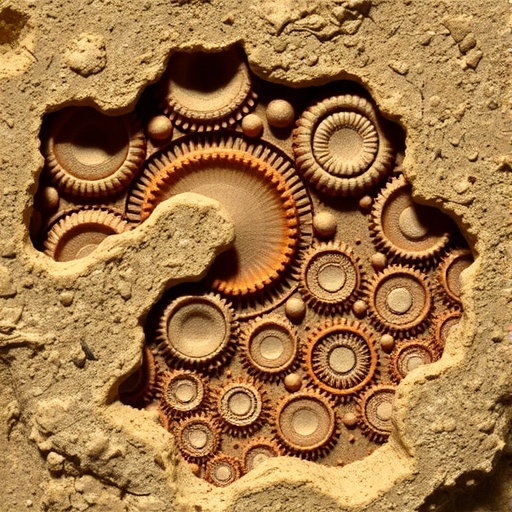
A groundbreaking study published in 2026 by a team of researchers including A.J. Boyd, M.A.R. Harding, and E.A. Bell examines the historical microbiological activities of Earth, specifically focusing on marine detrital sediments that date back a staggering 3.7 billion years. This research offers compelling evidence for the existence of diverse anaerobic metabolisms during a time when life was simplistic and primarily prokaryotic. The findings present profound implications for our understanding of early Earth conditions and the evolution of life itself, as well as the biochemical pathways that may have shaped the environment in which early organisms thrived.
The early Earth was once a vastly different landscape, obscured by a thick atmosphere with little to no free oxygen. It was within such an anoxic environment that microbial life began its evolutionary journey. These microorganisms played an essential role in the biogeochemical cycles, allowing for nutrient recycling and energy transfer, essentially laying the groundwork for complex life forms to emerge later. The anaerobic metabolic pathways identified in the research provide a critically important look into how life survived and thrived despite these restrictive conditions.
In their study, the researchers utilized advanced techniques to analyze marine detrital sediments collected from ancient rock layers. These sediments, preserved over billions of years, act as time capsules that hold the environmental signatures of Earth’s distant past. By applying genomic sequencing and geochemical analyses, the team identified various microbial communities that once populated these sediments, revealing a rich tapestry of metabolic processes that operated in anaerobic conditions.
Among the significant findings of this study is evidence of multiple anaerobic metabolic pathways, such as sulfate reduction, methanogenesis, and fermentation processes. Each of these pathways represents a different strategy that microorganisms used to harness energy and survive in a low-oxygen environment. The presence of these diverse metabolic pathways indicates that life was not only resilient during these times but also adapted to exploit various chemical resources available in their surroundings.
The implications of these findings extend beyond merely understanding early microbial life. They shed light on how ancient ecosystems functioned and how the energetic underpinnings of these ecosystems allowed for the sustainability of life. This research suggests that even before the Great Oxidation Event, different groups of microorganisms had successfully diversified in their metabolic capabilities, indicating a complex web of interactions among early life forms.
Furthermore, the study prompts important questions about the potential for life on other planets with similar anoxic conditions. Just as Earth’s early history holds clues about the resilience and adaptability of life, exoplanets may harbor unknown microbial forms capable of thriving under harsh atmospheric conditions. Understanding these anaerobic processes may inform astrobiological models and guide future explorations of celestial bodies, including Mars and Europa, where similar environmental conditions persist.
One remarkable aspect of the research is the lessons it teaches about nutrient cycling in ancient environments. Microbial activity is fundamental to nutrient transformation; therefore, understanding these processes can improve our grasp of how ecosystems functioned in prehistoric times. The same principles observed in these ancient sediments might offer insights into contemporary environments suffering from nutrient depletion, such as those affected by agricultural runoff and climate change.
As the study unfolds, more detailed implications for evolutionary biology come to light. The exploration of these anaerobic metabolisms may provide pivotal clues regarding the evolutionary pressures that shaped the genetic and phenotypic traits of early life. These pathways alone could help clarify how life on Earth transitioned from simple single-celled organisms to more complex multicellular forms, ultimately leading up to the remarkable biodiversity we see today.
Moreover, the research highlights the critical role of sedimentary rocks as archives of ancient life and environmental conditions. These geological formations serve not only as evidence of past life but also as indicators of how life affected the geochemical cycles of our planet. Future studies inspired by this research could expand upon these theories, providing a more comprehensive portrait of the interconnections between life and Earth’s evolving landscapes.
The innovative methodologies employed in this research contribute to a growing interdisciplinary effort to decode the ancient history of our planet. By bridging the fields of microbiology, geology, and geochemistry, scientists can paint a more nuanced picture of early Earth and the dynamics between living organisms and their environments through time. As such, this study encourages ongoing collaboration and dialogue among scientists to uncover the complexities of life’s origins.
This compelling investigation into the depths of Earth’s microbiological past raises public interest in the sciences that study our planet’s history. The narrative of resilience and adaptation of life is a powerful story, one that not only captivates scientific communities but also bridges gaps with the general public. The outcomes of this research invite readers to reflect on the tenacity of life and renew curiosity about the biological principles that govern our world.
As society grapples with pressing global challenges such as climate change and biodiversity loss, insights gathered from ancient life can serve as a source of inspiration. Understanding how life not only survived but flourished under extreme conditions urges us to rethink our approaches to contemporary environmental issues. The lessons from the past are not just historical; they are also a call to action for future sustainability efforts.
Finally, as this research gains attention, it would be essential to explore the broader philosophical implications of life’s resilience amidst adversity. The narrative woven by these 3.7-billion-year-old sediments is one of survival against all odds, evoking reflections about the nature of life itself. It challenges us to consider what other forms of life might exist, waiting to be discovered, in places beyond our own planet, and what stories they might tell about existence amidst harsh realities.
Boyd, A.J., Harding, M.A.R., Bell, E.A. et al. Evidence for diverse anaerobic metabolisms in 3.7-billion-year-old marine detrital sediments.
Commun Earth Environ (2026). https://doi.org/10.1038/s43247-026-03188-6
Cite Scienmag News
Morgan Morrow. (January 13, 2026). Ancient Sediments Reveal Diverse Anaerobic Microbial Life. Scienmag. https://scienmag.com/ancient-sediments-reveal-diverse-anaerobic-microbial-life/
Morgan Morrow. "Ancient Sediments Reveal Diverse Anaerobic Microbial Life." Scienmag, 13 January 2026, https://scienmag.com/ancient-sediments-reveal-diverse-anaerobic-microbial-life/. Accessed 3 September 2026.
Morgan Morrow. "Ancient Sediments Reveal Diverse Anaerobic Microbial Life." Scienmag. January 13, 2026. https://scienmag.com/ancient-sediments-reveal-diverse-anaerobic-microbial-life/


