


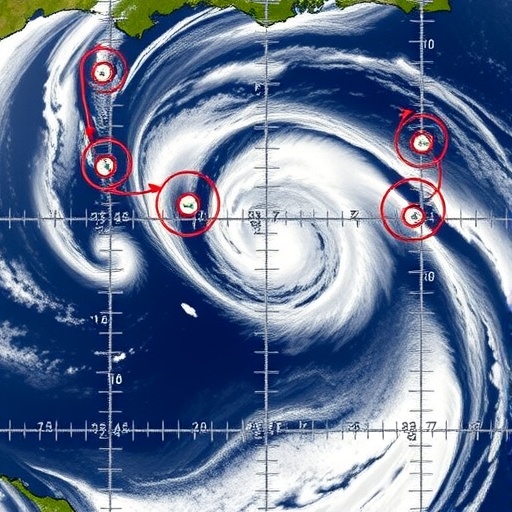
In a groundbreaking study published in Communications Earth & Environment, researchers have unveiled a pivotal link between evolving atmospheric dynamics and the notable decline of tropical cyclone activity in the Southern Hemisphere. This research elucidates how alterations in the Madden-Julian Oscillation (MJO), a dominant pattern of tropical atmospheric variability, are intricately driving the long-term decrease in the occurrence and intensity of southern tropical cyclones. The findings not only deepen our understanding of tropical climate systems but also carry profound implications for regional weather patterns and disaster preparedness in vulnerable areas.
The Madden-Julian Oscillation is an enigmatic and complex phenomenon characterized by an eastward-moving pulse of enhanced and suppressed tropical rainfall, typically cycling over 30 to 60 days. This oscillation exerts a powerful influence on weather and climate variability across the tropics and mid-latitudes, affecting monsoons, tropical storm development, and even global atmospheric circulation. Despite its recognized significance, the MJO’s long-term evolution under changing climate conditions has remained elusive, partly due to the intricate cloud-radiation feedbacks and convective processes it encompasses.
This new research spearheaded by Cao, Li, and Wang, among others, employed state-of-the-art climate models and extensive historical meteorological datasets to probe the shifting characteristics of the MJO over recent decades. Their analysis reveals a systematic modulation in the intensity, frequency, and spatial patterns of the MJO, which correlates strongly with a steady downturn in tropical cyclone genesis over the Southern Hemisphere’s vast ocean basins. The study pinpoints how modified atmospheric convection patterns suppress cyclone formation, fundamentally transforming the interplay between ocean heat content and atmospheric instability.
A critical aspect of the investigation involved disentangling the numerous factors that influence tropical cyclone behavior. While increased sea surface temperatures have often been discussed as a prime driver of cyclone variability, the researchers demonstrate that changes in the MJO’s propagation speed and rainfall intensity have an even more decisive role in curtailing cyclone activity. These MJO-induced alterations weaken the atmospheric moisture convergence and vertical wind shear conditions favorable for cyclone intensification, offering new insight into the mechanisms of cyclone suppression.
The findings challenge prior assumptions that climate warming would invariably lead to an increase in tropical cyclone frequency or severity in all regions. Instead, this study paints a more nuanced picture where regional atmospheric oscillations modulate the effects of oceanic warming, sometimes in counterintuitive ways. The Southern Hemisphere’s tropical cyclone basins appear increasingly influenced by a weakening and slowing MJO cycle, leading to fewer storms making landfall and potentially altering rainfall distribution patterns in coastal ecosystems.
Further emphasizing the study’s significance, the researchers correlate the observed MJO changes with anthropogenic forcing, suggesting that human-induced greenhouse gas emissions have contributed to the altered convective dynamics. Their model simulations indicate that the cooling effects of aerosols in combination with greenhouse warming may be shifting tropical atmospheric stability thresholds, indirectly impacting the MJO and its capacity to support cyclone genesis. This highlights the need for improved representation of aerosol-cloud interactions in climate models.
Importantly, the team explored not just cyclone frequency but also their intensity and duration. They find that while overall cyclone counts decline, the distribution of storm intensities shifts slightly, with some evidence of fewer but potentially more prolonged cyclones under specific MJO phases. This complex behavior underscores the delicate balance of atmospheric conditions modulating cyclones and provides a crucial perspective on how future tropical storm activity might evolve under ongoing climate change.
The study’s implications extend beyond meteorological curiosity; they are vital for the millions of people living in cyclone-prone regions of the Southern Hemisphere, including parts of Australia, South America, and the Indian Ocean islands. A reduced number of tropical cyclones could temporarily alleviate cyclone-induced damages, but the researchers caution that altered rainfall patterns, storm tracks, and associated atmospheric changes could bring unforeseen risks such as prolonged drought or flooding events.
To deepen understanding and confirm the longevity of these trends, the authors advocate for enhanced observational networks across the tropics, including satellite missions specifically tuned to monitor MJO convective structures and cyclone genesis parameters. They also call for ongoing refinement of high-resolution coupled climate models capable of capturing MJO-cyclone interactions with higher fidelity. This dual approach would enable more accurate seasonal forecasts and climate projections critical for regional resilience planning.
Another notable contribution of the research lies in its methodological innovation. The team utilized machine learning algorithms to analyze vast datasets of atmospheric variables and tropical cyclone tracks, enabling them to identify subtle shifts in the spatiotemporal behavior of the MJO that traditional statistical methods might overlook. This fusion of advanced data science with meteorology exemplifies the cutting edge of climate research, offering new pathways to decode complex Earth system feedbacks.
The study also delves into the broader climatological context, comparing the Southern Hemisphere findings against MJO and cyclone trends in the Northern Hemisphere. While the Northern Hemisphere exhibits a different pattern of cyclone changes linked to its own atmospheric oscillations and oceanographic settings, the research underscores the unique sensitivity of the Southern Hemisphere’s tropical dynamics to subtle shifts in the MJO. This inter-hemispheric contrast enhances overall understanding of how global climates respond to multifaceted forcings.
Looking toward the future, the researchers stress that these emerging insights into the MJO’s role in cyclone variability should be integrated into disaster risk management frameworks and infrastructure design in vulnerable nations. Enhanced projection capabilities could aid governments and agencies in anticipating periods of reduced cyclone risk, potentially optimizing resource allocation and early warning strategies. Conversely, understanding periods when the MJO might intensify tropical storm activity is equally essential for preparedness.
The study’s findings also invigorate discussions about the feedback loops between tropical atmospheric oscillations and oceanic heat distribution. As climate change continues to evolve ocean temperatures and stratification, adjustments in the MJO could feed back into larger scale climate phenomena such as the Southern Annular Mode and El Niño-Southern Oscillation, thereby influencing global weather patterns. This research adds a vital piece to that complex puzzle, connecting localized tropical phenomena to planetary-scale climate processes.
Overall, this landmark research represents a significant advancement in tropical meteorology and climate science. By unraveling the causal mechanisms behind the diminishing Southern Hemisphere tropical cyclone counts, it enhances predictive capability for one of nature’s most formidable forces. As global temperature trajectories remain uncertain, understanding such intricate atmospheric-ocean interactions is critical for navigating the multifarious challenges posed by a changing climate.
This study, led by Cao, Li, Wang, and their colleagues, exemplifies the power of multidisciplinary science—combining atmospheric physics, computational modeling, and innovative data analytics—to elucidate pressing environmental questions. As the climate continues to evolve rapidly, such insights will be indispensable for shaping policies and safeguarding communities against future extreme weather events.
Cao, J., Li, X., Wang, B. et al. Madden-Julian oscillation changes drive the long-term decline of Southern Hemisphere tropical cyclones.
Commun Earth Environ (2026). https://doi.org/10.1038/s43247-026-03708-4
Cite Scienmag News
Violet Maxwell. (June 8, 2026). Madden-Julian Oscillation Fuels Southern Cyclone Decline. Scienmag. https://scienmag.com/madden-julian-oscillation-fuels-southern-cyclone-decline/
Violet Maxwell. "Madden-Julian Oscillation Fuels Southern Cyclone Decline." Scienmag, 8 June 2026, https://scienmag.com/madden-julian-oscillation-fuels-southern-cyclone-decline/. Accessed 4 September 2026.
Violet Maxwell. "Madden-Julian Oscillation Fuels Southern Cyclone Decline." Scienmag. June 8, 2026. https://scienmag.com/madden-julian-oscillation-fuels-southern-cyclone-decline/


