


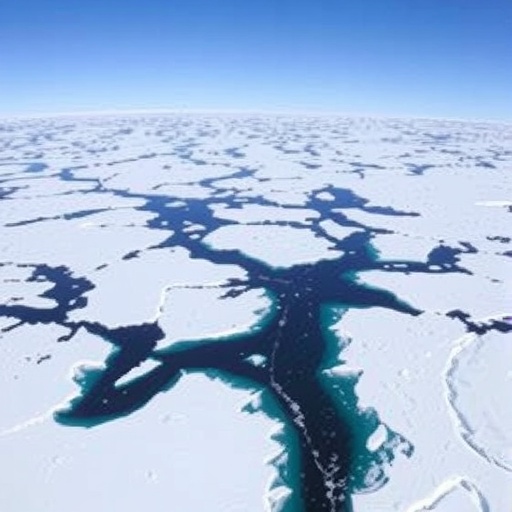
Antarctica’s contribution to future sea-level rise has long been shrouded in uncertainty, presenting a formidable challenge to coastal communities worldwide. The complexity arises primarily from interactions between the Southern Ocean and the Antarctica ice shelves—floating extensions of land ice that play a crucial role in buttressing continental glaciers. These ice shelves regulate the flow of ice into the ocean, and any changes in their stability could dramatically accelerate ice loss. However, understanding the mechanisms that govern ice shelf disintegration remains one of the most difficult problems in cryosphere science, owing to the intricate and often small-scale processes driving basal melting beneath these floating ice masses.
Recent research led by Zinck, Lhermitte, Wearing, and colleagues has now illuminated previously hidden details about the basal melting of Antarctic ice shelves, fundamentally altering our understanding of ice shelf dynamics. Utilizing an innovative combination of high-resolution stereo imagery and satellite altimetry, their study presents detailed maps of basal melt rates at a staggering 50-meter horizontal resolution. This unprecedented resolution reveals intricate channelized melting patterns that were largely invisible to prior observational methods and substantially underestimated in existing models. These channels may act as focal points for accelerated melting, profoundly influencing ice shelf stability and retreat.
The significance of these new melt maps lies in their ability to expose intense melting localized within narrow, elongated channels carved into the ice-shelf base. These sub-ice-shelf channels, often only tens to hundreds of meters wide, dictate how warm ocean water flows beneath the ice. The research highlights that basal melt rates within these channels are between 42 to 50 percent higher than previously estimated by conventional remote sensing and modeling techniques. This vast underestimation implies that melting processes are more dynamic and aggressive than formerly believed, accelerating ice shelf thinning and weakening in critical regions.
Understanding the basal melting processes is not simply an academic exercise; it has direct implications for predicting future ice loss and related sea-level rise. Ice shelves act as a buttressing force—imposing a back pressure that slows the flow of grounded ice into the ocean. As basal melting preferentially thins these shelves along channel paths, it can trigger the localized weakening or “channel breakthrough” events that propagate destabilization across the entire ice shelf system. The consequences are potentially catastrophic, as rapid ice shelf retreat may lead to swift acceleration of upstream glaciers and massive ice discharge.
Despite decades of studying Antarctica’s ice shelves, capturing the full spatial heterogeneity of basal melting has been an elusive goal. Traditional techniques—such as airborne radar sounding or coarse satellite altimetry—are limited in vertical and horizontal resolution, missing fine-scale variations critical to understanding ice shelf health. By combining stereoscopic satellite imagery, which allows precise mapping of subtle ice shelf surface undulations, with advanced altimetry data, the researchers overcame these limitations, unveiling complex basal melting patterns at resolutions one to two orders of magnitude finer than prior studies.
This advancement is particularly timely given accelerating ocean warming around Antarctica observed in recent decades. Warmer Circumpolar Deep Water intrusions beneath ice shelves have been linked to increased basal melt rates, yet the fine-scale pathways and interaction dynamics remained poorly characterized. The new high-resolution melt maps provide a critical window into how ocean heat is transferred to the ice shelf base, enabling improved quantification of melting hotspots and their spatial evolution over time.
The findings also expose challenges for ice sheet modeling, a pillar of climate prediction. Current ice sheet and coupled ice-ocean models tend to operate at coarser spatial resolutions and rely on parameterizations that inadequately capture channelized melt dynamics and feedback mechanisms. This lack of process representation introduces major uncertainties into sea-level rise projections, which depend on accurately simulating ice shelf weakening and ice stream responses across timescales from decades to centuries. By integrating these high-resolution basal melt observations into models, scientists can refine predictions of ice shelf vulnerability and resulting contributions to global sea-level budgets.
Moreover, the study exemplifies the essential role of satellite remote sensing in monitoring Antarctica’s rapidly changing ice environment, especially given the continent’s remoteness and the difficulty of in situ measurements. High-resolution mapping technologies open new avenues for detecting early warning signs of ice shelf destabilization, such as channel expansion and localized thinning, which could inform risk assessments and climate mitigation strategies. This methodology also offers potential extensions to other polar regions where ice-ocean interactions are poorly constrained.
Understanding and quantifying Antarctic basal melt rates lies at the intersection of multiple scientific disciplines—including glaciology, oceanography, remote sensing technology, and climate modeling. The cross-disciplinary approach demonstrated in this study highlights the innovation required to address one of the most pressing uncertainties in Earth’s climate system. Only by embracing finer scales and combining observational strengths can researchers unravel the complex feedback loops that govern ice shelf integrity.
The study’s revelations underscore the urgency to improve our observational infrastructures and modeling frameworks in the face of ongoing climate change. Coastal populations worldwide depend on accurate projections of sea-level rise to adapt their infrastructure and policies. As part of this imperative, research efforts must scale up to capture the full complexity of ocean-driven basal melting and its dynamic consequences for ice shelf stability on both regional and continental scales.
In essence, this work marks a paradigm shift in our understanding of Antarctic ice shelf dynamics and basal melting processes. By exposing the true extent of channelized melting, it challenges previous assumptions and redraws the boundary conditions that underpin current ice sheet projections. As research deepens, these insights will become integral to mitigating the global hazards posed by Antarctic ice loss and rising seas.
Looking ahead, the integration of such high-resolution basal melt maps into coupled ice-ocean models holds promise for more accurate and realistic predictions of ice shelf evolution under multiple warming scenarios. Efforts to expand the spatial coverage and temporal frequency of these observations will be crucial to track ongoing changes, unravel feedback mechanisms, and guide climate resilience planning worldwide.
This breakthrough in Antarctic cryosphere science is a testament to the power of innovation at the intersection of satellite technology and geophysical understanding. It signals a new era for Antarctic ice shelf research, where high-resolution, process-focused observations will become the cornerstone of efforts to forecast and mitigate sea-level rise, safeguarding vulnerable communities against the impacts of a warming world.
Cite Scienmag News
Sloane Callahan. (January 9, 2026). Channelized Melt Beneath Antarctic Ice Shelves Underestimated. Scienmag. https://scienmag.com/channelized-melt-beneath-antarctic-ice-shelves-underestimated/
Sloane Callahan. "Channelized Melt Beneath Antarctic Ice Shelves Underestimated." Scienmag, 9 January 2026, https://scienmag.com/channelized-melt-beneath-antarctic-ice-shelves-underestimated/. Accessed 4 September 2026.
Sloane Callahan. "Channelized Melt Beneath Antarctic Ice Shelves Underestimated." Scienmag. January 9, 2026. https://scienmag.com/channelized-melt-beneath-antarctic-ice-shelves-underestimated/


