


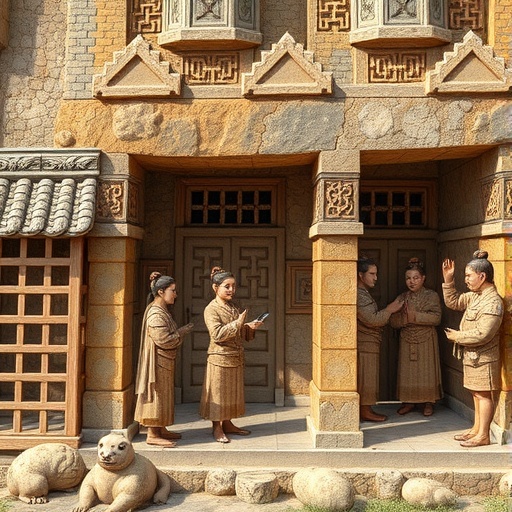
In a recent groundbreaking study focusing on the Eastern Zhou period in China, researchers have unveiled significant insights into social stratification and inequality during this time. The study involved an extensive examination of 32 skeletons excavated from the Songzhuang Cemetery in Henan Province, utilizing advanced methodologies such as isotopic analysis, ancient DNA extraction, and sex-specific proteomics. These interdisciplinary approaches have shed light on the complex interplay of diet, social class, and gender, unearthing the harsh realities faced by marginalized individuals, particularly young women, in this ancient society.
The Eastern Zhou era, spanning from 771 to 221 BC, is recognized for its marked social hierarchies and pronounced inequalities. Within this framework, the study specifically investigates the treatment of women within society, revealing that a staggering 22 out of the 26 identified sacrificial victims were female. This stark statistic raises crucial questions about gender roles and the societal expectations placed upon women during this historical period. It suggests that young women were often relegated to the status of sacrificial offerings, emphasizing their vulnerability and the gendered nature of social stratification at the time.
Delving deeper into diet, the research team employed carbon and nitrogen isotopic analyses to highlight stark dietary differences among social classes. The study found that individuals of noble status enjoyed a diverse and protein-rich diet that incorporated significant amounts of millet, while their counterparts who were designated as sacrificial companions exhibited a more varied diet that was distinctly lower in protein. This division in dietary intake is further illustrated through specific isotopic data, which clearly demarcates the nutritional disparities among the groups analyzed.
In the study, the authors present compelling isotopic values: nobles boasted a δ¹³C_bone value of −8.6‰ contrasted to the human sacrifice group, which showed a δ¹³C_bone value of −10.9‰ for one subgroup and −14.1‰ for another. Additionally, the nitrogen levels also revealed disparities, with nobles presenting a δ¹⁵N_bone value of 11.6‰ compared to 8.5‰ of the first human sacrifice group and 7.7‰ of the second. These findings encapsulate the nutritional divide that delineated social class in the Eastern Zhou period.
Turning to childhood experiences, enamel and dentin isotope analyses presented a revealing narrative. These analyses indicate that the dietary inequalities were established from a young age, thus perpetuating class inequalities into adulthood. Remarkable isotopic data surfaced from this analysis, such as a δ¹³C_enamel value of −1.5‰ for nobles, −3.8‰ for the first human sacrifice group, and −6.9‰ for the second. This early differentiation in diet underlines the consequences of social stratification that were ingrained, beginning in childhood, fostering a cycle that would be difficult to break.
The researchers also explored mobility within these ancient social structures through strontium and oxygen isotope evidence. Astonishingly, the results indicated a high proportion of non-local migrants among the noble class, suggesting instances of geographic mobility that were not commonplace for the lower status groups. This revelation opens up discussions on the networks of kinship, alliances, and migrations that may have facilitated social mobility for certain individuals.
One particularly poignant aspect of the study is the genetic analysis revealing familial ties that connect four noblewomen to a sacrificial victim. This connection underscores the intricate relationships forged through kinship and marriage, which were vital in maintaining and enhancing one’s social standing amidst the cultural landscape of the Eastern Zhou period. This genetic evidence paints a more detailed picture of how social status was not only inherited but negotiated through familial alliances.
While the overall narrative reflects a rigid class structure filled with inequities, individual cases illustrate infrequent instances of mobility across social strata. The researchers pointed to certain dental isotope sequences that indicated dietary shifts during childhood for two individuals, highlighting the complexities of social transitions. These rare instances of class mobility raise critical questions about the potential for agency and change within a predominantly stratified society.
The implications of this research extend beyond mere historical curiosity; they invite contemporary reflections on the persistence of social inequalities and the ways in which they manifest in modern societies. Understanding past societies can enrich our comprehension of current social dynamics, providing context to the ongoing conversations about equity and justice in the present day. The Eastern Zhou period serves as a reminder of both the fragility of social standing and the profound impact of gender and class on individuals’ lives.
In summary, this study not only unravels the intricate fabric of societal inequalities in ancient China but also emphasizes the importance of interdisciplinary approaches in archaeological and historical research. By combining bioarchaeological methods with genetic and isotope analyses, the authors provide a nuanced understanding of the lives of individuals who were often overlooked in historical narratives. This research highlights that even within strongly hierarchical societies, there are echoes of agency, resilience, and the reconfiguration of social identities over time.
This groundbreaking work is likely to have a substantial impact on the fields of archaeology, anthropology, and social history, encouraging further exploration into the lives of marginalized groups in the past. It serves as a catalyst for ongoing dialogue about the complexities of identity, inequality, and societal structure, reinforcing the need for continued investigation of our historical narratives to uncover the voices of those who have long been silenced by time.
The revelations from the Songzhuang Cemetery illustrate the power of modern science in reconstructing our understandings of history. By leveraging innovative techniques and engaging with the remains of the past, contemporary researchers are not merely uncovering artifacts but are resurrecting the stories and lives entwined within these remains, enriching our collective memory and understanding of ancient societies.
Cite Scienmag News
Celia A. (December 30, 2025). Ancient DNA Uncovers Social Inequality in Eastern Zhou. Scienmag. https://scienmag.com/ancient-dna-uncovers-social-inequality-in-eastern-zhou/
Celia A. "Ancient DNA Uncovers Social Inequality in Eastern Zhou." Scienmag, 30 December 2025, https://scienmag.com/ancient-dna-uncovers-social-inequality-in-eastern-zhou/. Accessed 29 August 2026.
Celia A. "Ancient DNA Uncovers Social Inequality in Eastern Zhou." Scienmag. December 30, 2025. https://scienmag.com/ancient-dna-uncovers-social-inequality-in-eastern-zhou/


