


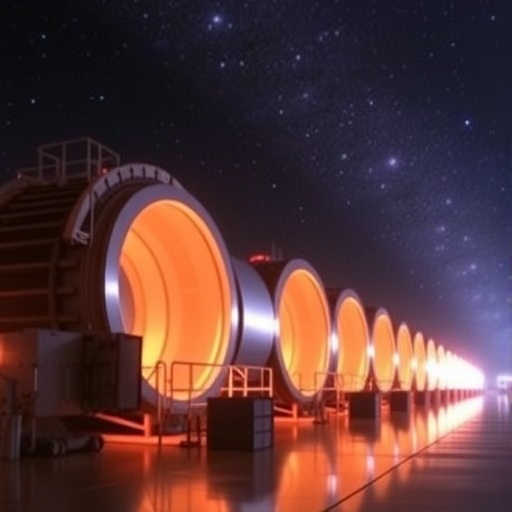
The world of particle physics stands on the precipice of a monumental leap forward, poised to redefine our understanding of the fundamental building blocks of the universe and the forces that govern them. A groundbreaking feasibility study report, published in the European Physical Journal C, unveils the ambitious blueprint for the Future Circular Collider (FCC), a next-generation particle accelerator that promises to unlock cosmic secrets currently hidden beyond our observational grasp. This colossal undertaking, envisioned as a successor to the Large Hadron Collider (LHC), represents a culmination of decades of theoretical advancements and technological innovation, aiming to push the boundaries of scientific exploration to previously unimaginable frontiers. Its potential impact on physics, cosmology, and even our perception of reality is so profound that it is already capturing the imagination of researchers and science enthusiasts worldwide, heralding what could be the most significant scientific endeavor of the 21st century. The sheer scale and ambition of the FCC project are breathtaking, signaling a renewed commitment to fundamental scientific inquiry and a testament to humanity’s insatiable curiosity about the cosmos.
The FCC is not merely an incremental upgrade; it is a paradigm shift in how we probe the universe. Its proposed design incorporates a staggering 100-kilometer ring, dwarfing the LHC, and envisions colliding particles at energies orders of magnitude higher. This exponential increase in energy will allow scientists to explore phenomena that are currently inaccessible, potentially revealing new fundamental particles, forces, and even dimensions. The report meticulously details the technical specifications, engineering challenges, and scientific justifications for such an ambitious project, painting a vivid picture of a facility that will serve as the ultimate microscope into the subatomic realm. The collaborative effort behind this report, involving hundreds of leading scientists and engineers from across the globe, underscores the universal appeal and critical importance of this scientific quest, demonstrating an unprecedented level of international cooperation in the pursuit of knowledge.
Among the primary scientific objectives of the FCC is the precise study of the Higgs boson, the elusive particle that imparts mass to other fundamental particles. While the LHC famously discovered the Higgs in 2012, our understanding of its properties remains incomplete. The FCC’s increased luminosity and energy capabilities will allow for a vastly more detailed characterization of the Higgs, enabling scientists to search for subtle deviations from its predicted behavior. Such deviations could be the first hints of physics beyond the Standard Model, our current best description of fundamental particles and their interactions, opening the door to revolutionary new theories. This meticulous examination of the Higgs boson is not just about understanding a single particle; it is about potentially unraveling the very mechanism of mass generation, a cornerstone of our universe’s structure.
Beyond the Higgs, the FCC is designed to be a gateway to discovering entirely new particles and phenomena. At these unprecedented energy scales, physicists expect to encounter exotic particles predicted by theoretical frameworks like supersymmetry, which proposes a symmetry between fundamental particles called bosons and fermions. The discovery of such particles would not only validate these elegant theories but also shed light on profound cosmological mysteries, such as the nature of dark matter, the invisible substance that constitutes a significant portion of the universe’s mass. The FCC could be the key to finally identifying the particles that make up this enigmatic cosmic component, offering a tangible link between the microscopic world and the grand cosmic structure.
The report also highlights the FCC’s potential to probe the fundamental nature of gravity at extremely high energies. While the Standard Model describes three of the four fundamental forces – electromagnetism, the weak nuclear force, and the strong nuclear force – gravity remains an outlier, notoriously difficult to integrate into quantum field theory. Collisions at the FCC’s energy scale might generate gravitons, hypothetical particles mediating the force of gravity, or reveal deviations from Einstein’s theory of general relativity at these extreme energies, paving the way for a unified theory of quantum gravity. This would represent arguably the most significant theoretical achievement in physics since the development of quantum mechanics and relativity.
The engineering and technological hurdles for constructing and operating the FCC are immense, demanding innovation across a multitude of disciplines. The report details sophisticated magnet technologies capable of generating incredibly powerful magnetic fields, advanced vacuum systems to maintain an ultra-pure environment for particle beams, and cutting-edge detector designs capable of capturing the fleeting signatures of high-energy interactions with unprecedented precision. The sheer scale of the underground infrastructure required, the intricate control systems, and the vast amounts of data to be processed all represent significant engineering triumphs in the making, pushing the boundaries of what is currently achievable in large-scale scientific infrastructure.
The selection of the FCC’s exact location is a crucial aspect of the feasibility study, with several promising sites identified. Each site presents unique geological, environmental, and logistical considerations that must be carefully evaluated. The choice will undoubtedly influence the project’s timeline, cost, and overall construction strategy. Regardless of the final decision, the construction will represent a massive civil engineering project, creating new tunnels and infrastructure that could also benefit other scientific and societal endeavors. The intricate planning involved in selecting a suitable location highlights the complex interplay between scientific ambition and practical implementation.
The operational phase of the FCC will generate an astronomical amount of data, far exceeding that produced by the LHC. This necessitates the development of advanced computing infrastructures and sophisticated algorithms for data analysis. Machine learning and artificial intelligence will play an increasingly vital role in sifting through this torrent of information to identify meaningful signals of new physics amidst a sea of background noise. The development of such advanced computational tools will have far-reaching implications beyond particle physics, impacting fields such as medicine, finance, and environmental science. This data deluge necessitates a global network of computing power and advanced analytical techniques.
The collaboration behind the FCC report is a testament to the global nature of scientific pursuit. Hundreds of researchers, engineers, and technicians from institutions worldwide have contributed their expertise, pooling resources and knowledge to bring this ambitious vision to fruition. This international cooperation fosters a spirit of shared discovery and ensures that the scientific benefits of the FCC will be accessible to the global research community, transcending national borders and political divides. Such a unified effort is crucial for tackling challenges of this magnitude and ensuring the equitable distribution of scientific knowledge.
The economic implications of the FCC project are also substantial, extending beyond the direct costs of construction and operation. The development of new technologies and specialized expertise will spur innovation in various industries, creating high-skilled jobs and fostering economic growth. Furthermore, the educational impact, inspiring a new generation of scientists and engineers, is invaluable. The long-term societal benefits, derived from a deeper understanding of the universe and its fundamental laws, are immeasurable, potentially leading to technological advancements we cannot even foresee today. The investment in the FCC is an investment in our future.
The ethical considerations surrounding such a large-scale scientific project are also being carefully addressed. Transparency in research, responsible resource management, and minimizing environmental impact are paramount. The report emphasizes a commitment to sustainable practices and open communication with the public regarding the project’s progress and findings. Ensuring public trust and engagement is crucial for the long-term success and support of such a monumental undertaking. The project aims to be a beacon of responsible scientific exploration.
The journey from concept to reality for the FCC will be a long and arduous one, requiring sustained dedication, significant investment, and continued technological innovation. However, the potential rewards – a deeper understanding of the universe, the discovery of new fundamental principles, and the inspiration for future generations – make this endeavor undeniably worthwhile. The FCC represents not just a scientific instrument, but a profound statement about humanity’s enduring quest for knowledge and our drive to unravel the cosmos’ most profound mysteries. It is a bold declaration of intent to continue pushing the frontiers of the known.
The scientific community is buzzing with anticipation for what the FCC might unveil. The prospect of discovering new particles, understanding the fundamental forces in a unified manner, and perhaps even glimpsing the very fabric of spacetime at its most fundamental level is what drives such ambitious scientific endeavors. The FCC is more than just a machine; it is a promise of profound discovery, a beacon of hope for unlocking the universe’s deepest secrets. The implications of its potential discoveries ripple through every aspect of our scientific understanding and our place within the grand cosmic tapestry.
The feasibility study report is a critical milestone, providing a comprehensive roadmap for the path ahead. It meticulously outlines the scientific case, technical requirements, and organizational framework necessary for the FCC’s realization. While significant challenges remain, the detailed planning and collaborative spirit demonstrated in this report offer a strong foundation for moving forward. The successful construction and operation of the FCC would undoubtedly mark a new golden age of particle physics, comparable to the discoveries that shaped the 20th century.
The publication of this report is more than just a scientific announcement; it is an invitation to the world to envision a future where humanity’s quest for knowledge knows no bounds. The FCC represents the collective dreams of countless scientists, a testament to the power of human ingenuity when directed towards understanding the fundamental questions of existence. The very real possibility of answering questions that have puzzled humanity for millennia makes this project a truly captivating and potentially world-altering endeavor that will inspire awe and wonder for decades to come.
Benedikt, M., Zimmermann, F., Auchmann, B. et al. Future Circular Collider Feasibility Study Report.
Eur. Phys. J. C 85, 1468 (2025). https://doi.org/10.1140/epjc/s10052-025-15077-x
Cite Scienmag News
Grant Pearson. (December 24, 2025). Future Collider: Feasibility Study Reveals Promising Path. Scienmag. https://scienmag.com/future-collider-feasibility-study-reveals-promising-path/
Grant Pearson. "Future Collider: Feasibility Study Reveals Promising Path." Scienmag, 24 December 2025, https://scienmag.com/future-collider-feasibility-study-reveals-promising-path/. Accessed 31 August 2026.
Grant Pearson. "Future Collider: Feasibility Study Reveals Promising Path." Scienmag. December 24, 2025. https://scienmag.com/future-collider-feasibility-study-reveals-promising-path/


