


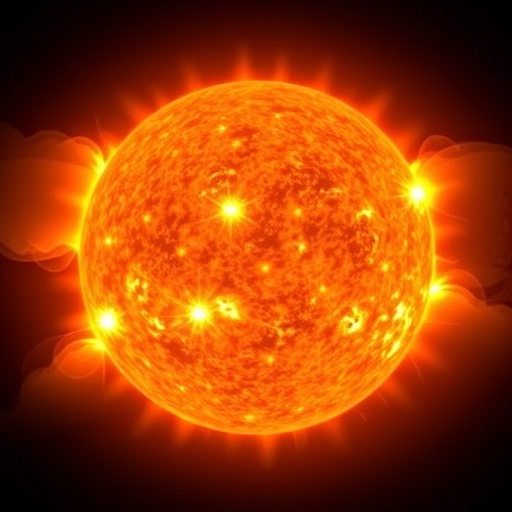
BOULDER, CO — April 25, 2026 — From our vantage point on Earth, the Sun presents itself as a luminous, seemingly uniform disk, an image deeply ingrained in scientific understanding and popular imagination alike. However, what meets our eyes represents only one hemisphere—the near side—while the far side remains perpetually concealed beyond the Sun’s visible limb. This hidden side harbors solar activity that can eventually rotate into Earth’s view, often manifesting as solar flares and coronal mass ejections capable of disrupting satellite operations, communication networks, power grids, and astronaut safety. For decades, solar physicists have sought to peer behind this cosmic veil, striving to anticipate and mitigate the hazards posed by these elusive far-side phenomena.
The advent of helioseismology in the late 20th century revolutionized our ability to investigate the Sun’s concealed hemisphere. By analyzing the acoustic waves generated within the solar interior—ripples that reverberate and propagate throughout the Sun—scientists developed techniques that map large active regions on the Sun’s far side well before they become visible from Earth. These sound waves, or solar oscillations, act as probes ferrying information from hidden depths to surface observatories, revealing not just magnetic activity but internal structural dynamics. This method provided a breakthrough in early space weather forecasting, offering an unprecedented window into the solar far side’s evolving landscape.
Despite the immense progress rendered by helioseismology, until recently, one fundamental property of these far-side active regions remained beyond reach: determining the magnetic polarity. Magnetic polarity is a fundamental characteristic defining the orientation of magnetic fields—positive polarity describes fields pointing outward from the solar surface, while negative polarity indicates fields directed inward. This polarity dictates how the Sun’s magnetic field interacts with the heliosphere and influences the trajectory and impact of eruptive solar phenomena. Understanding polarity is essential to assessing whether a solar eruption could spark a powerful geomagnetic storm on Earth or produce milder, less disruptive effects.
This longstanding challenge has now been addressed through an innovative technique spearheaded by researchers at the U.S. National Science Foundation National Solar Observatory (NSF NSO). Leveraging extensive helioseismic data from the NSF-NOAA Global Oscillation Network Group (GONG), a consortium of six robotic solar telescopes strategically positioned worldwide, scientists have devised a physics-driven approach to decode the magnetic polarity embedded within far-side active regions. This marks a major leap forward in solar science, enabling the first-ever polarity-resolved magnetic mapping of the solar far side.
The NSF-NOAA GONG network continuously monitors the Sun’s acoustic oscillations, deciphering the subtle shifts and phase variances in these waves as they propagate through the solar interior. These oscillations carry signatures of magnetic interactions that, until recently, were only partially understood. According to Dr. Kiran Jain, the lead scientist of the NSO Far Side Project, “Though magnetic field strengths have been previously estimated from helioseismic data, the novel aspect of our method lies in accurately determining the magnetic polarity and tilt angles of active regions using physics-based interpretations of phase shift measurements.” This critical advancement allows scientists to infer the magnetic configuration and orientation of features that remain completely invisible through direct optical observations.
By meticulously analyzing the phase shifts—minute time delays present in helioseismic wave patterns—researchers can reconstruct magnetograms that distinctly map positive and negative magnetic fields on the otherwise inaccessible solar hemisphere. These polarity-resolved magnetograms not only confirm the existence and location of large sunspot clusters but provide detailed insights into their magnetic architecture. Such data are essential for modeling the Sun’s global magnetic field, which influences everything from solar wind conditions to the frequency and severity of space weather events.
The significance of this development is heightened when considering the Sun’s rotation period of approximately 27 days as observed from Earth. Active regions emerging on the far side can rotate into view before their magnetic properties have been directly observed, hampering short-term space weather prediction capabilities. With the ability to resolve magnetic polarity remotely, scientists can incorporate comprehensive magnetic maps into global models days in advance, granting forecasters a valuable lead time. This improved predictive capacity is crucial for safeguarding satellites, astronaut missions, terrestrial power and communication infrastructure, and navigation systems from solar storm hazards.
This technique represents a profound synthesis of helioseismology and magnetic field theory, exploiting established magnetic behavior rules such as the Hale polarity law—which governs the orientation and cyclic polarity reversals of sunspot groups across solar cycles. By applying these known dependencies in tandem with the observed helioseismic phase-shift patterns, researchers can reconstruct a vivid and detailed magnetic landscape of the Sun’s far side that dynamically evolves with solar activity.
Dr. Amr Hamada, the lead author of the study, emphasizes, “The Sun’s internal acoustic waves don’t merely reveal where active regions form; they now disclose how the magnetic fields within those regions are organized. This insight propels us closer to our ultimate goal: achieving a continuous, complete magnetic map of the entire Sun—including the hemisphere hidden from direct telescope observations.”
Such a global magnetic perspective carries transformative potential for solar physics, space weather forecasting, and heliophysics research. Continuous, high-fidelity magnetic field data from all solar hemispheres could redefine how scientists understand solar cycle dynamics, magnetic flux transport, and the initiation of space weather events. By providing early, polarity-specific warnings of impending magnetic eruptions, this capability could help mitigate the economic and technological impacts associated with extreme solar storms.
The journey to this point has been decades in the making, underpinned by decades of technical innovation in instrumentation, data analysis, and theoretical modeling. Instruments like the Global Oscillation Network Group and the Solar Orbiter’s Polarimetric and Helioseismic Imager (SO/PHI) established foundations for cross-validating helioseismic inferences with direct magnetic observations when active regions rotate onto Earth-facing solar territory. These complementary datasets enhance confidence in the new method’s accuracy and reveal finer details about solar magnetic topology.
Despite these advances, the research community recognizes ongoing challenges: further refinement of helioseismic inversion techniques and integration with other solar observations is necessary to improve spatial resolution and reduce uncertainties. Moreover, continuous funding and international collaboration will be vital to sustain long-term observations and develop next-generation instruments capable of probing solar magnetism with unprecedented precision.
Looking forward, the implications extend beyond solar physics. The methodology and insights generated by helioseismology promise to inform stellar astrophysics more broadly, allowing scientists to infer magnetic structures in other stars where direct imaging is impossible. This opens a new frontier for comparative studies of stellar magnetism and its influence on exoplanetary environments.
In summary, the ability to directly resolve magnetic polarity on the Sun’s far side represents a watershed moment in heliophysics. By transforming sound waves into magnetic maps, scientists have unveiled a hidden dimension of solar activity—ushering in an era where we can continuously monitor the Sun’s entire magnetic heartbeat. This breakthrough not only advances scientific knowledge but equips humanity with improved tools to anticipate and respond to solar-driven disruptions that affect our technological civilization.
The full findings are detailed in the study titled “Polarity-resolved far-side magnetograms based on helioseismic measurements,” currently in press with the journal Scientific Reports. The research team’s efforts underscore the power of combining sophisticated observational networks with robust theoretical frameworks to push the boundaries of what we can know about the star at the center of our solar system.
News Publication Date: April 25, 2026
Web References:
https://www.nature.com/articles/s41598-026-42917-x
References:
Hamada, A., Jain, K., Pevtsov, A., et al. (2026). Polarity-resolved far-side magnetograms based on helioseismic measurements. Scientific Reports. DOI: 10.1038/s41598-026-42917-x
Keywords
Helioseismology, Solar Far Side, Magnetic Polarity, Solar Active Regions, Solar Oscillations, Global Oscillation Network Group (GONG), Solar Magnetic Fields, Space Weather Forecasting, Solar Cycle, Magnetic Maps, Solar Eruptions, Solar Interior Sound Waves
Cite Scienmag News
Grant Pearson. (April 27, 2026). NSF-NOAA GONG Reveals Hidden Magnetic Activity on the Sun’s Far Side. Scienmag. https://scienmag.com/nsf-noaa-gong-reveals-hidden-magnetic-activity-on-the-suns-far-side/
Grant Pearson. "NSF-NOAA GONG Reveals Hidden Magnetic Activity on the Sun’s Far Side." Scienmag, 27 April 2026, https://scienmag.com/nsf-noaa-gong-reveals-hidden-magnetic-activity-on-the-suns-far-side/. Accessed 7 September 2026.
Grant Pearson. "NSF-NOAA GONG Reveals Hidden Magnetic Activity on the Sun’s Far Side." Scienmag. April 27, 2026. https://scienmag.com/nsf-noaa-gong-reveals-hidden-magnetic-activity-on-the-suns-far-side/


