


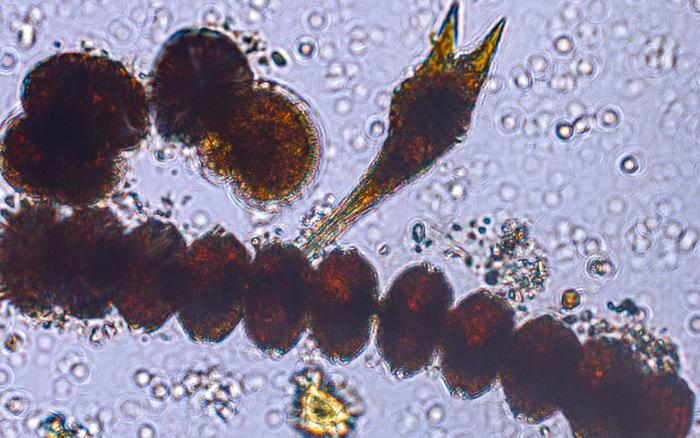
Comprising the base of the food web, plankton are extremely important to marine ecosystems. However, there is still much to be discovered about these organisms, and that’s especially true for mixoplankton.

Credit: Photo by Heather Corson.
Comprising the base of the food web, plankton are extremely important to marine ecosystems. However, there is still much to be discovered about these organisms, and that’s especially true for mixoplankton.
Plankton are typically divided into two groups. Similar to plants, phytoplankton contain chlorophyll and derive energy from photosynthesis. Zooplankton, on the other hand, consume other organisms for their energy. However, there is also a third group, mixoplankton, that is a combination of the two. And, despite accounting for, at times, more than half of all plankton in the ocean, they remain poorly classified from a scientific perspective.
This is why a group of researchers is calling upon their community to better understand these diverse and fascinating creatures. In a journal article published in Frontiers of Marine Science, the scientists propose eight research questions with accompanying methodologies to help propel mixoplankton to the forefront of aquatic ecology. The paper is a follow-up to a 2023 publication that broadly outlined a series of important mixoplankton research topics.
“It’s impossible to overemphasize the impact of expanding this field. Everything that happens at the base of the food web will eventually cascade into other parts of the ecosystem, impacting species many people rely upon for nourishment or income,” said lead author Nicole Millette, assistant professor at William & Mary’s Virginia Institute of Marine Science (VIMS). “While there is a small but dedicated group of researchers studying these creatures, mixoplankton are routinely overlooked in scientific studies due to limitations of current methodologies. Until mixoplankton are routinely included in plankton research, we will only have part of the picture of what is occurring at the base of the marine ecosystem.”
The questions posed in the paper are centered around four mixotrophy research topics: evolution, observable traits and their accompanying tradeoffs, ecological biogeography and biogeochemistry and trophic transfer. The interdisciplinary methods proposed to answer these questions combine empirical data with modeling approaches, utilizing techniques such as flow cytometry, omics and molecular methods, isotopes, analysis of historical data and mathematical modeling to help unravel the complexities of mixoplankton.
The implications of answering these questions are not limited to the small organisms at the center of the research.
“If we want to understand how climate change will impact ocean ecosystems, we must understand how they are currently operating to determine what changes might occur in the future.” said Millette. “Our lack of understanding of mixoplankton’s role in the food web and biogeochemical cycling severely limits our ability to accurately predict how the ocean ecosystem may shift under climate change.”
Ultimately, the authors hope to inspire others to consider how they might contribute to the field, emphasizing the potential to shift our foundational understanding of plankton ecology.
“My goal is that, within my career, it becomes normal when I teach biological oceanography to talk about mixoplankton as one of the three main plankton groups, instead of occasionally acknowledging their existence,” said Millette. “Progress has been made, but there is so much more to be discovered.”
Journal
Frontiers
Subject of Research
Animals
Article Title
Recommendations for advancing mixoplankton research through empirical-model integration
Article Publication Date
4-Jun-2024
Cite Scienmag News
Violet Maxwell. (June 26, 2024). Plankton researchers urge their colleagues to mix it up. Scienmag. https://scienmag.com/plankton-researchers-urge-their-colleagues-to-mix-it-up/
Violet Maxwell. "Plankton researchers urge their colleagues to mix it up." Scienmag, 26 June 2024, https://scienmag.com/plankton-researchers-urge-their-colleagues-to-mix-it-up/. Accessed 12 September 2026.
Violet Maxwell. "Plankton researchers urge their colleagues to mix it up." Scienmag. June 26, 2024. https://scienmag.com/plankton-researchers-urge-their-colleagues-to-mix-it-up/

