


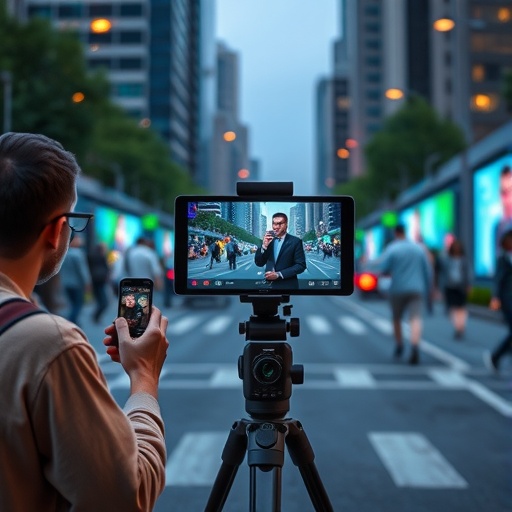
In the rapidly evolving landscape of telecommunications, the advent of 5G technology has established a transformative foundation for various applications, particularly in the realm of multimedia communication and analysis. A groundbreaking study titled “Leveraging 5G networks for event video summarization via multimodal analysis” by Vrochidis, Panagiotidis, Parcharidis, and their collaborators, published in the journal ‘Discover Artificial Intelligence’, sheds light on the synergistic potential of 5G networks in enhancing event video summarization capabilities through multimodal techniques.
As events continue to proliferate across various sectors—from sports to conferences—the sheer volume of video content generated poses significant challenges for efficient content consumption. Traditional methods of video summarization often fall short in delivering concise yet informative highlights that capture the essence of an event. However, the integration of 5G technology with advanced multimodal analysis approaches presents a viable solution to this dilemma. With unprecedented data transfer speeds and low latency attributes, 5G allows for the rapid processing and dissemination of high-quality video content in real time.
One of the critical advantages of leveraging 5G networks lies in their ability to facilitate the seamless transmission of rich multimedia data streams. This capability is especially crucial when it comes to event videos where multiple modalities, such as audio, visual, and textual information, converge. The study delves into the innovative methodologies that harness these modalities to enrich summary generation, allowing for a more nuanced understanding of the content. By employing machine learning algorithms and deep neural networks, the researchers can analyze various data types, transforming an extensive video feed into a digestible summary.
Moreover, the authors emphasize the role of multimodal analysis as a cornerstone of effective video summarization. In essence, multimodal analysis refers to processing and interpreting information from diverse input sources, such as video frames, audio signals, and even social media data associated with an event. By synthesizing these different types of information, the model can discern critical moments in a video, such as highlights from a sports game or key speeches from a conference, enhancing user engagement and information retention.
The study articulately addresses the core technological components that underpin this innovative approach. Utilizing extended networks capable of supporting massive data transfer with millisecond-level latencies, the researchers demonstrate how 5G technology can significantly optimize the functionality of video summarization algorithms. With the bandwidth that 5G provides, real-time analytics are no longer a distant dream but a present reality, enabling viewers to access condensed event summaries almost instantaneously.
The framework for this video summarization system is designed to operate through cloud-based infrastructure that can dynamically allocate resources based on demand. This means that events generating high traffic, such as popular concerts or significant sports matches, can benefit from enhanced processing and delivery capabilities, ensuring that users receive the most accurate and entertaining summaries. The cloud aspect also allows for the integration of artificial intelligence tools that further refine and improve the summarization processes over time through continuous learning.
Furthermore, user-centric considerations are paramount in the creation of effective summarization tools. The authors advocate for a system that not only analyzes content but also incorporates user feedback to tailor video summaries according to viewer preferences. This interactive model ensures that the summaries produced are not only relevant but also engaging, thereby increasing viewer satisfaction and encouraging more active participation in future events.
The implications of this research are profound, extending beyond mere entertainment or event coverage. In fields such as education, where lectures and seminars can be efficiently summarized for students, or emergency services, where critical unfolding events require rapid information dissemination, the potential applications are immense. The research illustrates how 5G technology can serve as a powerful enabler for industries that rely on real-time information sharing and dynamic content creation.
As the competition in the telecommunications industry intensifies, the development of solutions like the one presented in this study could provide companies with a significant edge. By embracing 5G and its capabilities, enterprises can transform how they engage with content and audiences, creating a more connected and responsive ecosystem. The proactive approach to integrating cutting-edge technology with advanced analytics could set new standards for efficiency and quality in media consumption.
The study also highlights the challenges that come with such an innovative approach. Issues regarding data privacy, bandwidth limitations in remote areas, and the necessity for widespread infrastructure upgrades are all crucial considerations that need to be addressed. The researchers advocate for policy-making bodies and corporations to collaborate on building the necessary ecosystem that can support this advanced technology, balancing innovation with ethical responsibilities.
In summary, the work of Vrochidis and colleagues offers a glimpse into the future of video summarization in a world energized by 5G networks. By exploring multimodal analysis as a means to distill complex events into engaging summaries, they provide a roadmap that could redefine user experiences in a spectrum of applications. The continuous evolution of technology promises exciting advancements that not only enhance content delivery but also cultivate a more informed audience engaged in global conversations.
As we navigate this intersection of technology and communication, the insights from this research emphasize the importance of adaptation and integration. In a digital age defined by continuous information flow, ensuring that this information remains accessible, relevant, and enjoyable is paramount. The researchers’ contributions serve as a vital foundation for future explorations into harnessing next-generation networks for enriched multimedia experiences, unlocking possibilities previously constrained by traditional bandwidth and processing limitations.
In conclusion, the potential of 5G networks combined with advanced video summarization techniques stands as a testament to the remarkable capabilities of modern telecommunications. As the landscape evolves, ongoing collaboration among researchers, industry leaders, and policymakers will be crucial in harnessing these innovations responsibly and sustainably, creating a future defined by informed engagement, creativity, and connection.
Vrochidis, A., Panagiotidis, S., Parcharidis, S. et al. Leveraging 5G networks for event video summarization via multimodal analysis.
Discov Artif Intell (2025). https://doi.org/10.1007/s44163-025-00719-6
Cite Scienmag News
Denise Maddox. (December 12, 2025). Utilizing 5G for Multimodal Event Video Summarization. Scienmag. https://scienmag.com/utilizing-5g-for-multimodal-event-video-summarization/
Denise Maddox. "Utilizing 5G for Multimodal Event Video Summarization." Scienmag, 12 December 2025, https://scienmag.com/utilizing-5g-for-multimodal-event-video-summarization/. Accessed 3 September 2026.
Denise Maddox. "Utilizing 5G for Multimodal Event Video Summarization." Scienmag. December 12, 2025. https://scienmag.com/utilizing-5g-for-multimodal-event-video-summarization/


