


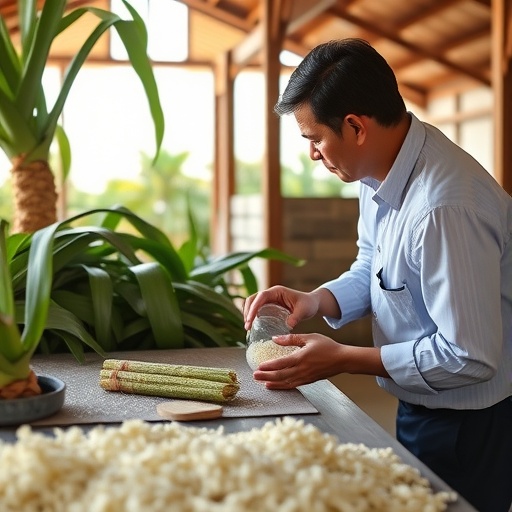
In a groundbreaking study that delves into the innovative harnessing of agricultural waste, researchers have explored the potential of sugarcane leaves through a simulation-based process design framework. This research, led by Panjapornpon, Kaoloun, Sriariyanun, and their colleagues, focuses on the sulfonation-based pretreatment method under mild conditions, aiming to enhance the valorization of biomass in an economically and technically sound manner. This forward-thinking approach could revolutionize the way we perceive and utilize agricultural byproducts, presenting a sustainable pathway in the field of biorefinery.
Sugarcane, one of the most widely cultivated crops globally, is renowned for its economic significance in sugar production. However, alongside the lucrative cane juice, a substantial amount of leaf biomass is left unutilized. Historically, the leaves have been viewed as waste, often burned or discarded after harvesting. The current research challenges this notion by demonstrating that these leaves hold potential as a valuable resource. By repositioning sugarcane leaves as a feedstock for bio-refining, the study offers a dual benefit: reducing waste while creating valuable products that can contribute to the bioeconomy.
The sulfonation-based pretreatment method posits a novel process where the structural characteristics of the biomass can be altered, thereby enhancing its accessibility for subsequent processing. The researchers employed sophisticated simulation tools to model different scenarios, analyzing variables like temperature, pressure, and duration of treatment. The findings indicate that under controlled mild conditions, the sulfonation process becomes more efficient, leading to improved yield and quality of extracted compounds. This iterative modeling approach is not only innovative but also critical for optimizing processes commonly employed in industrial applications.
One of the standout features of this research is its emphasis on techno-economic assessment alongside the simulation studies. By integrating economic evaluations into the process design, the authors provide a comprehensive overview of both the technical feasibility and the cost-effectiveness of the sulfonation method. Their preliminary assessment reveals that, while initial investment costs may be substantial, the potential return on investment through the valorization of sugarcane leaves could significantly outweigh these expenses in the long run.
The study also recognizes the importance of environmental sustainability. The sulfonation-based pretreatment is explored not just from a financial perspective but also concerning its ecological footprint. By utilizing agricultural waste, the researchers contribute to a circular economy model, which actively seeks to minimize waste, reduce emissions, and promote resource efficiency. This ecological consideration aligns with global calls for more sustainable agricultural practices, further emphasizing the relevance of their findings.
As the research progresses, one might wonder about the scalability of this process. The authors discuss the challenges of transitioning from simulation models to real-world applications. Implementing new technologies at an industrial scale often involves various hurdles, including engineering constraints, regulatory approvals, and market adoption. However, the foundational work presented in this study serves as a vital stepping stone towards developing practical applications that could one day see sugarcane leaves being processed at an industrial scale.
Moreover, the potential implications of this research extend beyond sugarcane leaves. The methodologies and findings could inspire similar initiatives across a range of other agricultural residues, such as corn stover, wheat straw, or even forestry waste. This universality underscores the importance of continuous research and development in the biomass valorization sector, highlighting the extensive opportunities that lie in untapped organic materials.
The researchers advocate for a collaborative approach to further propel this work. Interdisciplinary partnerships among agricultural scientists, process engineers, environmental biologists, and economists will be crucial in refining and actualizing the processes developed in this study. Such collaborations could lead to innovations that not only enhance efficiency but also ensure that the benefits of these biorefining technologies are equitably distributed across different sectors and communities.
In conclusion, Panjapornpon and colleagues’ research into the sulfonation-based pretreatment of sugarcane leaves marks an exciting advancement in the field of biomass valorization. Through strategic simulation-based design and thorough techno-economic assessment, the study showcases the potential to transform agricultural waste into valuable resources. As industries increasingly seek sustainable alternatives and improved resource management, the findings from this research could play a pivotal role in shaping future biorefineries and contributing to a greener economy.
While the journey from academic study to practical application is filled with challenges, the groundwork laid by this research provides a promising outlook for the integration of agricultural residues into our economic and ecological frameworks. The implication of these findings reaches far beyond sugarcane leaves, representing a significant step towards a more sustainable utilization of the world’s biomass resources.
As we look towards the future, continued investment in this field of research will be essential. Not only does it offer a way to mitigate waste, but it also proposes viable solutions for some of the pressing environmental issues of our time, from greenhouse gas emissions to resource depletion. The road ahead is promising, and the research conducted by Panjapornpon and their team is a vital part of this journey.
In closing, it is crucial to underscore the need for ongoing research in biomass treatment methodologies. Evaluating new processes and assessing their economic impacts will shape the future of the industry, creating opportunities for innovation while addressing the need for sustainability. The work presented is not just an isolated study but rather part of a larger narrative that seeks to redefine our interactions with agricultural waste, sparking a transformative wave in bioeconomy and sustainability practices globally.
Panjapornpon, C., Kaoloun, A., Sriariyanun, M. et al. Simulation-Based Process Design and Preliminary Techno-Economic Assessment of Sulfonation-Based Pretreatment of Sugarcane Leaves Under Mild Conditions.
Waste Biomass Valor (2025). https://doi.org/10.1007/s12649-025-03428-4
Cite Scienmag News
Denise Maddox. (December 12, 2025). Revolutionizing Sugarcane Processing: Sulfonation Techniques Explored. Scienmag. https://scienmag.com/revolutionizing-sugarcane-processing-sulfonation-techniques-explored/
Denise Maddox. "Revolutionizing Sugarcane Processing: Sulfonation Techniques Explored." Scienmag, 12 December 2025, https://scienmag.com/revolutionizing-sugarcane-processing-sulfonation-techniques-explored/. Accessed 5 September 2026.
Denise Maddox. "Revolutionizing Sugarcane Processing: Sulfonation Techniques Explored." Scienmag. December 12, 2025. https://scienmag.com/revolutionizing-sugarcane-processing-sulfonation-techniques-explored/


