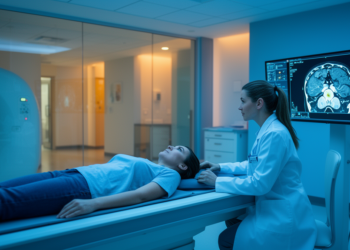
Researchers report that a newer form of arterial spin labeling magnetic resonance imaging, known as four-dimensional ASL or 4D ASL, can help predict how patients will fare three months after a subacute ischemic stroke. The findings, published in BMC Neuroscience, come from a study of 28 patients and suggest that measurements of corrected cerebral blood flow and collateral circulation captured with this technique carry strong prognostic information.
Four-dimensional arterial spin labeling is described in the study as an innovative method of ASL perfusion that uses five post-labeling delays to calculate arterial transit time and corrected cerebral blood flow, abbreviated cCBF.
The study focused on patients in the subacute phase of ischemic stroke who all had moderate-to-severe stenosis or occlusion of the unilateral M1 segment of the middle cerebral artery, the internal carotid artery terminus with or without M1 middle cerebral artery involvement, or both.
To define prognosis, the team used the modified Rankin Scale, a standard measure of functional disability, scored at three months after the first stroke onset. Patients were divided into two groups: those with a favorable prognosis, defined as a modified Rankin Scale score of 2 or less, and those with a poor prognosis, defined as a score above 2. Perfusion levels measured with 4D ASL were then compared between these groups.
The comparison produced a clear signal. Perfusion indicators measured across the cerebral hemisphere were found to accurately predict prognosis, and significant differences emerged specifically in the meningeal branch of the middle cerebral artery and the middle cerebral artery deep penetrating branch.
Timing of blood arrival also mattered. The increase in corrected cerebral blood flow in the group with good prognosis, whether measured on the side of the arterial narrowing or on the normal side, was greater than in the group with poor prognosis at post-labeling delays of 1.0 seconds to 1.5 seconds. In practical terms, patients who ultimately did well showed a stronger rise in corrected flow when blood labeled at these intermediate delays reached the tissue, a pattern the poorer-outcome group did not display to the same degree.
Beyond group comparisons, the researchers performed receiver operating characteristic curve analysis, a standard statistical method for testing how well a measurement separates two outcomes, using perfusion values against the three-month prognosis. According to the results, the perfusion indicators demonstrated high diagnostic efficacy for predicting prognosis, meaning the curves indicated strong discrimination between favorable and poor outcomes.
The authors conclude that cerebral perfusion levels and collateral circulation, as assessed via 4D ASL in patients with subacute ischemic stroke associated with unilateral intracranial arterial stenosis, can effectively predict patient outcomes. The study was registered on ClinicalTrials.gov under identifier NCT06289036, with a registration date of February 24, 2024, and is noted as retrospectively registered. The article was published open access on October 28, 2026, and is shared as accepted peer-reviewed research carrying a permanent DOI, with a final version of record to follow. Because the study involved 28 patients at a single stage of stroke evolution, the findings establish a promising prognostic signal for this imaging approach in this patient group rather than a broadly validated clinical rule.
Subject of Research: Using multi-delay 4D arterial spin labeling perfusion imaging to predict three-month prognosis in subacute ischemic stroke patients with unilateral intracranial arterial stenosis
Article Title: Predicting prognosis in subacute ischemic stroke through brain perfusion and collateral circulation with 4D ASL
Article References: Shen, Z., Jia, Y., Zhang, Y., Gao, C., Li, S., Xing, Y., Guo, X., Guo, X., Zheng, M., Sun, Y., Li, Y., Chen, Y., Pu, J., Shi, Y., Bao, J., & Tian, S. (2026). Predicting prognosis in subacute ischemic stroke through brain perfusion and collateral circulation with 4D ASL. BMC Neuroscience. https://doi.org/10.1186/s12868-026-01057-8
Image Credits: AI Generated
DOI: 10.1186/s12868-026-01057-8
Keywords: 4D ASL, arterial spin labeling, ischemic stroke, subacute stroke, cerebral perfusion, collateral circulation, middle cerebral artery, modified Rankin Scale, prognosis, BMC Neuroscience, Predicting, subacute
Cite Scienmag News
Cassandra Pierce. (October 29, 2026). 4D ASL Perfusion Imaging Predicts Three-Month Outcomes in Subacute Stroke. Scienmag. https://scienmag.com/4d-asl-perfusion-imaging-predicts-three-month-outcomes-in-subacute-stroke/
Cassandra Pierce. "4D ASL Perfusion Imaging Predicts Three-Month Outcomes in Subacute Stroke." Scienmag, 29 October 2026, https://scienmag.com/4d-asl-perfusion-imaging-predicts-three-month-outcomes-in-subacute-stroke/. Accessed 29 October 2026.
Cassandra Pierce. "4D ASL Perfusion Imaging Predicts Three-Month Outcomes in Subacute Stroke." Scienmag. October 29, 2026. https://scienmag.com/4d-asl-perfusion-imaging-predicts-three-month-outcomes-in-subacute-stroke/