

Monday, November 16, 2026
Science
No Result
View All Result
  • Login
  • HOME
  • SCIENCE NEWS
  • CONTACT US
  • HOME
  • SCIENCE NEWS
  • CONTACT US
No Result
View All Result
Scienmag
No Result
View All Result
Home Science News Medicine

Zebrafish drug screen finds no rescue for Marfan syndrome heart stress

October 29, 2026
in Medicine
Ophelia Keating
By Ophelia Keating Scienmag Editorial Profile - Health Services Research
Reading Time: 3 mins read
0
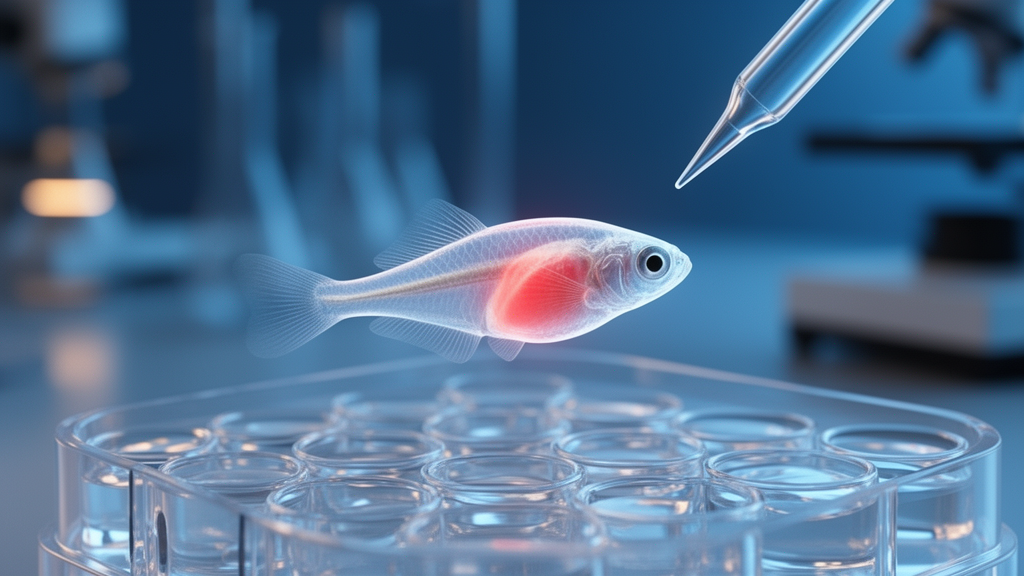
Zebrafish drug screen finds no rescue for Marfan syndrome heart stress

Zebrafish drug screen finds no rescue for Marfan syndrome heart stress

65
SHARES
587
VIEWS
Share on FacebookShare on Twitter
ADVERTISEMENT

Marfan syndrome is a life-threatening inherited connective tissue disorder caused by pathogenic variants in the fibrillin-1 gene, and it is characterized by progressive cardiovascular disease. Current medical therapies can slow disease progression, but they do not prevent major complications, which underscores the need for new treatment strategies and unbiased approaches to drug discovery. A new study in BMC Pharmacology and Toxicology describes an integrated zebrafish-based platform built to meet that need, combining quantitative molecular readouts with detailed phenotypic profiling in a living vertebrate model.

The researchers worked with a zebrafish model of Marfan syndrome that lacks fibrillin-3, a model that recapitulates key cardiovascular features of the human disease, including cardiac stress, valvular defects, arrhythmia, and aortic dilation. To measure cardiac stress sensitively and quantitatively, the team generated a novel transgenic reporter zebrafish expressing secreted nanoluciferase under the control of the stress-responsive nppb promoter.

The reporter performed strongly in validation experiments. Larvae lacking fibrillin-3 showed markedly elevated nppb activity that correlated with phenotypic severity and peaked during developmental stages of highest mortality, indicating that the molecular signal tracks closely with the visible and lethal manifestations of disease. The nanoluciferase assay offered a dynamic range of roughly 1,000-fold, substantially outperforming assays based on Firefly luciferase, which makes it a sensitive tool for detecting changes in cardiovascular stress in high-throughput settings.

Using this platform, the team evaluated existing and candidate therapies for Marfan syndrome. Pharmacological inhibition of TGF-β signaling, a pathway long implicated in the condition, produced only transient or deleterious effects, highlighting the context-dependent nature of modulating this pathway. Standard treatments also fell short: β-blockers, the angiotensin receptor blocker losartan, and allopurinol failed to consistently improve cardiac stress, pericardial edema, or dilation of the bulbus arteriosus in the model.

The centerpiece of the study was an unbiased high-throughput drug screen of more than 1,500 clinically approved compounds, tested across multiple developmental treatment windows. The screen identified a small number of primary and secondary hits, compounds that initially appeared to reduce disease readouts. However, none of these candidates demonstrated reproducible phenotypic rescue when subjected to rigorous validation involving multiple doses and multiple treatment windows. In other words, no definitive therapeutic candidate emerged from the screen.

The authors conclude that the study establishes a sensitive zebrafish-based platform for early, quantitative assessment of cardiovascular stress in Marfan syndrome, while also highlighting the limited efficacy of current therapies, the context-dependent effects of TGF-β modulation, and the biological complexity underlying the disease. Although the search for disease-modifying interventions did not yield a winning compound, the work lays a foundation for expanded unbiased discovery efforts, and the open-access study was published on 29 October 2026.

Subject of Research: A zebrafish nanoluciferase reporter platform for quantitative drug discovery in Marfan syndrome

Article Title: Integrated luminescence and phenotypic profiling for drug discovery in a zebrafish model of Marfan syndrome

Article References: Horvat, M., Caboor, L., De Rycke, K., Mennens, L., Daniels, E., Wyseur, J., Verhelst, E., Roos, I., Rodríguez-Rovira, I., Egea, G., De Backer, J., & Sips, P. (2026). Integrated luminescence and phenotypic profiling for drug discovery in a zebrafish model of Marfan syndrome. BMC Pharmacology and Toxicology. https://doi.org/10.1186/s40360-026-01271-4

Image Credits: AI Generated

DOI: 10.1186/s40360-026-01271-4

Keywords: Marfan syndrome, zebrafish, nanoluciferase, drug screening, TGF-β signaling, fibrillin-3, cardiovascular disease, aortic dilation, nppb promoter, losartan, beta-blockers, high-throughput screening

Cite Scienmag News

Ophelia Keating. (October 29, 2026). Zebrafish drug screen finds no rescue for Marfan syndrome heart stress. Scienmag. https://scienmag.com/zebrafish-drug-screen-finds-no-rescue-for-marfan-syndrome-heart-stress/

Ophelia Keating. "Zebrafish drug screen finds no rescue for Marfan syndrome heart stress." Scienmag, 29 October 2026, https://scienmag.com/zebrafish-drug-screen-finds-no-rescue-for-marfan-syndrome-heart-stress/. Accessed 16 November 2026.

Ophelia Keating. "Zebrafish drug screen finds no rescue for Marfan syndrome heart stress." Scienmag. October 29, 2026. https://scienmag.com/zebrafish-drug-screen-finds-no-rescue-for-marfan-syndrome-heart-stress/

Tags: aortic dilationbeta-blockerscardiovascular diseasecardiovascular features of Marfan syndrome in zebrafishdrug discovery for connective tissue disordersdrug screeningfibrillin-3fibrillin-3 gene knockout zebrafish modelhigh-throughput screeninglimitations of current Marfan syndrome therapieslosartanMarfan syndromenanoluciferasenanoluciferase assay for cardiac stress detectionnovel transgenic zebrafish stress reporternppb promoterphenotypic profiling of zebrafish Marfan modelquantitative molecular readouts in zebrafish modelsTGF-β signalingunbiased approaches to genetic disease treatmentzebrafishZebrafish drug screening for Marfan syndrome
Share26Tweet16
Previous Post

4D ASL Perfusion Imaging Predicts Three-Month Outcomes in Subacute Stroke

Next Post

Enzyme PLA2G4A fuels lung cancer growth through an HSF1 signaling axis

Related Posts

Interferon-Induced LAP3 Promotes Mouse Embryo Resorption by Inhibiting Trophoblast Mitophagy
Biology

Interferon-Induced LAP3 Promotes Mouse Embryo Resorption by Inhibiting Trophoblast Mitophagy

November 16, 2026
Biliary Fascioliasis Mimics Bile Duct Stones: Insights from Four Clinical Cases
Medicine

Biliary Fascioliasis Mimics Bile Duct Stones: Insights from Four Clinical Cases

November 16, 2026
Physical Fitness Declined Among Belgian Children Between 2004 and 2022
Medicine

Physical Fitness Declined Among Belgian Children Between 2004 and 2022

November 16, 2026
AlphaFold3 Outperforms Conventional Tools in Predicting Adeno-Associated Virus Capsid Structures
Medicine

AlphaFold3 Outperforms Conventional Tools in Predicting Adeno-Associated Virus Capsid Structures

November 16, 2026
Emotion-Congruent Music Sequences Support Two-Stage Emotional Regulation After Romantic Breakups
Psychology & Psychiatry

Emotion-Congruent Music Sequences Support Two-Stage Emotional Regulation After Romantic Breakups

November 16, 2026
Evidence-Based Protocols Refine Mesenchymal Stem Cell Thawing and Clinical Administration
Medicine

Evidence-Based Protocols Refine Mesenchymal Stem Cell Thawing and Clinical Administration

November 16, 2026
Next Post
Enzyme PLA2G4A fuels lung cancer growth through an HSF1 signaling axis

Enzyme PLA2G4A fuels lung cancer growth through an HSF1 signaling axis

  • Mothers who receive childcare support from maternal grandparents show more optimized

    Mothers who receive childcare support from maternal grandparents show more parental warmth, finds NTU Singapore study

    27656 shares
    Share 11059 Tweet 6912
  • University of Seville Breaks 120-Year-Old Mystery, Revises a Key Einstein Concept

    1061 shares
    Share 424 Tweet 265
  • Bee body mass, pathogens and local climate influence heat tolerance

    682 shares
    Share 273 Tweet 171
  • Researchers record first-ever images and data of a shark experiencing a boat strike

    546 shares
    Share 218 Tweet 137
  • Groundbreaking Clinical Trial Reveals Lubiprostone Enhances Kidney Function

    531 shares
    Share 212 Tweet 133
Science

Embark on a thrilling journey of discovery with Scienmag.com—your ultimate source for cutting-edge breakthroughs. Immerse yourself in a world where curiosity knows no limits and tomorrow’s possibilities become today’s reality!

RECENT NEWS

  • Interferon-Induced LAP3 Promotes Mouse Embryo Resorption by Inhibiting Trophoblast Mitophagy
  • Researchers Recreate Gothic Choir Stalls Using Photogrammetry and CNC Digital Modeling
  • Systematic Review Outlines Artificial Intelligence Strategies for Designing Functional Taste Peptides
  • Environmental Regulations Shifted Hog Farming and Pollution to Yangtze Boundary Counties

Categories

  • Agriculture
  • Anthropology
  • Archaeology
  • Athmospheric
  • Biology
  • Biotechnology
  • Blog
  • Bussines
  • Cancer
  • Chemistry
  • Climate
  • Earth Science
  • Editorial Policy
  • Marine
  • Mathematics
  • Medicine
  • Pediatry
  • Policy
  • Psychology & Psychiatry
  • Science Education
  • Science News
  • Social Science
  • Space
  • Technology and Engineering

Subscribe to Blog via Email

Enter your email address to subscribe to this blog and receive notifications of new posts by email.

Join 5,150 other subscribers

© 2026 Scienmag - Science Magazine

Welcome Back!

Login to your account below

Forgotten Password?

Retrieve your password

Please enter your username or email address to reset your password.

Log In
No Result
View All Result
  • HOME
  • SCIENCE NEWS
  • CONTACT US

© 2026 Scienmag - Science Magazine

Discover more from Science

Subscribe now to keep reading and get access to the full archive.

Continue reading

