


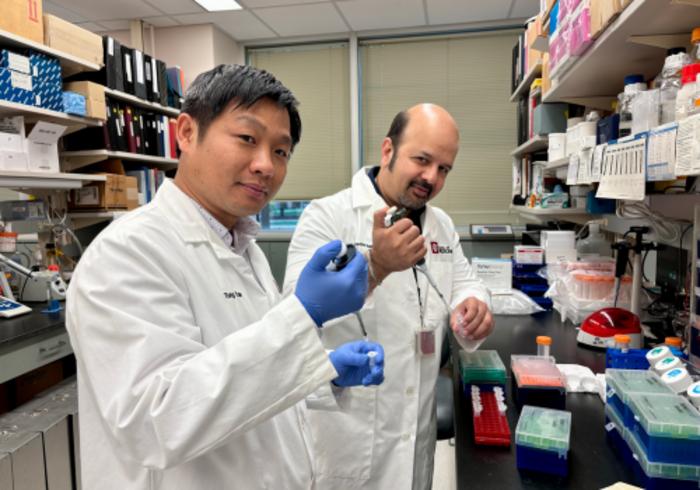
INDIANAPOLIS — Indiana University School of Medicine scientists are on a mission to understand why hematopoietic stem cells, responsible for producing all types of mature blood cells, exhibit better responses in a low-oxygen environment within the bone marrow, also known as hypoxia. Their discoveries and innovative approaches could influence treatment options like bone marrow transplantation for conditions such as bone marrow failure and rare blood diseases involving gene corrected stem cells.

Credit: Indiana University School of Medicine
INDIANAPOLIS — Indiana University School of Medicine scientists are on a mission to understand why hematopoietic stem cells, responsible for producing all types of mature blood cells, exhibit better responses in a low-oxygen environment within the bone marrow, also known as hypoxia. Their discoveries and innovative approaches could influence treatment options like bone marrow transplantation for conditions such as bone marrow failure and rare blood diseases involving gene corrected stem cells.
A new four-year, $2.7 million grant from the National Institute of Diabetes and Digestive and Kidney Diseases (NIDDK) will support the project, “Hypoxia’s role in regulating stressed hematopoietic stem cells,” and is co-led by Reuben Kapur, PhD, and Ngoc Tung Tran, PhD. The study will expand on research identifying hypoxia’s positive impact in sustaining the functions of hematopoietic stem cells, in particular stem cells derived from Fanconi anemia patients who possess defective stem cells.
“My previous research in collaboration with Dr. Hal Broxmeyer and Dr. Maegan Capitano showed that stem cells with mutations resulting in Fanconi anemia survive and function better in hypoxia versus in higher oxygen conditions,” said Kapur, director of the Herman B Wells Center for Pediatric Research and co-leader of the Hematopoiesis and Hematologic Malignancies Program at the Indiana University Melvin and Bren Simon Comprehensive Cancer Center. “Having a better understanding of these distinctions can potentially improve treatments for diseases caused by problems with defective stem cells in patients.”
Kapur’s research findings will shed light on rare blood disorders like Fanconi anemia, a condition often associated with cancer development, which, among other things, affects hematopoietic stem cells in the bone marrow where there are naturally occurring hypoxic conditions. Patients with bone marrow failure, including Fanconi anemia, can receive a diagnosis at any point from infancy through adulthood. Additionally, patients exhibit a diverse range of symptoms, making diagnosis and treatment complex and challenging.
According to Kathleen Overholt, MD, assistant professor of pediatrics at IU and director of the Bone Marrow Failure Program at Riley Children’s Health, curative treatment for most bone marrow failure disorders is commonly bone marrow transplantation. However, because these disorders typically involve mutations related to DNA repair or maintenance, the transplantation process carries significant risks and clinicians often choose to treat their patients symptomatically until there is a definitive need for the procedure.
“Transplantation only cures the blood and immune system, and these diseases affect every cell in the body,” Overholt said. “This means that despite transplantation, there are still cancer risks in all the other cells.”
To address these risks, another key objective of Kapur and Tran’s research is developing innovative strategies for enhancing the function of diseased blood stem cells to improve the success rates of hematopoietic stem cell transplantation and gene therapy treatment. By leveraging a unique gene correction approach, the researchers believe they have a way to correct the defective genes in Fanconi anemia without causing significant damage to the cells.
“The technique my lab developed, called the Spacer-Nick-mediated gene correction approach, offers a promising avenue for restoring the functionality of Fanconi anemia blood stem cells while minimizing adverse effects,” said Tran, assistant professor of pediatrics. “Ultimately, corrected stem cells could be transplanted into patients to address bone marrow failure, a leading cause of early mortality in pediatric patients.”
Tran and Kapur envision their multifaceted research and strategies will have far-reaching clinical implications, offering hope to individuals grappling with severe blood diseases.
“We hope that our study can be potentially applied to other blood disorders beyond Fanconi anemia in the future,” Tran said.
About IU School of Medicine
The IU School of Medicine is the largest medical school in the U.S. and is annually ranked among the top medical schools in the nation by U.S. News & World Report. The school offers high-quality medical education, access to leading medical research and rich campus life in nine Indiana cities, including rural and urban locations consistently recognized for livability. According to the Blue Ridge Institute for Medical Research, the IU School of Medicine ranks No. 13 in 2023 National Institutes of Health funding among all public medical schools in the country.
Cite Scienmag News
Nathaniel Bowman. (April 25, 2024). $2.7 million grant to explore hypoxia’s impact on blood stem cells. Scienmag. https://scienmag.com/2-7-million-grant-to-explore-hypoxias-impact-on-blood-stem-cells/
Nathaniel Bowman. "$2.7 million grant to explore hypoxia’s impact on blood stem cells." Scienmag, 25 April 2024, https://scienmag.com/2-7-million-grant-to-explore-hypoxias-impact-on-blood-stem-cells/. Accessed 6 September 2026.
Nathaniel Bowman. "$2.7 million grant to explore hypoxia’s impact on blood stem cells." Scienmag. April 25, 2024. https://scienmag.com/2-7-million-grant-to-explore-hypoxias-impact-on-blood-stem-cells/

