


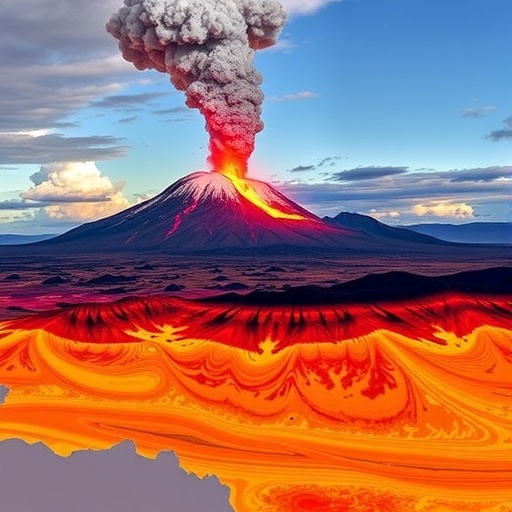
A new study suggests that volcanic eruptions in the nineteenth century did more than cool the planet for a few seasons: they may have interrupted one of Earth’s most important climate conversations. According to research by S. Wang, D. W. Oppo and C. C. Ummenhofer, published in Nature Communications, the normally connected patterns of variability in the Pacific and Indian oceans were disrupted by major volcanic activity during the 1800s. The finding offers a striking example of how a sudden disturbance in the atmosphere can alter relationships between distant ocean basins, potentially changing rainfall patterns, drought risk and the behavior of climate systems that influence billions of people.
The Pacific and Indian oceans are not isolated components of the climate system. They exchange energy through atmospheric circulation, ocean currents and wind-driven feedbacks that can transmit anomalies across vast distances. In the Pacific, the El Niño–Southern Oscillation, or ENSO, periodically shifts warm water and atmospheric convection between the western and eastern tropical Pacific. In the Indian Ocean, related changes can appear through Indian Ocean Dipole variability, in which the eastern and western parts of the basin become unusually warm or cool relative to one another. These oscillations are generated by different physical mechanisms, but they can interact. When their phases align, their effects on monsoon rainfall, tropical storms and global temperature can intensify; when their relationship weakens, familiar climate connections can break down.
The new research focuses on how volcanic eruptions altered that relationship. Explosive eruptions inject sulfur dioxide into the stratosphere, where it is converted into sulfate aerosols capable of reflecting incoming sunlight back into space. This produces a temporary reduction in surface heating, often accompanied by changes in land–sea temperature contrasts and atmospheric circulation. The cooling is not spatially uniform. Continents can respond rapidly, while the ocean, with its enormous heat capacity, changes more slowly. The contrast between rapidly cooled land and relatively warm ocean can reorganize winds, rainfall and convection. In the tropics, even a modest shift in the location of rising air can influence trade winds and modify ocean-atmosphere feedbacks thousands of kilometers away.
That matters because ENSO and Indian Ocean variability depend on delicate balances. In the tropical Pacific, trade winds normally push warm surface water toward the west, allowing cooler, nutrient-rich water to rise near the South American coast. Changes in wind strength can flatten or steepen the thermocline—the boundary separating warm surface water from colder deep water—and thereby amplify or suppress El Niño or La Niña conditions. The Indian Ocean is governed by its own monsoon circulation and air–sea interactions, but it can respond to Pacific-driven changes in atmospheric pressure and convection. The study indicates that nineteenth-century volcanism interfered with these linked processes, reducing or rearranging the coupling that normally helps variability in one basin influence the other.
To identify this disruption, the researchers examined evidence extending beyond the short period covered by modern instrumental measurements. Long climate records are essential because reliable global ocean observations begin only in the twentieth century, while the most powerful nineteenth-century eruptions occurred before satellites, ocean buoys and comprehensive weather networks existed. Scientists therefore reconstruct past climate behavior using natural archives such as tree rings, corals, ice cores and historical records, alongside climate-model simulations. These records preserve indirect signals of temperature, moisture and circulation. By comparing reconstructed Pacific and Indian Ocean variability before and after major eruptions, researchers can test whether the statistical relationship between the two basins changed after volcanic forcing.
The analysis points to the nineteenth century as an unusual interval in which the Pacific–Indian Ocean connection became less stable. Rather than simply shifting the average temperature of the climate system downward, volcanic forcing appears to have changed the timing, strength and spatial expression of ocean variability. A volcanic aerosol veil can disturb the seasonal cycle, alter tropical convection and trigger wind anomalies that push the ocean away from its usual state. Once initiated, ocean feedbacks can either reinforce the disturbance or steer the system toward a different pattern. The result is not necessarily a single, uniform response after every eruption. The climate system’s reaction depends on the eruption’s magnitude, latitude, season, aerosol distribution and the background state of the oceans when the eruption occurs.
This finding could help explain why climate variability during the nineteenth century does not always fit modern expectations. Scientists frequently use present-day relationships between ENSO, the Indian Ocean Dipole and regional rainfall to interpret historical events or anticipate future risks. But if external shocks can temporarily weaken those relationships, then a Pacific signal may not produce its usual Indian Ocean response, and an Indian Ocean anomaly may not feed back into the Pacific in the familiar way. Such decoupling can make seasonal forecasts less reliable. A rainfall pattern that would ordinarily be associated with El Niño might fail to appear, while regions normally protected from drought or flooding could experience unexpected extremes because the atmospheric bridge between the basins has changed.
The implications extend beyond historical climate reconstruction. Volcanic eruptions are natural experiments that reveal how the climate system behaves under abrupt forcing, and their effects provide a test for climate models. If models reproduce the observed nineteenth-century disruption, confidence increases that they capture essential ocean–atmosphere mechanisms. If they fail, the mismatch may expose weaknesses in the representation of tropical convection, aerosol forcing, ocean mixing or cross-basin teleconnections. These details are technically important because climate projections are not determined only by average warming. They also depend on how variability changes: whether El Niño events become more or less frequent, how the Indian Ocean Dipole evolves, and whether established relationships between climate modes remain intact under new background conditions.
The study also carries a warning for a world facing other forms of rapid climate forcing. Volcanism is episodic, but human-driven greenhouse-gas emissions are steadily altering the radiative balance of the atmosphere. Greenhouse warming changes ocean stratification, evaporation, atmospheric moisture and the location of tropical convection. Those shifts could modify the same feedbacks that connect the Pacific and Indian oceans, even without a volcanic eruption. The nineteenth-century record therefore functions as a reminder that climate “modes” are not rigid clocks. Their behavior can be reorganized when the environment changes, and the consequences may appear not only in global temperature but in the distribution of rainfall, the severity of droughts, flood-producing storms and the reliability of climate forecasts.
By showing that nineteenth-century volcanism disrupted Pacific–Indian Ocean coupling, Wang, Oppo and Ummenhofer add a new dimension to the story of volcanic climate impacts. The key message is not simply that eruptions cool the planet. They can also reshape the pathways through which distant ocean basins communicate, temporarily rewriting the chain of feedbacks that governs tropical climate. As researchers work to improve reconstructions and simulations of past events, the study offers a vivid lesson: Earth’s climate is a tightly connected network, but its connections are conditional. A disturbance in one part of the system can silence, amplify or redirect signals traveling across an entire ocean—and the altered pattern may determine where the next climate extremes unfold.
Cite Scienmag News
Violet Maxwell. (August 26, 2026). 19th-Century Volcanism Disrupted Pacific–Indian Ocean Climate Variability Coupling. Scienmag. https://scienmag.com/19th-century-volcanism-disrupted-pacific-indian-ocean-climate-variability-coupling/
Violet Maxwell. "19th-Century Volcanism Disrupted Pacific–Indian Ocean Climate Variability Coupling." Scienmag, 26 August 2026, https://scienmag.com/19th-century-volcanism-disrupted-pacific-indian-ocean-climate-variability-coupling/. Accessed 4 September 2026.
Violet Maxwell. "19th-Century Volcanism Disrupted Pacific–Indian Ocean Climate Variability Coupling." Scienmag. August 26, 2026. https://scienmag.com/19th-century-volcanism-disrupted-pacific-indian-ocean-climate-variability-coupling/


