


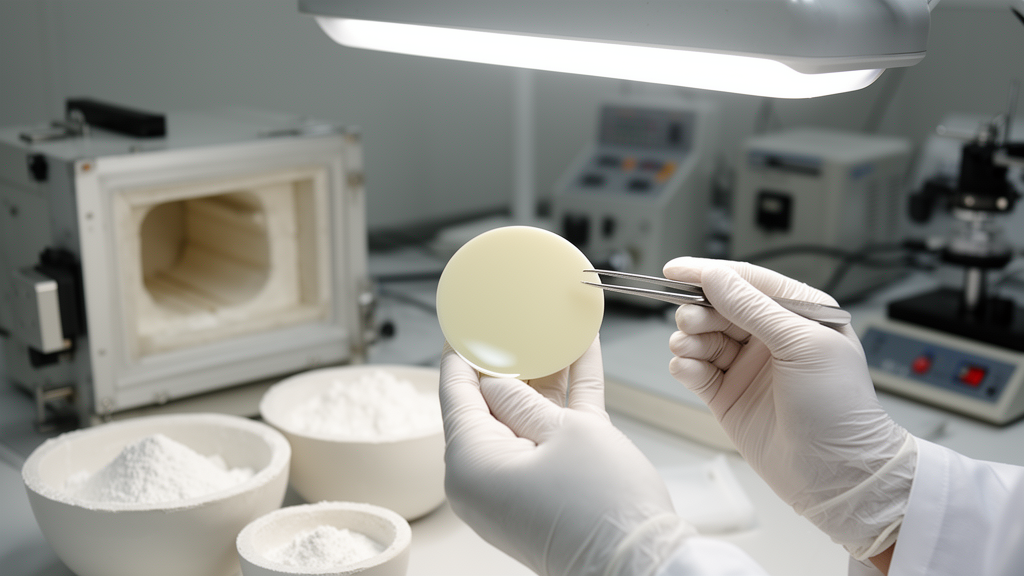
Experimental work described in the Journal of Materials Science reports that substituting (Zn0.5Ti0.5)3+ into cordierite ceramics produced a stable solid solution and enhanced the measured microwave dielectric properties of an optimized formulation. The study’s abstract reports a relative permittivity, εr, of 4.482, a quality factor–resonant frequency product, Q×f, of 55,772 GHz, and a resonant frequency temperature coefficient, τf, of −19.7 ppm/°C.
The researchers fabricated Mg2Al4−x(Zn0.5Ti0.5)xSi5O18 ceramics using a conventional solid-state reaction method. They investigated the materials’ phase composition, structural evolution and microwave dielectric properties. According to the abstract, Zn/Ti co-doping was incorporated into the cordierite lattice, while a secondary MgAl2O4 phase appeared as the doping content increased. The optimized composition showed a higher Q×f value and a relatively higher εr than the other tested formulations.
The authors associated the increase in εr with improved relative density, formation of the secondary phase and enhanced polarizability from (Zn0.5Ti0.5)3+. They also associated the Q×f enhancement with increased relative density, the secondary phase, a reduced full width at half maximum and improved crystal structural symmetry. In addition, the abstract reports a pronounced correlation between τf, structural distortion of the [MgO6] octahedra and the occurrence of the secondary phase. These are the study authors’ proposed explanations and observed associations rather than independent device-level demonstrations.
To explore possible use in 5G communication, the researchers designed a microstrip antenna operating at 4.97 GHz based on the developed ceramic. The abstract describes this as a design and an indication of potential for wireless communication; it does not report measured antenna gain, bandwidth, efficiency or operation in an operational 5G system. The available evidence is limited to the journal abstract and does not provide the full experimental dataset, the optimized value of x, uncertainty estimates for the reported properties or a complete comparison with undoped cordierite. The findings therefore establish a promising laboratory material result while leaving application performance and broader comparative performance to be evaluated in the full study.
Subject of Research: Experimental evaluation of Zn/Ti co-doped cordierite ceramics for microwave dielectric applications
Article Title: Effects of (Zn0.5Ti0.5)3+ substitution on the sintering behavior and microwave dielectric properties of cordierite-based ceramics
Article References: Yang, X., Wu, Z., Yang, X., Peng, B., Yan, Z., Guo, X., & Xiao, L. (2026). Effects of (Zn0.5Ti0.5)3+ substitution on the sintering behavior and microwave dielectric properties of cordierite-based ceramics. Journal of Materials Science, 61(43), 33461-33478. https://doi.org/10.1007/s10853-026-13715-7
Image Credits: AI Generated
DOI: 10.1007/s10853-026-13715-7
Keywords: cordierite ceramics, Zn/Ti co-doping, microwave dielectrics, relative permittivity, quality factor, temperature coefficient, solid-state reaction, microstrip antenna, 5G components, Journal of Materials Science, Effects, substitution
Cite Scienmag News
Denise Maddox. (October 20, 2026). Zn/Ti co-doped cordierite ceramics show improved microwave dielectric properties in experimental study. Scienmag. https://scienmag.com/zn-ti-co-doped-cordierite-ceramics-show-improved-microwave-dielectric-properties-in-experimental-study/
Denise Maddox. "Zn/Ti co-doped cordierite ceramics show improved microwave dielectric properties in experimental study." Scienmag, 20 October 2026, https://scienmag.com/zn-ti-co-doped-cordierite-ceramics-show-improved-microwave-dielectric-properties-in-experimental-study/. Accessed 20 October 2026.
Denise Maddox. "Zn/Ti co-doped cordierite ceramics show improved microwave dielectric properties in experimental study." Scienmag. October 20, 2026. https://scienmag.com/zn-ti-co-doped-cordierite-ceramics-show-improved-microwave-dielectric-properties-in-experimental-study/


