


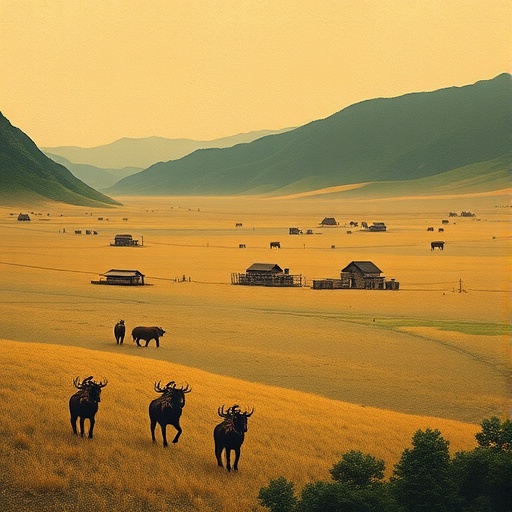
In a world steeped in archaeological wonders, the recently published research by Huan and Brosseder shines a spotlight on the socio-cultural dynamics of the Yuhuangmiao community, nestled between the sprawling steppes and the rich plains of China. This study, housed in the journal Asian Archaeology, seeks to unravel the complex interplay of cultural exchanges, economic practices, and social organization that characterized this unique community, providing valuable insights into how ancient societies adapted and thrived in changing environments.
The Yuhuangmiao site represents a crucial link in understanding the broader historical narratives of East Asia. This area is not merely a backdrop; rather, it is a geographical and cultural intersection that has witnessed significant developments through various epochs. The researchers meticulously analyzed artifacts, settlement layouts, and ecological data, all of which paint a vivid picture of the community’s daily life. They delve into how these factors influenced social hierarchies and communal relationships, revealing a tapestry of interactions that transcends mere survival.
At the heart of this investigation lies an exploration of the economic structures that facilitated the community’s growth. The research outlines various subsistence strategies that were employed, from agriculture to animal husbandry, each adapting to the ecological constraints of their environment. This adaptability hints at a sophisticated understanding of resource management that allowed the Yuhuangmiao people to flourish despite the challenges posed by shifting climatic conditions. Such insights are particularly relevant as contemporary societies grapple with similar challenges today.
Moreover, Huan and Brosseder have utilized cutting-edge techniques in their analysis, employing both traditional archaeological methods and modern technology. The integration of remote sensing and GIS mapping has enabled them to visualize the spatial dynamics of the Yuhuangmiao community comprehensively. These tools provide an unprecedented lens through which to view the ancient landscape, revealing settlement patterns that might have otherwise gone unnoticed. The high-resolution imagery coupled with archaeological data enriches our understanding of not just the community layout but also the socio-political relations that may have existed.
Social stratification in ancient societies is often a contentious subject, and the findings from Yuhuangmiao contribute significantly to this debate. The data suggests a more nuanced hierarchy than previously understood, with evidence indicating specialized roles within the community. This reevaluation challenges traditional narratives that often depict ancient societies as simplistic or monolithic in their structure. By highlighting the division of labor and the emergence of leadership roles, the researchers provide a framework for understanding the complexities of social organization in historical contexts.
Cultural exchange is another focal point of this research. The Yuhuangmiao community was not isolated; interactions with neighboring societies are evidenced through the presence of non-local artifacts. The researchers speculate on trade routes and cultural exchanges that might have enriched the Yuhuangmiao people’s social fabric. By tracing these connections, the study not only illuminates the community’s influences but also situates them within a broader regional framework, emphasizing the significance of intersocietal relationships in shaping cultural identities.
The researchers also delve into the spiritual dimensions of the Yuhuangmiao community. Rituals and belief systems are integral to understanding any society, and this study is no exception. Preliminary findings reveal a rich tapestry of spiritual practices that reflect the community’s values and social cohesion. The integration of archaeological and anthropological perspectives allows for a deeper exploration of how spirituality influenced societal norms and behaviors, providing a richer context for their cultural expressions.
For those intrigued by the interplay of environment and culture, the ecological studies within this research are particularly illuminating. The authors meticulously document the biophysical landscape of the Yuhuangmiao region, linking it to human activity and settlement patterns. This holistic view underscores the importance of environmental factors in shaping cultural identity and social organization—a perspective that resonates strongly in today’s discussions regarding sustainability and ecological stewardship.
Furthermore, the lasting impact of the Yuhuangmiao community is reflected in its legacies. As the researchers outline, the influences of this ancient society can still be traced in contemporary cultural practices and regional identities. Understanding these connections not only enriches our historical narratives but also serves as a reminder of the enduring nature of cultural heritage. This continuity emphasizes the importance of preserving archaeological sites, as they are not mere artifacts of the past but integral to the ongoing story of human civilization.
As we look towards the future, the research conducted by Huan and Brosseder opens new avenues for inquiry. The methodologies employed and the questions raised invite further exploration into similar communities across East Asia. Scholars and enthusiasts alike are encouraged to engage with these findings, contributing to a broader dialogue about the nuances of cultural dynamics throughout history. The Yuhuangmiao site stands as a testament to the ingenuity of ancient peoples and their capacity for adaptation, setting the stage for future research endeavors in archaeology.
In conclusion, the socio-cultural dynamics of the Yuhuangmiao community serve as a profound reminder of the interconnectedness of human experience. By examining the multifaceted aspects of this society, Huan and Brosseder not only enhance our understanding of a specific locale but also contribute to a larger narrative about the resilience and adaptability of cultures in the face of environmental and social challenges. Their work is a call to action for continued exploration in the field of archaeology, urging us to look deeper into the layers of human history that shape our present and future.
In a world that often overlooks the lessons of the past, the insights gleaned from the Yuhuangmiao community offer a vital perspective on human resilience. This research not only informs our understanding of ancient societies but also encourages a deeper appreciation for the complexity and richness of human cultural evolution. As we continue to unearth stories from the depths of our history, the findings from Yuhuangmiao stand as a beacon of enlightenment, inviting us to engage with the enduring legacy of our ancestors.
Huan, L., Brosseder, U. Yuhuangmiao: the socio-cultural dynamics of a community between the steppes and the Chinese plains.
asian archaeol 8, 229–249 (2024). https://doi.org/10.1007/s41826-024-00098-4
Cite Scienmag News
Courtney Benton. (January 23, 2026). Yuhuangmiao: Cultural Dynamics of Steppe-Plain Communities. Scienmag. https://scienmag.com/yuhuangmiao-cultural-dynamics-of-steppe-plain-communities/
Courtney Benton. "Yuhuangmiao: Cultural Dynamics of Steppe-Plain Communities." Scienmag, 23 January 2026, https://scienmag.com/yuhuangmiao-cultural-dynamics-of-steppe-plain-communities/. Accessed 4 September 2026.
Courtney Benton. "Yuhuangmiao: Cultural Dynamics of Steppe-Plain Communities." Scienmag. January 23, 2026. https://scienmag.com/yuhuangmiao-cultural-dynamics-of-steppe-plain-communities/


