


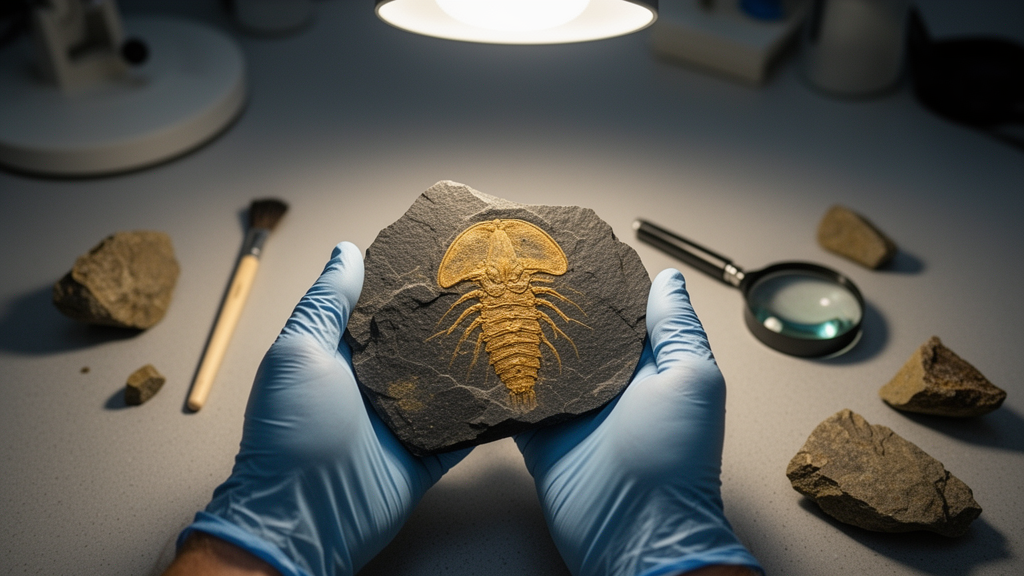
Deep in the fine-grained dolostone of upstate New York, a flattened, shield-like fossil has quietly rewritten the end of one of the Cambrian period’s most iconic arthropod stories. Paleontologists have described only the second known Silurian specimen of Naraoia, a genus of two-shelled arthropods famous for its spectacular Cambrian record, in a new study published in the journal Fossil Record. The specimen, recovered from the Phelps Member of the Fiddlers Green Formation at Passage Gulf in Herkimer County, extends the known range of the youngest naraoiid species from Ontario, Canada into New York State and adds precious anatomical detail to a lineage that otherwise vanishes from the fossil record after the Cambrian explosion.
Naraoiids are nektaspidid arthropods defined by a strikingly simple body plan: two exoskeletal shields, a head shield and a trunk shield, with few to no thoracic tergites between them. Unlike trilobites, their close Cambrian contemporaries, naraoiids lacked a calcified exoskeleton, meaning their soft, chitinous carapaces required exceptional fossilization conditions to survive the ravages of decay. The family comprises four genera—Naraoia, Liwia, Soomaspis, and Tariccoia—plus the subgenus Naraoia (Misszhouia). While the overwhelming majority of documented naraoiids are Cambrian in age, the group’s fossil record stretches, remarkably, to the late Silurian Pridoli epoch, making them one of the longest-surviving relicts of Cambrian faunas.
The only previously documented Silurian naraoiid, Naraoia bertiensis, was described from a single specimen found in the Williamsville Member at Ridgemount, Ontario, roughly 13.5 kilometers northwest of Buffalo. The new specimen, cataloged as NYSM 19522 in the New York State Museum paleontology collections, was assigned to Naraoia cf. bertiensis and comes from the Phelps Member of the Fiddlers Green Formation at Passage Gulf, approximately 352 kilometers east of Buffalo. Both units belong to the Bertie Group, a Pridolian succession deposited near the center of the northeast-southwest trending Appalachian foreland basin, when this part of Laurentia sat about 30 degrees south of the paleo-equator.
The Bertie Group is famous among paleontologists for its exceptionally preserved eurypterids, the so-called sea scorpions that rank among the largest arthropods ever to live. Its fine-grained, clayey dolostone units—informally called waterlimes for their historical use in hydraulic cement production—preserve soft-bodied organisms with extraordinary fidelity. The new specimen was preserved in dorsal view with no relief, showing a partly articulated cephalic shield and trunk. The cephalic shield is suboval with minute genal angles, measuring 14.6 millimeters wide and 11.4 millimeters long, while the trunk shield is suboval, slightly pointed posteriorly, at 12.3 millimeters wide and 9.49 millimeters long. Under low-angle light, minute radial linear structures appear on the right side of the trunk, and a possible terminal axial trunk spine is noted.
Comparisons with the holotype specimen ROM 56013 from the Williamsville Member reveal telling differences. The new specimen is roughly 40 percent smaller than the Ontario specimen, suggesting it may represent a more juvenile individual. It also lacks the marginal rim and doublure documented in the holotype, though a lunate furrow in the center of the cephalic shield may represent a posterior hypostome margin—differences likely reflecting substantial dorsoventral compression. Crucially, partial rotation of the cephalon over the trunk indicates that NYSM 19522 is a moult, aligning with what paleontologists call Type C naraoiid preservation: articulated dorsal sclerites with no preserved appendages or digestive organs. Both known Silurian Naraoia specimens are therefore moults, hinting that these animals may have gathered in shallow, brackish waters to shed their exoskeletons, just as eurypterids did.
The paleoenvironment of the Bertie Group has long been debated, with interpretations ranging from relatively fresh to hypersaline. Evidence for brackish conditions includes land plants like Cooksonia, salinity-tolerant linguliform brachiopods and gastropods, limited evidence for strictly marine taxa like echinoderms, and restricted bioturbation. Arguments for hypersalinity rest on the presence of salt hoppers, halite molds and casts, and desiccation cracks on bedding planes bearing eurypterid fossils. Recent work suggests that eurypterid accumulations in the Bertie typically follow small-scale transgressions that freshened shallow subtidal waters to near-normal conditions, with the animals gathering to moult and reproduce before burial by storm sedimentation. The rarity of Naraoia in units that preserve non-biomineralized arthropods so commonly therefore requires explanation—possibly the new specimen was allochthonous, transported into the deposit by storm currents, as marine windrows in the Phelps Member suggest.
Beyond the specimen itself, the study tackles a broader biogeographic puzzle using paleo-digital elevation models. The researchers compiled naraoiid occurrence records from the Paleobiology Database, retaining 142 Cambrian occurrences, just four Ordovician occurrences, and only two Silurian occurrences. These were paleo-rotated to median time slices of each period—515 million years ago for the Cambrian, 465 for the Ordovician, and 430 for the Silurian—using the PALEOMAP dataset. The results show a striking contraction: Cambrian naraoiids were predominantly located in low-latitude regions across Laurentia, Baltica, South China, and Gondwana, generally inhabiting open marine environments. Ordovician naraoiids are observed only in Gondwana, in open marine, restricted, and brackish-to-marine settings, while the youngest forms are limited to Laurentia.
The bathymetric analysis reveals an intriguing deepening trend through time. Cambrian naraoiids ranged between 160 and 800 meters below sea level, Ordovician forms clustered around 200 meters below sea level, and Silurian forms ranged between 200 and 520 meters below sea level. This pattern supports the proposal that geologically younger naraoiids migrated to deeper water, off-shelf environments, inhabiting refugia-like conditions after the Cambrian. The apparent rarity of post-Cambrian naraoiids, the authors argue, is not an evolutionary pattern but evidence of taphonomic bias and a lack of appropriate fossil sites. Comprehensive evaluations of exceptionally preserved fossil assemblages show a marked decrease in Lagerstätten representing open marine environments across the Cambrian-Ordovician interval, meaning non-biomineralized open marine taxa are rarely recorded in younger strata.
Since Naraoia appears in both Cambrian and Silurian strata of Laurentia, it likely persisted in the same region throughout the Ordovician, absent from the fossil record only because suitable deposits with exceptional preservation have not been explored in detail. It would be unparsimonious to propose that Naraoiidae went locally extinct in Laurentia and then migrated back in the Silurian. More plausible is that these forms inhabited outer shelf refugia, and the rare findings of Naraoia hammani in deep-water settings of the Prague Basin suggest naraoiids were probably far more widespread in open marine environments during the Ordovician than the sparse record implies. Identifying and examining such deposits in Laurentia and elsewhere may therefore uncover more Ordovician naraoiids.
The authors acknowledge potential biases in their bathymetric reconstruction, including the resolution of the paleo-elevation models, imprecise age ranges for specimens, and sparse locality records in the database. Four naraoiid occurrences were excluded from the water depth analysis due to erroneous positive elevation values, numerical artifacts of data resolution. Potential solutions include re-examining data points in geographic and age resolution, inputting more data from the primary literature into the Paleobiology Database, and developing more precise plate models aimed at correctly reconstructing environments and water depth. Even with these caveats, the second Silurian Naraoia specimen stands as vivid evidence that a lineage born in the Cambrian explosion clung to existence for over a hundred million years, surviving in quiet refugia long after its world had changed beyond recognition.
Subject of Research: Novel evidence for the youngest Naraoia and a reassessment of naraoiid paleobiogeography
Article Title: Novel evidence for the youngest Naraoia and a reassessment of naraoiid paleobiogeography
Article References: Bicknell, R. D. C., Goodman, A., Laibl, L., & Amati, L. (2025). Novel evidence for the youngest Naraoia and a reassessment of naraoiid paleobiogeography. Fossil Record, 28(1), 115-124. https://doi.org/10.3897/fr.28.150343
Image Credits: AI Generated
DOI: 10.3897/fr.28.150343
Keywords: Naraoia, paleontology, Silurian, arthropods, Cambrian, Fossil Record, Bertie Group, paleobiogeography, Novel, evidence, youngest, reassessment
Cite Scienmag News
Gavin Prescott. (October 18, 2026). Youngest Naraoia fossil found in New York rewrites arthropod survival story. Scienmag. https://scienmag.com/youngest-naraoia-fossil-found-in-new-york-rewrites-arthropod-survival-story/
Gavin Prescott. "Youngest Naraoia fossil found in New York rewrites arthropod survival story." Scienmag, 18 October 2026, https://scienmag.com/youngest-naraoia-fossil-found-in-new-york-rewrites-arthropod-survival-story/. Accessed 18 October 2026.
Gavin Prescott. "Youngest Naraoia fossil found in New York rewrites arthropod survival story." Scienmag. October 18, 2026. https://scienmag.com/youngest-naraoia-fossil-found-in-new-york-rewrites-arthropod-survival-story/


