


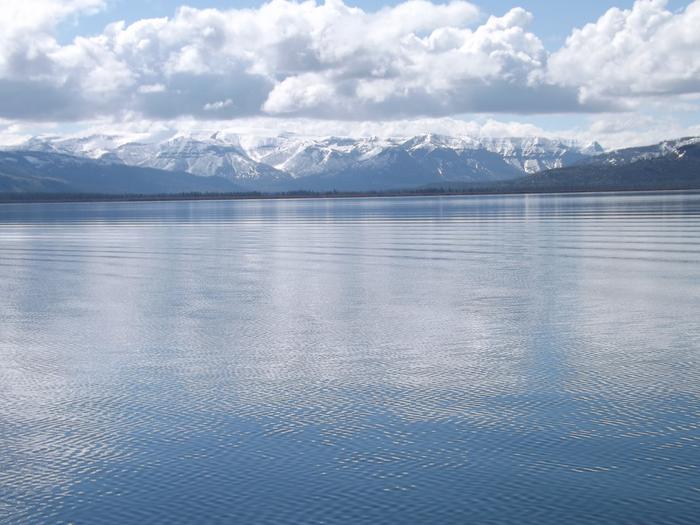
The length of time that Yellowstone Lake is covered by ice each year has not changed in the past century, despite warming temperatures in the region, according to new research led by University of Wyoming scientists.

Credit: Lusha Tronstad
The length of time that Yellowstone Lake is covered by ice each year has not changed in the past century, despite warming temperatures in the region, according to new research led by University of Wyoming scientists.
That is an unexpected finding, as most lakes around the world are experiencing shorter durations of ice cover, the scientists note in a new paper published in the journal Environmental Research Letters.
“We show that contrary to expectation, the ice phenology of Yellowstone Lake has been uniquely resistant to climate change,” wrote the scientists, led by Lusha Tronstad, lead invertebrate zoologist with UW’s Wyoming Natural Diversity Database and Department of Zoology and Physiology, and Isabella Oleksy, a former UW postdoctoral researcher now on the University of Colorado-Boulder faculty. “The unchanging ice phenology of Yellowstone Lake stands in stark contrast to similar lakes in the Northern Hemisphere.”
Other researchers involved in the study are from Utah State University, Colorado State University and Colorado Mesa University.
Situated at 7,733 feet above sea level in the heart of Yellowstone National Park, Yellowstone Lake is North America’s largest high-elevation lake, roughly 20 miles long and 14 miles wide with a surface area of 132 square miles. It freezes over completely in late December or early January and usually thaws in late May or early June.
Records for the lake’s ice-off date have been recorded each year by Lake Village Ranger Station staff since 1927, and the ice-on date has been recorded since 1931. In addition to studying those records, the scientists analyzed climate data for the same period, 1927-2022, including air temperatures and precipitation. They also compared Yellowstone Lake’s data with seven similar lakes in northern Europe.
The lack of long-term change in the duration of Yellowstone Lake’s ice cover was unexpected because the Yellowstone region has seen a warming climate, the researchers say. Since 1950, annual temperatures have increased by 1.8 degrees Fahrenheit throughout the greater Yellowstone ecosystem. The changes are particularly pronounced at the high elevation of Yellowstone Lake, where air temperatures increased by about 2.5 degrees Fahrenheit between 1980-2018.
“Using local weather data, we found some evidence for increased summer, fall and spring temperatures, primarily in the last three decades,” the scientists wrote about air temperatures at Yellowstone Lake. “Given the key role of air temperatures in driving ice formation and break-up, it is noteworthy that we did not find evidence for corresponding shifts in ice phenology.”
Why the apparent discrepancy?
While it is possible that fall minimum temperatures — which are important in predicting ice formation — are not rising as quickly as overall temperature trends in the region, a more likely explanation is that increased snowfall at Yellowstone Lake has served as a buffer against warmer weather, the scientists say.
Snow cover, particularly in spring, can delay ice break-up. Cumulative spring snow, which was strongly correlated with delayed ice-off dates, has nearly doubled over the last century at Yellowstone Lake, the research showed. In general, precipitation has increased in spring and fall there.
That differs from the Upper Green River Basin to the south, where snowfall has declined or been relatively stable at high elevations.
“Shifts in local precipitation, especially increases in fall and spring snow, appear to be buffering (Yellowstone Lake) ice phenology against warming temperatures,” the researchers wrote.
But, the scientists are not sure how long this phenomenon will last, noting projections of continued warming and shifting precipitation regimes in the high Rocky Mountains.
“Our results, paired with recent analyses of climate projections, suggest a ‘tipping point’ may be coming when ice phenology abruptly changes for Yellowstone Lake,” they wrote. “This tipping point will largely stem from the ongoing shift from snow- to rain-dominated precipitation regimes in the fall and spring.
“… Increased spring rainfall has not yet caused a detectable long-term trend toward earlier ice break-up, potentially because of the counteracting effects of increased spring snow. As temperatures warm further, and fall and spring snowfall decreases, ice phenology may rapidly change on Yellowstone Lake.”
If that happens, “there may be wide-ranging consequences for nutrient cycling, lake productivity, fisheries and recreation,” the scientists concluded.
Journal
Environmental Research Letters
Method of Research
Data/statistical analysis
Subject of Research
Not applicable
Article Title
Despite a century of warming, increased snowfall has buffered the ice phenology of North America’s largest high-elevation lake against climate change
Article Publication Date
9-Apr-2024
Cite Scienmag News
Russell Cooper. (April 16, 2024). Yellowstone Lake ice cover unchanged despite warming climate. Scienmag. https://scienmag.com/yellowstone-lake-ice-cover-unchanged-despite-warming-climate/
Russell Cooper. "Yellowstone Lake ice cover unchanged despite warming climate." Scienmag, 16 April 2024, https://scienmag.com/yellowstone-lake-ice-cover-unchanged-despite-warming-climate/. Accessed 4 September 2026.
Russell Cooper. "Yellowstone Lake ice cover unchanged despite warming climate." Scienmag. April 16, 2024. https://scienmag.com/yellowstone-lake-ice-cover-unchanged-despite-warming-climate/

