


Every time a modern computer chip performs a calculation, electrons stream through silicon, colliding with atoms and shedding energy as waste heat. As artificial intelligence data centres multiply across the globe, that inefficiency has become one of the defining engineering problems of the decade. Silicon transistors cannot be miniaturized forever, and their clock speeds cannot rise indefinitely, so researchers everywhere are hunting for materials and operating principles that could carry information with far less electricity. A team at the Paul Scherrer Institute in Switzerland has now delivered a striking piece of that puzzle: using a suite of X-ray techniques at the SwissFEL free-electron laser, they have tracked, in unprecedented microscopic detail, how the different excitations inside a magnetic material hand energy to one another across timescales spanning nearly a millionfold range.
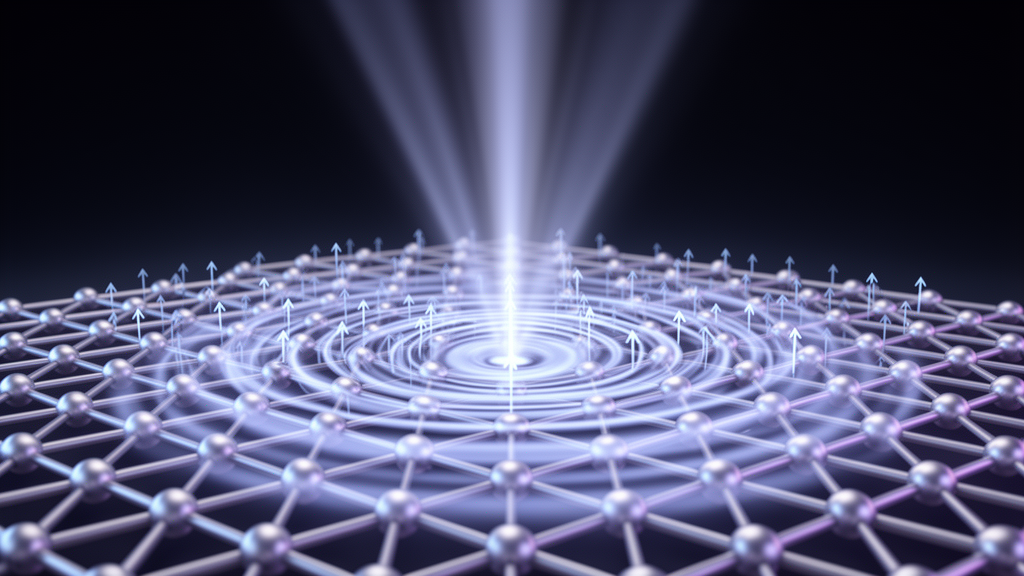
The excitations at the heart of the study are quasiparticles, collective disturbances that behave in many ways like particles even though they are not made of matter in the ordinary sense. Magnons are quasiparticles of spin: in a magnetic material, the electron spins act like a lattice of tiny compass needles, and when they tip over in sequence they form a travelling wave, much like a Mexican wave rippling around a football stadium. Crucially, it is not the electrons themselves that migrate through the crystal, only the pattern of their flips. Phonons, by contrast, are quantized vibrations of the atoms in the crystal lattice. Because both magnons and phonons carry well-defined energy and momentum as individual entities, quantum physics treats them as particles in their own right, and understanding how they interact is central to any technology that hopes to exploit them.
The appeal of magnons is that they could carry information without moving charge. In conventional chips, the flow of electrons through resistive pathways causes power losses and generates heat, which is precisely what limits how densely and how fast silicon devices can operate. If the electrons stayed put and only their spins were manipulated, logic operations could in principle be performed with dramatically less energy. This vision is called spintronics, a fusion of spin and electronics, and it depends on being able to create, control and read out magnons quickly and reliably. The PSI team, led by Hiroki Ueda, set out to answer a deceptively simple question: when magnons are born in a solid, what happens to them next, and how long do they survive?
To find out, the researchers chose copper oxide, a well-known antiferromagnetic material with strong coupling between its magnetism and its crystal lattice. First author Arnau Romaguera of the PSI Center for Photon Science explained the choice: the material is a textbook system for studying how magnetic order talks to lattice vibrations. The experiment began with an intense optical laser pulse fired at the sample. The pulse excited the electrons, which in turn caused the initially disordered spins to flip in coordinated rows, generating magnons. That birth happened within femtoseconds, a quadrillionth of a second, an interval so short that light itself travels only a fraction of a millimetre in that time.
What followed was a cascade across the quantum timescales. Over the first few picoseconds, a trillionth of a second, the freshly created coherent magnons waves scattered off one another and degraded into a sea of incoherent waves, like rough water after a wave has broken. Then, over the next three orders of magnitude, in the nanosecond range, the magnons finally interacted with the atoms of the crystal lattice and converted their energy into phonons, the quantized lattice vibrations. The energy flow thus moved from electrons to spins to lattice, and each handoff occurred on a distinctly different clock.
The headline result is that the magnons proved remarkably long-lived. Given the strong coupling between magnetism and the lattice in copper oxide, the team expected the spin energy to drain into vibrations almost immediately. Instead, Romaguera noted, the generated magnons took a surprisingly long time to pass their energy to the lattice. In human terms all of these timescales are vanishingly short, but in the quantum world they span many orders of magnitude, and the nanosecond lifetime of the magnons is generous by the standards of ultrafast magnetism. That longevity matters enormously for applications: it could provide enough time to perform and control logical operations before the spin information dissipates into heat.
Ueda offered a physical explanation for the slow handoff. Magnons and phonons obey very different relationships between their momentum and energy values, he explained, and this mismatch modulates how efficiently magnons can transfer their energy to the lattice. The inefficient coupling leads to the long magnon lifetime, and it also provides a design principle: by specifically engineering materials to tune the momentum-energy relationships of their quasiparticles, researchers could in principle adjust the magnon lifetime as desired, tailoring spintronic materials for the operations they need to perform.
Making all of this visible was itself a formidable experimental challenge, because the phenomena unfold across such diverse timescales. The team used a pump-probe scheme: a highly brilliant X-ray pulse from a free-electron laser is directed at the sample shortly after the optical laser pulse that generates the magnons. By gradually varying the delay between the two pulses, the researchers probe the material at different moments after excitation and reconstruct a sequence of snapshots of the microscopic events, like assembling a flipbook of the energy flow. In addition to two established X-ray techniques, the team employed a novel method for the first time, known as time-resolved resonant diffuse scattering. The key measurements were conducted at the Furka experimental station of SwissFEL at PSI, and complementary measurements were performed at the ESRF synchrotron in Grenoble, France.
The experimental snapshots were supplemented by quantum kinetic simulations that modelled the measured energy flow through the material. Ueda reported that the measurements are largely consistent with the theoretical calculations, which shows that the underlying theories of quasiparticle dynamics are well understood, even if they must be adapted to the specific structures of each material. That agreement is important because it means the framework developed for copper oxide can be carried forward as a predictive tool: researchers designing new spintronic materials can model how their magnons will behave before ever growing a crystal.
The work, published in Nature Communications as an experimental study of hierarchical quasiparticle dynamics in antiferromagnets, remains basic research, but it brings the electronics of the future one important step closer to practical application. By revealing the full interplay of electronic, magnetic and lattice excitations in a single coherent picture, the PSI team has shown that magnons in antiferromagnets can persist long enough to be useful, and that their lifetime is not an accident of nature but a property that can be understood, simulated and engineered. For a field racing to replace silicon before its physical limits are reached, knowing that the spin waves of the quantum world can be made to linger is exactly the kind of insight that turns a laboratory curiosity into a technology roadmap.
Subject of Research: Time-resolved X-ray scattering study of magnon and phonon quasiparticle dynamics in an antiferromagnetic copper oxide
Article Title: X-rays show how quasiparticles interact in solids
Article References: X-rays show how quasiparticles interact in solids. Original publication (Bibliographic details unavailable.)
Image Credits: AI Generated
DOI: Not provided
Keywords: magnons, phonons, quasiparticles, spintronics, antiferromagnets, SwissFEL, X-ray scattering, copper oxide, Paul Scherrer Institute, pump-probe technique, Nature Communications, quantum materials
Cite Scienmag News
Denise Maddox. (October 19, 2026). X-rays reveal long-lived magnons that could power future spintronic chips. Scienmag. https://scienmag.com/x-rays-reveal-long-lived-magnons-that-could-power-future-spintronic-chips/
Denise Maddox. "X-rays reveal long-lived magnons that could power future spintronic chips." Scienmag, 19 October 2026, https://scienmag.com/x-rays-reveal-long-lived-magnons-that-could-power-future-spintronic-chips/. Accessed 19 October 2026.
Denise Maddox. "X-rays reveal long-lived magnons that could power future spintronic chips." Scienmag. October 19, 2026. https://scienmag.com/x-rays-reveal-long-lived-magnons-that-could-power-future-spintronic-chips/


