


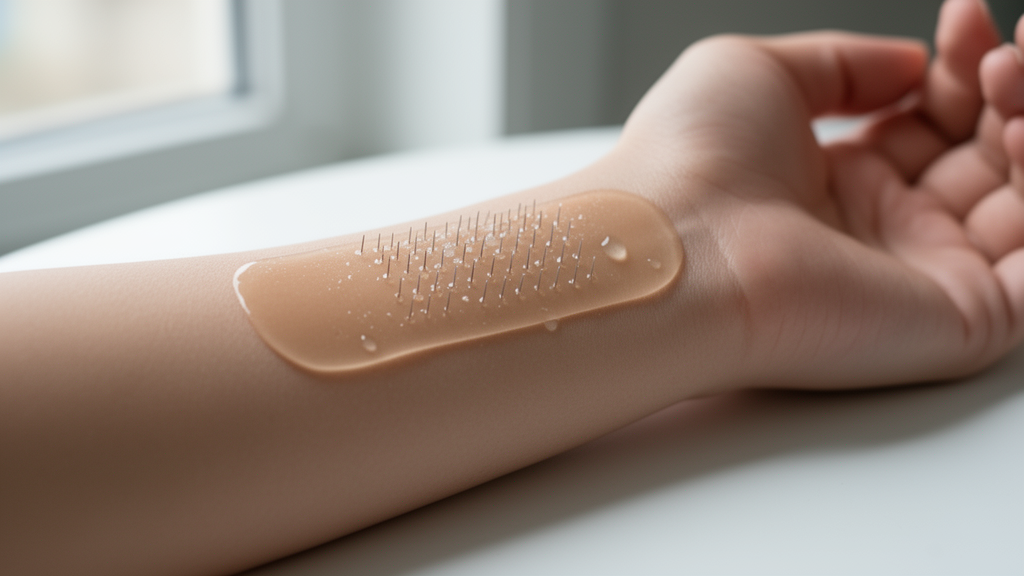
Continuous glucose monitoring has transformed diabetes management over the past two decades, but the sensors at the heart of every commercial device share a fundamental weakness: they depend on the enzyme glucose oxidase, a fragile biological catalyst that loses activity with heat, pH shifts, and time. Now a team at Wuhan Textile University, working with clinicians at Tongji Hospital, has unveiled a wrist-worn hollow microneedle platform that measures glucose in interstitial fluid without any enzyme at all, using an electrochemical trick to create the alkaline conditions its nonenzymatic catalyst needs right at the sensing interface. The work, published in Nature Communications, demonstrates rapid interstitial fluid extraction in rats and quasi-continuous monitoring, with preliminary feasibility shown in one human participant.
The central challenge the researchers confronted is a mismatch between chemistry and physiology. Nonenzymatic glucose sensors, which rely on direct electrocatalytic oxidation of glucose at metal electrodes, are attractive because they avoid the stability problems of enzymes. Yet many of the most effective nonenzymatic catalysts perform their glucose oxidation reaction optimally in alkaline media, while interstitial fluid — the fluid bathing the cells just beneath the skin — sits at a nearly neutral pH of around 7.4. Previous approaches either added alkaline solutions externally, which is impractical for a wearable device, or accepted degraded performance at physiological pH. The Wuhan team’s solution is elegant in its simplicity: rather than bringing alkaline chemistry to the electrode, they generate it electrochemically, in situ, exactly where and when it is needed.
The platform itself consists of two integrated modules. The first is a fluid-extraction module built around hollow microneedles that painlessly access interstitial fluid just below the skin surface. Negative pressure draws a small volume of this fluid into a detachable sensor cartridge, which serves a dual purpose: it physically separates the delicate tissue interface from the electrochemical sensing chamber, protecting the skin from direct electrode contact, and it enables the cartridge to be removed, rinsed, and reused — a regenerability that could dramatically extend device lifetime compared with single-use enzyme sensors.
The second module is where the electrochemical innovation lives. The sensing electrode is an Au–Pt/Ni foam composite, a three-dimensional porous structure that maximizes catalytic surface area. Before each glucose oxidation measurement, a brief cathodic pulse is applied to the electrode. This triggers the hydrogen evolution reaction — the same electrochemical process used in water electrolysis to produce hydrogen gas — which consumes protons at the electrode surface and generates hydroxide ions locally. The result is a thin, transient alkaline microenvironment at the electrode interface, created on demand, that provides the pH conditions the Au–Pt/Ni catalyst needs to efficiently oxidize glucose. Once the alkaline layer is established, the glucose oxidation reaction proceeds, and the resulting current provides a direct, enzyme-free readout of glucose concentration.
Crucially, the system is not simply a fixed sequence of steps. An integrated pH feedback mechanism regulates the hydrogen evolution and glucose oxidation stages, ensuring that the alkaline interface is generated only to the extent needed and that the sensing step occurs under optimal conditions. This closed-loop control — the same term borrowed from insulin-pump systems, though here referring to the sensing loop rather than drug delivery — prevents over-alkalinization that could damage tissue or interfere with measurements, and it allows the platform to adapt to varying extraction volumes and glucose concentrations. The researchers describe this as local microenvironment regulation: a strategy that decouples the pH requirements of the catalyst from the pH of the surrounding physiological fluid.
In vitro experiments validated the core electrochemistry, showing that the cathodic pre-treatment reliably generates the alkaline interface and that glucose oxidation currents scale with concentration under the created conditions. The team then moved to in vivo studies in rats, where the platform demonstrated rapid interstitial fluid extraction and quasi-continuous glucose monitoring — meaning repeated measurements over time rather than a single snapshot. The hollow microneedle approach, combined with negative-pressure extraction, proved capable of drawing sufficient fluid volumes quickly enough to support near-real-time tracking of glucose dynamics, a critical requirement for any device intended to compete with existing continuous glucose monitors that sample every few minutes.
A preliminary test in one human participant provided the first indication that the approach can translate across species. While the human data remain early-stage and the researchers are careful to characterize the result as feasibility rather than validation, the demonstration that the platform can extract interstitial fluid and generate reliable nonenzymatic glucose readings from a human wrist marks a meaningful step toward clinical translation. The wrist-worn form factor is particularly significant: it positions the device in the same anatomical territory as consumer smartwatches, potentially enabling integration with existing wearable ecosystems rather than requiring users to adopt an entirely new category of hardware.
The regenerability of the sensor cartridge deserves particular attention. Enzyme-based continuous glucose monitors typically require replacement every 7 to 14 days, both because glucose oxidase degrades and because fouling accumulates on the sensing membrane. The detachable cartridge design in the Wuhan platform allows the sensing chamber to be separated from the tissue interface, rinsed clean, and reused — addressing both the enzymatic stability problem and the fouling problem in a single architectural choice. If this regenerability proves durable over weeks or months of wear, it could substantially reduce the cost and waste associated with disposable sensor patches, a consideration that becomes increasingly important as continuous glucose monitoring expands beyond diabetes management into metabolic health tracking for general populations.
The broader significance of this work lies in its demonstration of a general strategy: rather than engineering catalysts to tolerate physiological conditions, the researchers engineered the local conditions to match the catalyst. This inversion of the usual design logic — creating the required microenvironment on demand through electrochemistry rather than searching for catalysts that work under ambient conditions — could extend beyond glucose sensing to other analytes whose detection depends on pH-sensitive electrocatalysis. The Au–Pt/Ni foam electrode itself represents a class of nonprecious-metal-rich composites that balance catalytic activity with the mechanical robustness needed for wearable applications.
Substantial hurdles remain before such a platform could reach patients. The human validation consists of a single participant; long-term biocompatibility of repeated microneedle insertion and negative-pressure extraction cycles needs systematic assessment; and the closed-loop pH regulation must prove robust across the wide range of skin properties, hydration states, and motion artifacts that real-world wear entails. Regulatory pathways for a device that generates local pH excursions at the tissue interface will require careful scrutiny. Nevertheless, the platform represents a conceptually fresh approach to one of the most persistent challenges in biosensing: reconciling the demands of high-performance electrocatalysis with the constraints of the living body. By generating its own alkaline microenvironment on demand, the Wuhan team’s wrist-worn system offers a glimpse of what enzyme-free, regenerable, quasi-continuous metabolic monitoring might look like — a technology that could, if the early results hold, reshape how millions of people track their glucose and, potentially, a much broader spectrum of biochemical signals.
Subject of Research: Regenerable, closed-loop, nonenzymatic continuous glucose monitoring enabled by in situ electrochemical interfacial alkalinization
Article Title: Regenerable, closed-loop, nonenzymatic continuous glucose monitoring enabled by in situ electrochemical interfacial alkalinization
Article References: Zeng, Q., Xia, L., Gong, J., Qin, J., Zhou, S., Fu, Z., Zhang, J., Lin, K., Zhang, C., Zhang, W., & Xu, W. (2026). Regenerable, closed-loop, nonenzymatic continuous glucose monitoring enabled by in situ electrochemical interfacial alkalinization. Nature Communications. https://doi.org/10.1038/s41467-026-78619-1
Image Credits: AI Generated
DOI: 10.1038/s41467-026-78619-1
Keywords: Regenerable, closed-loop, nonenzymatic, continuous, glucose, monitoring, enabled, situ, electrochemical, interfacial, alkalinization, scientific research
Cite Scienmag News
Ophelia Keating. (October 17, 2026). Wrist-Worn Microneedle Patch Creates Its Own Alkaline Microenvironment for Enzyme-Free Glucose Monitoring. Scienmag. https://scienmag.com/wrist-worn-microneedle-patch-creates-its-own-alkaline-microenvironment-for-enzyme-free-glucose-monitoring/
Ophelia Keating. "Wrist-Worn Microneedle Patch Creates Its Own Alkaline Microenvironment for Enzyme-Free Glucose Monitoring." Scienmag, 17 October 2026, https://scienmag.com/wrist-worn-microneedle-patch-creates-its-own-alkaline-microenvironment-for-enzyme-free-glucose-monitoring/. Accessed 17 October 2026.
Ophelia Keating. "Wrist-Worn Microneedle Patch Creates Its Own Alkaline Microenvironment for Enzyme-Free Glucose Monitoring." Scienmag. October 17, 2026. https://scienmag.com/wrist-worn-microneedle-patch-creates-its-own-alkaline-microenvironment-for-enzyme-free-glucose-monitoring/


