


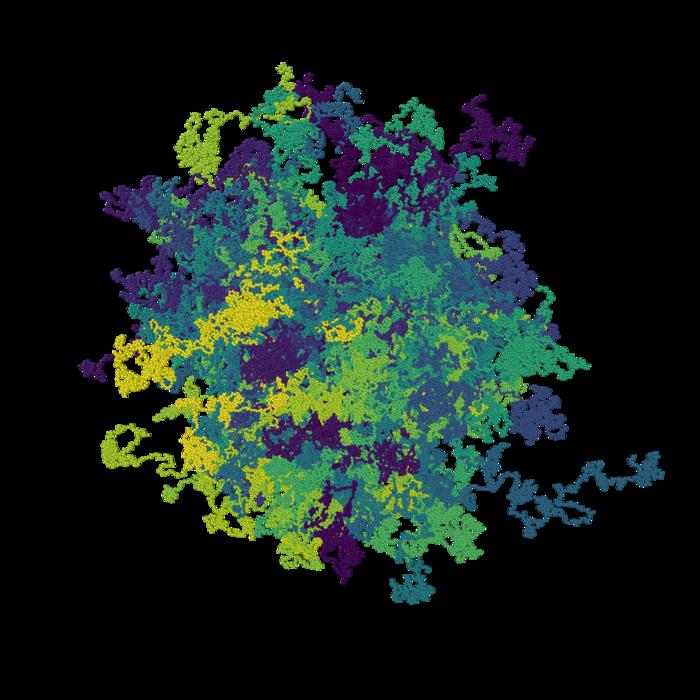
In a groundbreaking study recently published in Nature Communications, an international team of physicists from Heinrich Heine University Düsseldorf (HHU), together with collaborators from Darmstadt, Dresden, and the Max Planck Institute for the Physics of Complex Systems, has unveiled novel physical laws governing the behavior of active, self-propelled flexible polymer chains. These findings not only deepen our understanding of complex polymer dynamics but also offer compelling parallels to biological systems such as living clusters of worms and jellyfish tentacles, where active motion induces unexpected structural rigidity.
Polymers are long chains of repeating molecular units that, in their passive form, are well-studied within polymer physics. Traditionally, the complexity of entangled polymers has been characterized by the tube model. This model posits that each polymer chain moves within a virtual tube formed by neighboring chains, leading to constrained, snake-like diffusive motion known as reptation. In passive systems, the disentanglement time scales predictably with the length of the polymer, a relationship mathematically captured by universal scaling laws and their characteristic exponents. This foundational framework earned Pierre-Gilles de Gennes the Nobel Prize in Physics in 1991.
However, nature frequently deals with polymers that are not passive but active—chains composed of elements capable of self-propulsion and autonomous motion. Earthworm clusters and the writhing tentacles of the lion’s mane jellyfish offer vivid macroscopic examples where internal activity generates dynamic entanglement, conferring emergent rigidity and making unentanglement practically impossible. Similarly, robotic grippers mimicking these biological systems employ multiple synthetic flexible arms to grip objects by leveraging active entanglements. At even smaller scales, such active polymers are ubiquitous inside living cells, orchestrating a myriad of biological processes.
Until now, the influence of such intrinsic activity on the canonical tube model remained an open question. How does self-propulsion alter the fundamental scaling laws of entangled polymer systems? The research team addressed this challenge by deploying large-scale three-dimensional computer simulations that model clusters of flexible polymers endowed with active motion. Here, activity represents internally generated forces causing continuous, spontaneous motion of individual chains, distinct from thermal fluctuations alone.
The simulations revealed that active motion fundamentally modifies the long-standing universal scaling laws, producing an entirely different exponent governing the disentanglement times. Contrary to intuitive expectations that active movement would facilitate rapid disengagement, the researchers found that internal activity fosters robust new entanglements. These grip-like interactions amplify the effective stiffness of the entire collective, transforming what would otherwise be a fluidic polymer gel into a dynamically arrested, solid-like state.
This profound shift in behavior demanded a rethinking of the classical tube model. By introducing an augmented theoretical framework incorporating active forces and internal gripping, the researchers formulated a new tube model capable of accurately describing the emergent viscoelastic properties. This innovation bridges passive polymer physics with the active realm, illuminating how activity serves as a mechanism to self-entangle and freeze polymer assemblies in space and time.
Dr. Davide Breoni, lead author and former doctoral student under Professor Hartmut Löwen, remarked on the painstaking computational effort involved: preparing cluster simulations across a spectrum of polymer lengths required meticulous parameter tuning and immense computational resources. Nonetheless, this allowed precise numerical extraction of the modified scaling laws, conclusively demonstrating the systematic dependence of relaxation times on chain length under active conditions.
Further emphasizing the paradigm shift, Dr. Suvendu Mandel, a postdoctoral researcher involved in the project, noted that their findings overturn conventional assumptions. While activity is widely considered a facilitator of structural relaxation and enhanced dynamism, their results showcase that in certain soft matter systems, collective activity paradoxically enforces rigidity through persistent entanglement and mutual blockage.
Professor Löwen highlighted practical implications, envisioning the design of novel “smart materials” whose mechanical properties can be rapidly switched on demand by toggling internal activity. Such materials could revolutionize soft robotics, adaptive coatings, and bioengineered scaffolds, where controlling the transition between fluid-like flexibility and solid-like stiffness is paramount.
The study further connects to broader biological contexts, providing a theoretical basis for the mechanics of living systems composed of self-driven filaments, such as cytoskeletal networks and bacterial colonies. Understanding how activity induces mechanical rigidity may inform biomedical strategies aimed at manipulating tissue stiffness or combating biofilm formation.
From a theoretical standpoint, the new active tube model enriches the toolkit of polymer physicists by integrating nonequilibrium driving forces into a fundamentally equilibrium-based framework. This expansion challenges and extends decades of established knowledge, provoking renewed exploration into the physics of active soft matter.
Technologically, the insight into activity-induced stress plateaus opens pathways for engineering materials with tunable rheology. For example, soft gels that stiffen in response to biochemical triggers could find applications in drug delivery systems, responsive implants, and wearable electronics, marking a paradigm shift in material functionality.
As the team continues to investigate the interplay between polymer flexibility, activity strength, and entanglement topology, future studies will explore the transition thresholds between fluid, glassy, and solid-like regimes in active polymer solutions. These insights promise to further unravel the mysteries of living matter and its synthetic mimics.
In conclusion, this landmark research not only refines our understanding of polymer physics in active systems but also bridges fundamental science with tangible applications in materials science and biology. By demonstrating how active motion can paradoxically reinforce entanglement and solidity, it reshapes how scientists conceive dynamic assemblies, both in nature and the laboratory.
News Publication Date: 12 June 2025
Web References: DOI 10.1038/s41467-025-60210-9
References:
Breoni, D., Kurzthaler, C., Liebchen, B., Löwen, H., & Mandal, S. (2025). Giant Activity-Induced Stress Plateau in Entangled Polymer Solutions. Nature Communications, 16, 5305.
Keywords
Soft matter physics, active polymers, entanglement dynamics, active soft matter, living worm clusters, flexible polymer filaments, scaling laws, tube model, viscoelasticity, smart materials, biological polymers, polymer physics
Cite Scienmag News
Bethany Barker. (June 16, 2025). Wriggling Together: Exploring Movement Within Entangled Worm Clusters. Scienmag. https://scienmag.com/wriggling-together-exploring-movement-within-entangled-worm-clusters/
Bethany Barker. "Wriggling Together: Exploring Movement Within Entangled Worm Clusters." Scienmag, 16 June 2025, https://scienmag.com/wriggling-together-exploring-movement-within-entangled-worm-clusters/. Accessed 4 September 2026.
Bethany Barker. "Wriggling Together: Exploring Movement Within Entangled Worm Clusters." Scienmag. June 16, 2025. https://scienmag.com/wriggling-together-exploring-movement-within-entangled-worm-clusters/


