


Machine learning can now reconstruct the elemental composition of historical iron gall inks from nothing more than the conservation test papers that conservators already press against manuscripts. The approach, developed by researchers in Poland and Slovenia and published in Results in Chemistry, combines bathophenanthroline indicator papers with laser ablation inductively coupled plasma mass spectrometry and neural networks to recover chemical information from documents that must never be sampled directly. The work was tested on some of Poland’s most treasured manuscripts, including marginal notes written by Nicolaus Copernicus and the Constitution of 3 May 1791.
Iron gall ink dominated European writing for nearly a thousand years, and because scribes prepared it from individual recipes, its final chemical composition varied greatly. Iron serves as the key chemical marker of the ink, but the inks also carry a range of accompanying elements, including sulfur, aluminum, copper, zinc, manganese and lead, which may originate from metal salts, plant-derived tannins, gums or impurities in historical raw materials. These elemental relationships are more informative than absolute signal intensities alone, since inked areas are heterogeneous at the microscale due to uneven deposition, aging and migration.
The stakes are high because most historical inks were chemically unbalanced. Acid hydrolysis of cellulose, followed by Fenton reactions catalyzed by free Fe(II) ions, drives the degradation known as iron gall ink corrosion. A statistical investigation of manuscripts in the Central Archives of Historical Records in Warsaw found signs of corrosion of different degrees in nearly 85 percent of the archival units examined, and 95 percent of the examined inks contained Fe(II). Dealing with holdings that contain hundreds of thousands of archival units requires modern tools for analyzing ink composition data, and an efficient tool for identifying corrosion-prone inks is essential for prioritizing preservation.
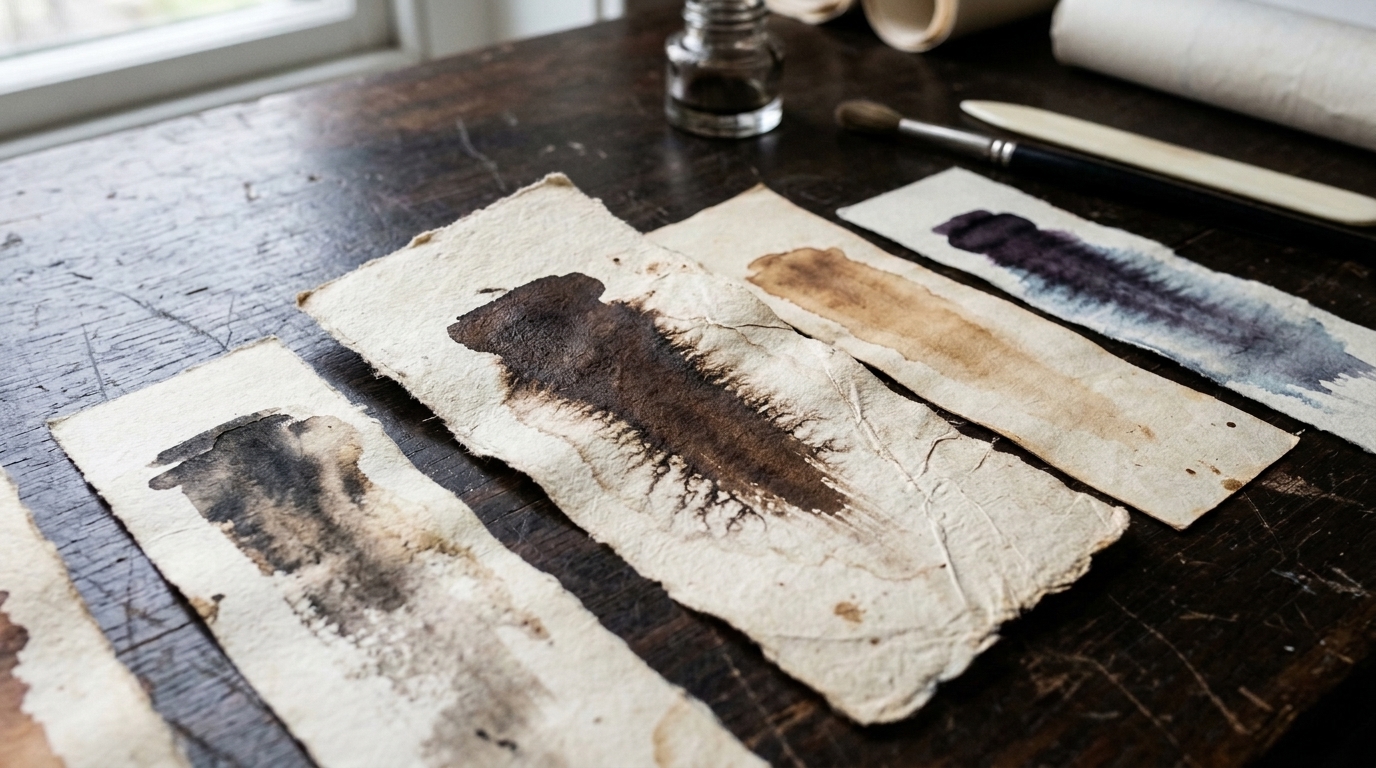
Conservation practice already relies on indicator papers soaked with bathophenanthroline, which allow colorimetric detection of Fe(II). When moistened and pressed against a letter for about 30 seconds, the indicator turns magenta if Fe(II) is present, a color reaction specific to that ion. Other elements in the ink also migrate to the indicator paper, even though they are not visually detected. Preliminary results had suggested these indicators could roughly approximate the overall composition of iron gall inks, and the team hypothesized that the relationship between the original ink and the chemically transferred signal preserved in the indicator could be quantitatively modeled.
To build the training data, the researchers used original fragments of archival manuscripts from the Central Archives of Historical Records in Warsaw, the Reference Material Collection of the Heritage Science Laboratory in Ljubljana and private collections. The materials came from European documents dated from the sixteenth century to the early twentieth century and represented different provenances, manufacturing traditions, ink compositions and states of preservation. Crucially, for all examples in the dataset it was possible both to use indicator papers and to collect a sample of the ink itself, because these particular documents were not strictly protected.
Each paired sample was analyzed with a 213 nm Nd:YAG laser coupled to a quadrupole ICP mass spectrometer, recording transient signals for 28 isotopes including carbon, sodium, magnesium, aluminum, silicon, phosphorus, sulfur, chlorine, potassium, calcium, manganese, iron, copper, zinc and lead. The data were processed as transient signal intensities in counts per second, without calibration against reference materials or conversion to absolute concentrations. Isotope intensities were recalculated according to natural isotopic abundances as a normalization step only, and the authors explicitly note that no classical concentration-based limits of detection or quantification were reported, since the strategy relies on relative multi-elemental signal relationships.
After blank subtraction, spike removal, normalization, ordering by decreasing iron signal, averaging into sets of nine measurements and logarithmic transformation, the dataset yielded 2,430 indicator-ink data points from 243 paired samples. The 10 data points from the same sample were kept together during the train-validation-test split to prevent information leakage. The lead model, a regression neural network named InksNet with two hidden layers of 23 and 92 neurons, was trained to reconstruct the amounts of 11 elements, including aluminum, sulfur, manganese, cobalt, copper, zinc, lead, iron, magnesium, sodium and potassium. Random Forest and XGBoost models were trained for comparison.
On a test set of 490 excluded data points, InksNet outperformed the other models, though its advantage over Random Forest was minor. One-sided paired Student’s t-tests across folds confirmed superiority over Random Forest (p=0.04) and XGBoost (p=0.03) in terms of mean absolute error. The network provided its most accurate results for copper, an important element in the context of susceptibility to ink corrosion, and tended to underestimate elemental amounts while the tree-based models overestimated them. The authors stress that the accuracy of prediction is limited and that the results remain preliminary due to the scarcity of the training data, so they do not prejudge the general superiority of either model.
The team then applied the trained models to strictly protected manuscripts where direct sampling is impossible: Copernicus’s marginalia in incunabula and early printed books from the Hosianum Higher Theological Seminary Library in Olsztyn, the three preserved handwritten original copies of the Constitution of 3 May 1791, and Merkuriusz polski, a seventeenth-century verse encyclopedia by Jakub Kazimierz Haur held at the University of Warsaw Library. For the constitution, visual inspection suggested iron gall ink with light brown, dark brown and black writings, but direct sampling is not possible due to the exceptional value of the objects.
A separate analysis compared reconstructed compositions of corroded and non-corroded samples, where corroded meant documents exhibiting visible perforation within inked areas. The corroded samples, though limited in number, showed some grouping in the reconstructed compositional space, associated with higher combined contributions of iron, copper and sulfur, consistent with current chemical understanding of iron gall ink deterioration, while samples enriched in sodium, potassium and magnesium showed less severe or no visible corrosion. Several visually intact samples, including one from Merkuriusz polski, occupied nearby compositional space or showed the same directional shift toward the iron-copper-sulfur-dominated regime. The authors caution that this should not be interpreted as evidence that these documents are necessarily at risk, because corrosion development depends on paper composition, ink penetration, local microenvironment and storage history, and whether such similarity predicts future deterioration would require substantially larger datasets and independent validation. The preprocessing and prediction workflow is available as a web application called tINKer, which the authors hope will support reproducibility and the gathering of additional training data.
Subject of Research: Machine-learning reconstruction of historical iron gall ink elemental composition from bathophenanthroline indicator papers analyzed by LA-ICP-MS
Article Title: Non-destructive recovery of historical ink chemistry using machine learning
Article References: Domżał, B., Towarek, A., Chlebowska, J., Goldstein, A., Żelazko, B., Jutrzenka-Supryn, D., Czuczko, J., Czajka, A., Fabiańska, A., Halicz, L., Gambin, A., & Wagner, B. (2026). Non-destructive recovery of historical ink chemistry using machine learning. Results in Chemistry, 32, Article 103985. https://doi.org/10.1016/j.rechem.2026.103985
Image Credits: AI Generated
DOI: 10.1016/j.rechem.2026.103985
Keywords: iron gall ink, machine learning, InksNet, LA-ICP-MS, bathophenanthroline, indicator paper, ink corrosion, Copernicus, Constitution of 3 May 1791, heritage science, conservation, elemental analysis
Cite Scienmag News
Bethany Barker. (November 5, 2026). Machine learning reads conservation test papers to reconstruct old ink chemistry. Scienmag. https://scienmag.com/machine-learning-reads-conservation-test-papers-to-reconstruct-old-ink-chemistry/
Bethany Barker. "Machine learning reads conservation test papers to reconstruct old ink chemistry." Scienmag, 5 November 2026, https://scienmag.com/machine-learning-reads-conservation-test-papers-to-reconstruct-old-ink-chemistry/. Accessed 22 November 2026.
Bethany Barker. "Machine learning reads conservation test papers to reconstruct old ink chemistry." Scienmag. November 5, 2026. https://scienmag.com/machine-learning-reads-conservation-test-papers-to-reconstruct-old-ink-chemistry/




