


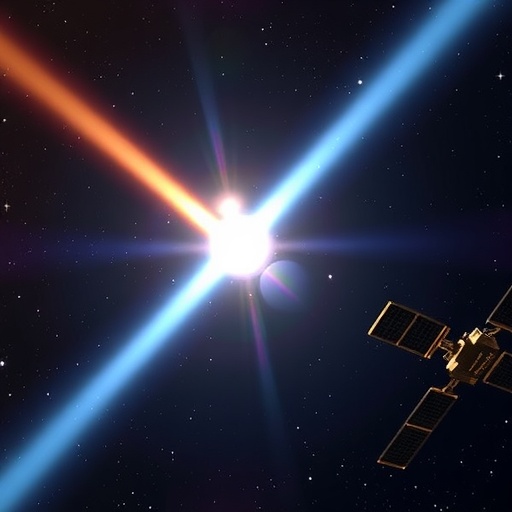
In a groundbreaking milestone for commercial space science, Mauve—the world’s first privately funded space science satellite—has successfully achieved its inaugural ‘first light,’ transmitting its initial batch of data back to Earth-based astronomers. This pivotal achievement marks the beginning of a transformative era in space observation, potentially revolutionizing how scientific data about the universe is acquired, analyzed, and disseminated. Developed by Blue Skies Space Ltd., a British space startup co-founded by scientists and alumni from King’s College London, Mauve represents a pioneering leap in the democratization and commercialization of space science.
The Mauve satellite was engineered to monitor stars across ultraviolet and visible wavelengths, focusing on detailed spectrophotometric analysis that probes the intricate mechanisms underlying stellar magnetic activity and flare phenomena. These stellar flares—sudden eruptions of energy on the surfaces of stars—play a vital role in shaping the environments of surrounding exoplanets, directly affecting their atmospheric composition and, by extension, their potential habitability. By systematically studying these energetic processes, Mauve aims to shed light on the delicate interplay between stellar dynamics and the conditions that might support life beyond our solar system.
At the heart of Mauve lies a compact 13-centimeter telescope equipped with a high-resolution spectrophotometer explicitly designed for ultraviolet (UV) light detection. This instrument captures the spectrum of electromagnetic radiation emitted by stars, allowing precise identification of the individual wavelengths and intensities of light they produce. Such spectral data are critical for understanding stellar composition, temperature, magnetic fields, and other fundamental physical characteristics. Through its capability to perform rapid integration over very short exposure times—such as the teasingly brief 5-second capture of Eta Ursae Majoris (Eta UMa)—Mauve promises unprecedented temporal resolution for monitoring dynamic stellar phenomena.
Eta UMa, a luminous hot star situated approximately 104 light-years away in the constellation Ursa Major, was chosen as Mauve’s initial calibration target. This B-type star emits intense ultraviolet radiation, making it an ideal candidate for validating the satellite’s spectrophotometric performance. The spectrum captured by Mauve was immediately compared with archival data from the Hubble Space Telescope’s Space Telescope Imaging Spectrograph (STIS), where Mauve’s single-capture spectrum, depicted in pink, aligns strikingly well with previous multi-exposure Hubble observations marked in blue. This congruence reaffirms the integrity of the newly acquired data and signals the satellite’s readiness to embark on more extended scientific investigations.
Beyond its initial success, Mauve aspires to conduct a multi-year mission during which it will experiment with a variety of astrophysical research objectives. Among these are investigations of planetary evolution in its nascent stages, an era critical to understanding how rocky planets develop atmospheres and conditions amenable to life. Furthermore, the satellite will explore binary star systems, leveraging their mutual gravitational interactions to test and refine existing theories of gravity. By continuously charting the life cycles of stars—from their energetic youth to their eventual demise—Mauve promises to provide unparalleled insights into stellar physics.
The democratizing vision behind Mauve was articulated by Blue Skies Space CEO and co-founder Dr. Marcell Tesseny, a King’s College London alumnus from the Department of Physics. He envisions a future where an interconnected fleet of compact, rapidly deployed satellites grants the global scientific community unmediated access to real-time space science data. This vision embodies a shift away from traditionally large, costly space observatories toward more agile, cost-effective platforms capable of frequent technology refresh and rapid response to emergent research opportunities.
Professor Giovanna Tinetti, Vice Dean (Research) in the Faculty of Natural, Mathematical and Engineering Sciences and co-founder of Blue Skies Space, expressed profound enthusiasm for the project’s initial success. She described the launch and first data as an emotional and scientific breakthrough alike, highlighting the unprecedented nature of Mauve as the world’s first private space science mission. This emotional milestone underlines the convergence of academic excellence with entrepreneurial innovation, a fusion that is rapidly reshaping the frontiers of space research.
Technically, the satellite’s ability to capture high-fidelity spectra using a small aperture telescope contrasts with the traditional reliance on massive observatories or instruments in Earth orbit. By utilizing advanced photometric sensors optimized for UV wavelengths—a region of the electromagnetic spectrum mostly blocked by Earth’s atmosphere—Mauve accesses data impossible to gather from terrestrial facilities. This capability opens new windows into phenomena such as stellar mass loss, chromospheric activity, and high-energy particle interactions.
Over the course of its projected three-year mission, Mauve will implement an observational programme responsive to the needs and priorities expressed by an engaged science community network. Researchers contributing to this program can request observations of target stars and systems to unlock answers to diverse astrophysical puzzles. This approach not only enhances scientific output but also fosters collaboration and data sharing, hallmarks of successful modern scientific endeavours.
The success of Mauve epitomizes the accelerating trend of commercial space ventures contributing essential infrastructure to global astrophysical research. By bypassing traditional funding and logistical bottlenecks, startups like Blue Skies Space are redefining what is achievable in space-based observation. This model promises to augment access to scientific information, accelerate discovery cycles, and reduce the cost barriers historically associated with space research.
The initial spectroscopic data signify just the beginning of Mauve’s scientific journey. Upcoming observations will include monitoring variable stars, mapping magnetic field fluctuations, and contributing to exoplanet atmospheric studies by characterizing stellar radiation environments. Each new dataset collected will deepen scientific understanding and refine models predicting stellar behavior and exoplanet habitability.
Taken together, Mauve’s launch and successful first light data herald a new epoch in space science—one where agile, cost-effective satellites complement large-scale missions to provide continuous, targeted exploration of the cosmos. As data continue to stream back to Earth, astronomers stand on the cusp of unprecedented discovery, enabled by the fusion of cutting-edge technology, entrepreneurial spirit, and academic excellence represented by Mauve and Blue Skies Space Ltd.
News Publication Date:
Not explicitly provided; satellite data acquired on 9 February 2026.
Web References:
Blue Skies Space Ltd.
References:
Not explicitly mentioned beyond institutional and observational data comparisons with Hubble Space Telescope STIS archives.
Cite Scienmag News
Grant Pearson. (February 27, 2026). World’s First Commercial Space Science Satellite Captures ‘First Light,’ Ushering in New Era for Astronomical Data and King’s Collaborations. Scienmag. https://scienmag.com/worlds-first-commercial-space-science-satellite-captures-first-light-ushering-in-new-era-for-astronomical-data-and-kings-collaborations/
Grant Pearson. "World’s First Commercial Space Science Satellite Captures ‘First Light,’ Ushering in New Era for Astronomical Data and King’s Collaborations." Scienmag, 27 February 2026, https://scienmag.com/worlds-first-commercial-space-science-satellite-captures-first-light-ushering-in-new-era-for-astronomical-data-and-kings-collaborations/. Accessed 4 September 2026.
Grant Pearson. "World’s First Commercial Space Science Satellite Captures ‘First Light,’ Ushering in New Era for Astronomical Data and King’s Collaborations." Scienmag. February 27, 2026. https://scienmag.com/worlds-first-commercial-space-science-satellite-captures-first-light-ushering-in-new-era-for-astronomical-data-and-kings-collaborations/


