


This study is led by Hui Shen, Keliang Zhao, Xinying Zhou, Xiaoqiang Li from the Institute of Vertebrate Paleontology and Paleoanthropology, Chinese Academy of Sciences, and Zhenwei Qiu from National Museum of China. The researchers have reconstructed how early millet farmers explored and shaped local woody plants, and the protection and management of Prunus fruit trees to acquire more food resources since 8000 yr BP.

Credit: ©Science China Press
This study is led by Hui Shen, Keliang Zhao, Xinying Zhou, Xiaoqiang Li from the Institute of Vertebrate Paleontology and Paleoanthropology, Chinese Academy of Sciences, and Zhenwei Qiu from National Museum of China. The researchers have reconstructed how early millet farmers explored and shaped local woody plants, and the protection and management of Prunus fruit trees to acquire more food resources since 8000 yr BP.
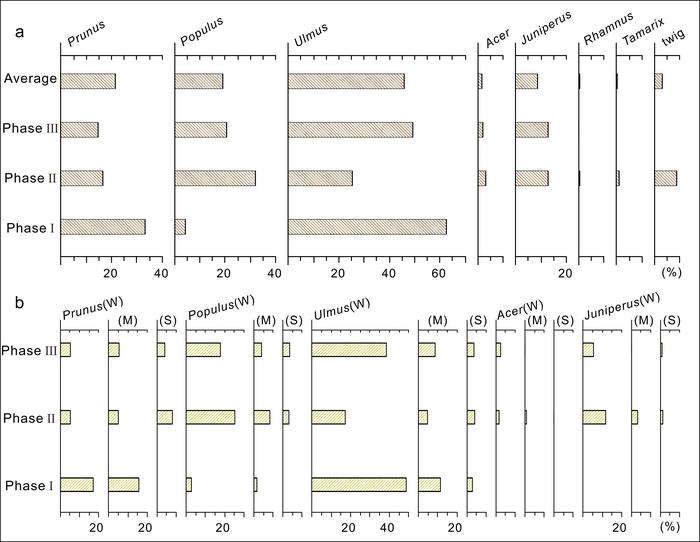
Wood charcoal identification at Xinglong revealed a variety of woody plants, including Prunus, Populus, Ulmus, Acer, Juniperus, Rhamnus, and Tamarix, showing the presence of large-scale woodland distributions around the site. The abundance of Prunus wood likely correlates with an importance of fleshy fruits at ancient Xinglong. On the basis of the habitats of identified plants, Xinglong people appear to have made full use of available wood resources, including riparian woodlands, shrubs on sunny slopes, and sparse forests in mountain valleys. Populus and Ulmus were the main sources of fuel. During 8000–7000 yr BP, the warm and humid climate promoted the emergence of Acer, Juniper, Tamarix, and Rhamnus plants, and the expansion of riparian Populus woodland, contributing to the increased harvesting of poplar woods.
The measurement of tree-ring curvature indicates that people mainly collected trunks or large branches of Ulmus, Populus, Acer, and Juniperus plants. Meanwhile, Xinglong people probably had mastered the knowledge of how to protect and manage Prunus woodlands via pruning and increasing the cutting of nonfruit trees to increase food supply, demonstrating the active response and adaptation of early millet cultivators to their environments.
See the article:
Shen H, Qiu Z, Zhao K, Zhou X, Li X. 2024. Wood use and forest management by Neolithic millet farmers at the Xinglong site, northern China.
Science China Earth Sciences, 67(6): 1910–1921,
Journal
Science China Earth Sciences
Cite Scienmag News
Violet Maxwell. (August 28, 2024). Wood charcoal reveals the existence of a variety of woody plants around early millet sites and people started pruning, protecting and managing Prunus fruit trees as early as 8000 yr BP. Scienmag. https://scienmag.com/wood-charcoal-reveals-the-existence-of-a-variety-of-woody-plants-around-early-millet-sites-and-people-started-pruning-protecting-and-managing-prunus-fruit-trees-as-early-as-8000-yr-bp/
Violet Maxwell. "Wood charcoal reveals the existence of a variety of woody plants around early millet sites and people started pruning, protecting and managing Prunus fruit trees as early as 8000 yr BP." Scienmag, 28 August 2024, https://scienmag.com/wood-charcoal-reveals-the-existence-of-a-variety-of-woody-plants-around-early-millet-sites-and-people-started-pruning-protecting-and-managing-prunus-fruit-trees-as-early-as-8000-yr-bp/. Accessed 3 September 2026.
Violet Maxwell. "Wood charcoal reveals the existence of a variety of woody plants around early millet sites and people started pruning, protecting and managing Prunus fruit trees as early as 8000 yr BP." Scienmag. August 28, 2024. https://scienmag.com/wood-charcoal-reveals-the-existence-of-a-variety-of-woody-plants-around-early-millet-sites-and-people-started-pruning-protecting-and-managing-prunus-fruit-trees-as-early-as-8000-yr-bp/

