


Pain is a necessary biological signal, but a variety of conditions can cause those signals to go awry. For people with chronic pain, the root is often faulty signals emerging deep within the brain, giving false alarms about a wound that has since healed, a limb that has since been amputated, or other intricate, hard-to-explain scenarios.

Credit: University of Utah
Pain is a necessary biological signal, but a variety of conditions can cause those signals to go awry. For people with chronic pain, the root is often faulty signals emerging deep within the brain, giving false alarms about a wound that has since healed, a limb that has since been amputated, or other intricate, hard-to-explain scenarios.
Patients with this kind of life-altering pain are constantly looking for new treatment options; now a new device from the University of Utah may represent a practical long-sought solution.
Researchers at the university’s John and Marcia Price College of Engineering and Spencer Fox Eccles School of Medicine have published promising findings about an experimental therapy that has given many participants relief after a single treatment session. They are now recruiting participants for a final round of trials.
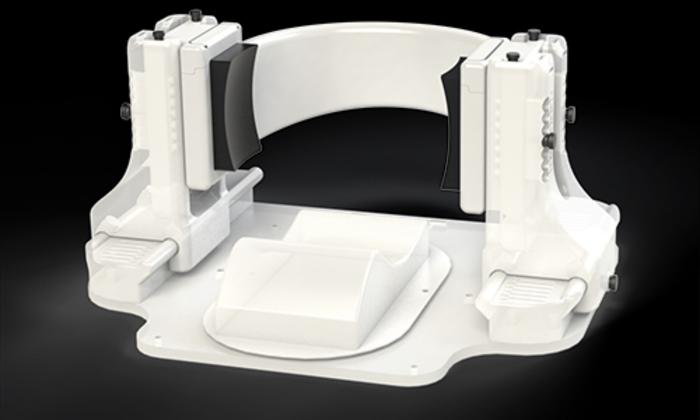
At the core of this research is Diadem, a new biomedical device that uses ultrasound to noninvasively stimulate deep brain regions, potentially disrupting the faulty signals that lead to chronic pain.
The findings from a recent clinical trial are published in the journal Pain. This study constitutes a translation of two previous studies, published in Nature Communications Engineering and IEEE Transactions on Biomedical Engineering, which describe the unique features and characteristics of the device and demonstrate its efficacy.
The study was conducted by Jan Kubanek, a professor in Price’s Department of Biomedical Engineering, and Thomas Riis, a postdoctoral researcher in his lab. They collaborated with Akiko Okifuji, professor of Anesthesiology in the School of Medicine, as well as Daniel Feldman, graduate student in the departments of Biomedical Engineering and Psychiatry, and laboratory technician Adam Losser.
The randomized sham-controlled study recruited 20 participants with chronic pain, who each experienced two 40-minute sessions with Diadem, receiving either real or sham ultrasound stimulation. Patients described their pain a day and a week after their sessions, with 60% of the experimental group receiving real treatment reporting a clinical meaningful reduction in symptoms at both points.
“We were not expecting such strong and immediate effects from only one treatment,” Riis said.
“The rapid onset of the pain symptom improvements as well as their sustained nature are intriguing, and open doors for applying these noninvasive treatments to the many patients who are resistant to current treatments,” Kubanek added.
Diadem’s approach is based on neuromodulation, a therapeutic technique that seeks to directly regulate the activity of certain brain circuits. Other neuromodulation approaches are based on electric currents and magnetic fields, but those methods cannot selectively reach the brain structure investigated in the researchers’ recent trial: the anterior cingulate cortex.
After an initial functional MRI scan to map the target region, the researchers adjusted Diadem’s ultrasound emitters to correct for the way the waves deflect off the skull and other brain structures. This procedure was published in Nature Communications Engineering.
The team is now preparing for a Phase 3 clinical trial, the final step before approval from the Food and Drug Administration to use Diadem as a treatment for the general public.
“If you or your relatives suffer from chronic pain that does not respond to treatments, please reach out to us; we need to recruit many participants so that these treatments can be approved for the general public,” Kubanek said. “With your help, we think chronic pain can be effectively silenced. And with new pain treatment options, we can tackle the opioid crisis, too.”
####
The study titled “Noninvasive targeted modulation of pain circuits with focused ultrasonic waves” was published July 30 in the journal Pain. Funding came from the National Institutes of Health and the University of Utah.
Journal
Pain
Method of Research
Randomized controlled/clinical trial
Subject of Research
People
Article Title
Noninvasive targeted modulation of pain circuits with focused ultrasonic waves
Article Publication Date
30-Jul-2024
COI Statement
J. Kubanek is an inventor on a patent related to the device function. The other authors have no conflict of interest to declare.
Cite Scienmag News
Denise Maddox. (August 28, 2024). Ultrasound devise shows promise for treating chronic pain. Scienmag. https://scienmag.com/ultrasound-devise-shows-promise-for-treating-chronic-pain/
Denise Maddox. "Ultrasound devise shows promise for treating chronic pain." Scienmag, 28 August 2024, https://scienmag.com/ultrasound-devise-shows-promise-for-treating-chronic-pain/. Accessed 3 September 2026.
Denise Maddox. "Ultrasound devise shows promise for treating chronic pain." Scienmag. August 28, 2024. https://scienmag.com/ultrasound-devise-shows-promise-for-treating-chronic-pain/

