


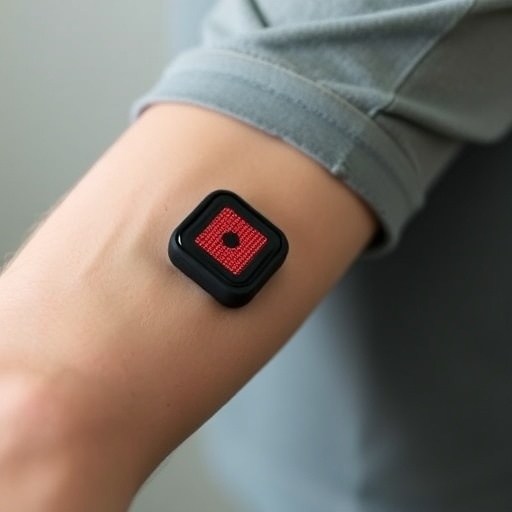
In a groundbreaking development poised to revolutionize personalized health monitoring, researchers have unveiled a wireless, battery-free, wearable sweat sensor capable of continuous, multimodal biochemical analysis in real-world conditions. This innovative device transcends traditional limitations of sweat sensing technology, offering a robust platform for long-term health monitoring that can operate reliably outside controlled laboratory environments. Central to this advance is a novel integration of molecularly imprinted polymers (MIPs), selected and optimized through advanced computational modeling, which allows the sensor to selectively and sensitively detect multiple biomarkers simultaneously in human sweat.
Wearable sweat sensors have long been hailed as a non-invasive method to track body chemistry, but their practical use has been hindered by several key challenges. Most devices have been unable to detect multiple molecular biomarkers concurrently, lacked the ability to regenerate sensing surfaces for continuous use, and suffered performance degradation under environmental stresses. These limitations have kept sweat sensing largely confined to controlled experimental settings. The newly reported device breaks this bottleneck by seamlessly combining multimodal molecular recognition, in situ regeneration functionality, and environmental robustness into a cohesive system.
The cornerstone of this technology lies in the use of synthetic molecularly imprinted polymers, which are engineered to bind target molecules with exceptional specificity. These polymers are custom-designed using density functional theory—a computational quantum mechanical modeling method—to optimize their affinity and selectivity for biomarkers such as cortisol, urea, lactate, and glucose within the complex biochemical milieu of sweat. This design paradigm enables the sensor to discern subtle molecular signatures amidst the noisy background of sweat components, a feat that conventional biosensors struggle to achieve.
A particularly transformative feature of this sweat sensor is its in situ regenerability, which maintains sensor performance over prolonged periods without manual intervention. Using an electrical potential applied directly to the molecularly imprinted polymer layers, the device facilitates the controlled elution of previously bound molecules. This voltage-induced desorption effectively “cleans” the sensor surface, restoring its ability to bind new target molecules continuously. This automated regeneration capability allows the sensor to perform uninterrupted monitoring for up to three weeks, a significant leap forward compared to existing technologies that typically require replacement or recalibration after a short period of use.
Integration with a wireless, battery-free electronics platform further elevates the sensor’s practicality for everyday use. The device can communicate data in real time to external receivers, enabling seamless health tracking without tethering the user to cumbersome hardware or frequent charging cycles. The elimination of batteries reduces device bulk and environmental impact, making it more comfortable and sustainable for long-term wear.
Remarkably, the sensor’s real-world validation includes extensive in situ testing, where volunteers wore the device continuously in various everyday settings. The sensor demonstrated stable and reliable detection performance over 21 days, maintaining consistent sensitivity and selectivity as individuals engaged in ordinary activities. This level of robustness against mechanical strain, temperature fluctuations, humidity changes, and sweat variability marks a milestone in wearable biosensing.
The ability to simultaneously monitor cortisol, a hormone linked to stress and circadian rhythms, alongside metabolic markers such as lactate, urea, and glucose, imbues this technology with broad applications. Continuous cortisol tracking can provide insights into mental health and stress management, while metabolic biomarkers offer real-time feedback on exercise intensity, hydration status, and glucose control for diabetic patients. This multimodal functionality enables a holistic view of an individual’s physiological state, potentially transforming both clinical diagnostics and personalized wellness guidance.
From a technical standpoint, the sensor architecture is carefully designed to optimize fluid sampling, molecular recognition, and data transmission. The molecularly imprinted polymer layers are integrated atop gold microelectrodes patterned on flexible substrates, allowing conformal skin contact and efficient sweat collection. The voltage switching regime used for regeneration is precisely controlled to avoid damaging the polymer matrix or electrodes, ensuring longevity. Additionally, encapsulation materials afford environmental protection against contaminants and mechanical wear while maintaining breathability for skin comfort.
The computational design methodology, leveraging density functional theory simulations, guided the selection of functional monomers and cross-linkers to maximize binding efficiency. This rational design approach circumvents the trial-and-error traditionally associated with molecular imprinting, resulting in high-performance binding sites tailored for each biomarker. Post-fabrication, rigorous characterization confirmed the expected binding kinetics and regeneration efficacy, correlating well with theoretical predictions.
Looking ahead, this wearable sweat sensor platform presents numerous promising avenues for further development. Scaling up the detection panel to include additional biomarkers linked to infectious diseases, electrolyte balance, or drug metabolism could enable comprehensive health monitoring suites. Coupling sensor data with machine learning algorithms may allow predictive analytics, early disease detection, or personalized intervention recommendations. Moreover, incorporation into ergonomic form factors such as wristbands, patches, or textiles could facilitate user adoption, especially for populations requiring constant monitoring.
The implications of this technology extend beyond healthcare into sports performance and lifestyle management domains. Athletes could leverage real-time lactate and urea data to optimize training regimens and recovery, while individuals could monitor glucose fluctuations to tailor diet and activity. The device’s all-day comfort and autonomy open the possibility for continuous monitoring throughout daily routines, providing unprecedented granularity of physiological data streams.
In sum, the introduction of a wireless, battery-free, regenerable multimodal sweat sensor signifies a paradigm shift in bioelectronic wearable technology. By overcoming enduring challenges through molecular engineering, electrochemical regeneration, and system integration, the researchers have charted a path toward practical, long-term continuous health monitoring in unconstrained real-world settings. This advancement not only enhances capabilities for monitoring critical biomarkers but also establishes a versatile platform adaptable to future biomolecular sensing needs.
The confluence of computational polymer design, innovative electrochemical engineering, and flexible electronics design exemplified in this project highlights the transformative potential of interdisciplinary approaches in biomedical device innovation. As sensor technologies evolve to become fully autonomous, durable, and multidimensional, personalized health monitoring can move from episodic clinical snapshots to continuous dynamic portraits, empowering individuals and healthcare providers alike.
This novel wearable sweat sensor technology hence marks a significant step toward democratizing access to molecular health insights with unprecedented depth and temporal resolution. Its successful validation in everyday settings assures readiness for translation into broad clinical trials and consumer deployment. As such, it paves the way for a future where continuous chemical monitoring is seamlessly embedded into daily life, facilitating proactive health management and improved outcomes.
The pioneering work presented here stands as a testament to the rapidly advancing frontier of bioelectronic sensors and adaptive biomaterials, heralding a new era in wearable health technology capable of directly interfacing with the body’s molecular signals in situ, continuously and autonomously.
Cite Scienmag News
Ophelia Keating. (May 13, 2026). Wireless Wearable Sweat Sensor Enables Continuous Biomarker Monitoring. Scienmag. https://scienmag.com/wireless-wearable-sweat-sensor-enables-continuous-biomarker-monitoring/
Ophelia Keating. "Wireless Wearable Sweat Sensor Enables Continuous Biomarker Monitoring." Scienmag, 13 May 2026, https://scienmag.com/wireless-wearable-sweat-sensor-enables-continuous-biomarker-monitoring/. Accessed 4 September 2026.
Ophelia Keating. "Wireless Wearable Sweat Sensor Enables Continuous Biomarker Monitoring." Scienmag. May 13, 2026. https://scienmag.com/wireless-wearable-sweat-sensor-enables-continuous-biomarker-monitoring/


