


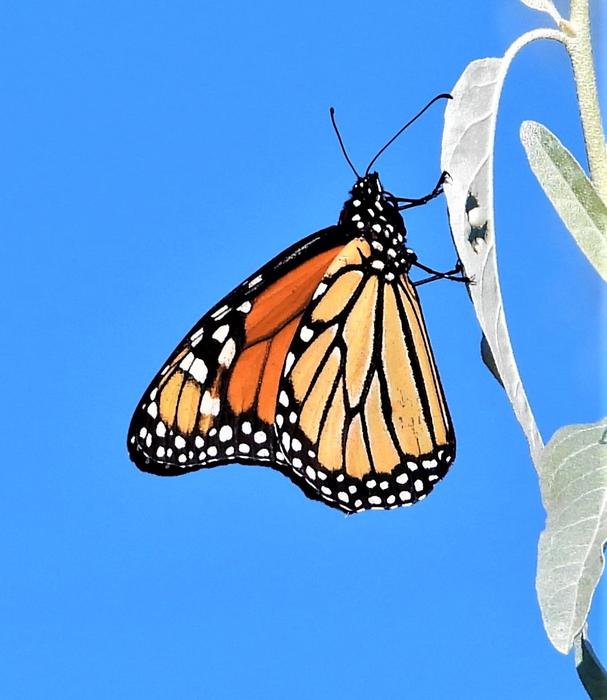
PULLMAN, Wash. — Monarch butterflies in Northern California are adapting to a changing climate by embracing an unexpected strategy: breeding in the winter. The shift could be key to the survival of the iconic insect, according to a new study published in the Journal of the Lepidopterists’ Society.

Credit: David James/WSU
PULLMAN, Wash. — Monarch butterflies in Northern California are adapting to a changing climate by embracing an unexpected strategy: breeding in the winter. The shift could be key to the survival of the iconic insect, according to a new study published in the Journal of the Lepidopterists’ Society.
The research, led by David James, an associate professor of entomology at Washington State University, revealed that monarch pupae that developed at an urban site in the San Francisco Bay Area during the winter of 2021/2022 had a survival rate of around 50%. This finding builds on a previous study that first documented winter breeding by monarchs in the region during the winter of 2020/2021, likely driven by climate warming.
“We are witnessing monarchs evolving and adapting to new environmental circumstances,” said James. “We can learn a lot from what they are doing, and this will inform our strategies for providing the resources they need to be successful.”
Over the past five years, overwintering populations of monarchs on the California coast have seen dramatic fluctuations, plummeting from 192,624 in 2017 to a historic low of just 1,899 in 2020, before rebounding to 247,246 and 335,479 butterflies in 2021 and 2022, respectively. Concurrently, there has been a substantial increase in winter-breeding monarchs that feed on non-native milkweeds in the urban Bay Area. The study by James and his team is the first to estimate the viability of monarch pupae during winter.
For the analysis, Maria Schaefer, a citizen scientist who has worked with James since 2020, monitored more than 100 wild monarch pupae at the Googleplex campus near Palo Alto during the winter of 2021/2022. Despite some losses due to landscaping activities, the study found a 49.4% success rate in pupal eclosion, which is the process of emerging as an adult butterfly. Furthermore, the researchers found that pupae can survive and produce adults for up to seven weeks in the winter compared to just 10 days during the summer.
“Given that winter is a sub-optimal environment for breeding, these results are promising,” James said.
The study also explored using exuviae, the shed-skin of the pupae, to detect the presence of the parasite Ophryocystis elektroscirrha. The analysis suggested that around 70% of the winter breeding population was likely infected with the parasite, highlighting the need for further research into its impact and that of other stressors on western monarch populations under natural conditions.
The rise of winter-breeding monarchs signals a potential adaptation to warmer winters and offers an alternative to the traditional overwintering of non-breeding butterflies at sites in places like Pacific Grove, Santa Cruz and Pismo Beach. To support this new behavior, conservation practices may need adjustment, James noted. For example, the timing of pruning the monarch’s major source of food in the area, non-native milkweed, currently done in early winter, could be shifted to late summer to support healthier winter-breeding populations.
“Currently, conservation guidelines dictate that ornamental milkweeds, the ones that winter-breeding monarchs primarily use, should be cut down during winter to minimize parasite infection,” James said. “This is clearly bad for winter-breeding. We suggest that these guidelines should be modified to have milkweed cut back during late summer instead of late fall which should still minimize parasite infection while ensuring availability of plants for monarch winter-breeding.”
Looking ahead, James and Schaefer will continue to monitor winter breeding monarch populations in the south Bay Area to gather more data. Their hope is that these monarchs will play an important role in ensuring the sustainability of the nation’s western monarch population.
Journal
Journal of the Lepidopterists’ Society
Article Title
Viability of Monarch Butterfly (Danaus plexippus) (Lepidoptera: Nymphalidae) Pupae during Winter in the South Bay Area of San Francisco, California, USA
Article Publication Date
4-Jun-2024
Cite Scienmag News
Sloane Callahan. (July 29, 2024). Winter breeding offers lifeline for monarch butterflies in Northern California. Scienmag. https://scienmag.com/winter-breeding-offers-lifeline-for-monarch-butterflies-in-northern-california/
Sloane Callahan. "Winter breeding offers lifeline for monarch butterflies in Northern California." Scienmag, 29 July 2024, https://scienmag.com/winter-breeding-offers-lifeline-for-monarch-butterflies-in-northern-california/. Accessed 5 September 2026.
Sloane Callahan. "Winter breeding offers lifeline for monarch butterflies in Northern California." Scienmag. July 29, 2024. https://scienmag.com/winter-breeding-offers-lifeline-for-monarch-butterflies-in-northern-california/

