


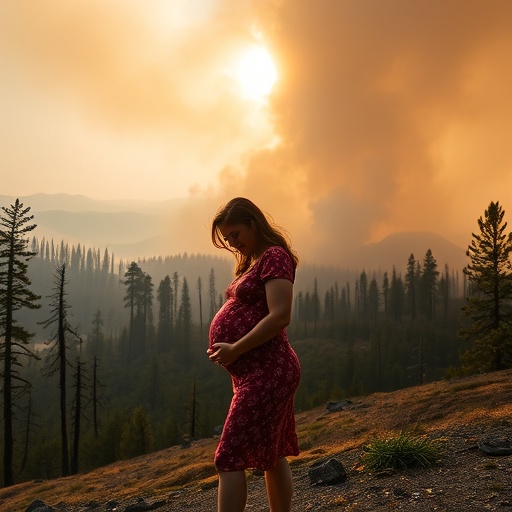
Wildfire smoke has become an increasingly important source of prenatal air pollution in the United States, even as overall exposure to fine particulate matter has declined. A new study published in Frontiers in Environmental Health has examined this changing pattern across the country, analyzing how exposure to PM₂.₅ during pregnancy varied between 2003 and 2019 and identifying the growing role of wildfire emissions in shaping pollution levels. The researchers found that improvements in air quality have substantially reduced average prenatal PM₂.₅ exposure, but that wildfire smoke is eroding part of this progress and is now responsible for most high-pollution days experienced during pregnancy.
The study analyzed approximately 64.5 million pregnancies across 2,842 counties in 48 states. Researchers combined pollution modeling with demographic information, including maternal ethnicity, county income, urban or rural residence, and access to maternity care. Their goal was to measure not only how much PM₂.₅ pregnant people encountered, but also who was most likely to experience pollution linked specifically to wildfires. This population-based approach allowed the team to move beyond maps showing where fires occurred and instead estimate how smoke affected communities and pregnancies across the contiguous United States.
PM₂.₅ refers to airborne particles with a diameter of 2.5 micrometers or smaller. Because these particles are tiny enough to penetrate deep into the lungs and enter the bloodstream, they can affect organs far beyond the respiratory system. During pregnancy, exposure has been associated with outcomes such as low birth weight and preterm birth. The researchers noted that particles generated by fires may be more harmful than the same mass of PM₂.₅ from some other sources because wildfire smoke contains a complex mixture of combustion products, including organic compounds, metals, and other reactive substances.
To separate wildfire pollution from other sources, the team conducted two computer-modeling runs. The first simulated total PM₂.₅ concentrations from human and natural sources, including vehicles, industrial activity, and fires. The second removed all fire-related emissions from the calculation. By comparing the results, the researchers estimated the portion of prenatal PM₂.₅ exposure attributable to wildfires. They also counted the number of days on which modeled concentrations exceeded 35 micrograms per cubic meter, the threshold used by the US Environmental Protection Agency to identify unhealthy daily particle pollution levels.
Across the study period, average daily prenatal exposure to PM₂.₅ from all sources fell by approximately 34%. This decline reflects the impact of cleaner vehicles, industrial controls, reduced emissions from power generation, and other air-quality policies implemented over recent decades. However, when wildfire-related pollution was excluded, the decrease was larger, at about 37%. The difference indicates that smoke from wildfires offset part of the improvement achieved through emissions regulation. In other words, air pollution would have declined more sharply if wildfire contributions had remained constant or diminished rather than increasing.
Wildfires’ share of total prenatal PM₂.₅ exposure more than doubled during the 17-year period, rising from approximately 3.7% in 2003 to 8.2% in 2019. The change was even more consequential when researchers examined unhealthy pollution days rather than average exposure. By the end of the study period, around 65% of prenatal PM₂.₅ exceedance days could be attributed to wildfire smoke. This does not mean that wildfire smoke accounted for 65% of all particle exposure, but it shows that fires increasingly determined when pollution reached levels considered unhealthy.
The increase was particularly pronounced in regions already vulnerable to severe fire seasons. In the northwestern United States, wildfire contributions to prenatal PM₂.₅ rose from 5.1% to 13.3%. Across western states, the proportion increased from roughly 3.7% to 9.7%. The burden was not distributed evenly within these regions. The highest wildfire-related exposures were recorded among low-income communities, rural populations, American Indian and Alaska Native communities, and areas facing shortages of maternity-care services. These overlapping vulnerabilities may limit residents’ ability to avoid smoke, obtain timely medical guidance, or use protective measures such as high-efficiency air filtration.
The researchers emphasized that the findings do not diminish the value of air-quality regulations. The reductions achieved through legislation and pollution-control programs have protected millions of pregnant people and developing fetuses, and current exposure levels would be considerably higher without those measures. Instead, the results suggest that wildfire smoke is becoming a major obstacle to continued progress. As climate conditions contribute to hotter, drier landscapes and longer fire seasons in many regions, smoke can travel hundreds or even thousands of kilometers, exposing communities far from the flames themselves.
Several major smoke events occurred after the study ended, including the extensive western US fires of 2020 and the Canadian wildfire outbreaks of 2023, which sent hazardous smoke across large parts of the eastern United States. The study cannot determine whether wildfire pollution continued to rise after 2019, but the researchers said it is plausible that the proportion of unhealthy prenatal exposure days caused by wildfire smoke has increased. They also acknowledged limitations, including the inability to track whether people moved between counties during pregnancy or whether they reduced exposure with masks, indoor air cleaners, or temporary relocation. Nevertheless, the study provides a detailed national picture of an emerging public-health challenge and offers evidence that wildfire preparedness, air-quality alerts, and targeted maternal-health resources should be directed toward the communities carrying the greatest burden.
News Publication Date: 7-Aug-2026
Web References: https://doi.org/10.3389/fenvh.2026.1838836
References: Liang M et al., “Wildfire Contributions to Prenatal PM₂.₅ Exposure in the Contiguous United States, 2003–2019,” Frontiers in Environmental Health, DOI: 10.3389/fenvh.2026.1838836
Cite Scienmag News
Harold Sullivan. (August 7, 2026). Wildfires now lead unhealthy air pollution exposure among pregnant women in US. Scienmag. https://scienmag.com/wildfires-now-lead-unhealthy-air-pollution-exposure-among-pregnant-women-in-us/
Harold Sullivan. "Wildfires now lead unhealthy air pollution exposure among pregnant women in US." Scienmag, 7 August 2026, https://scienmag.com/wildfires-now-lead-unhealthy-air-pollution-exposure-among-pregnant-women-in-us/. Accessed 4 September 2026.
Harold Sullivan. "Wildfires now lead unhealthy air pollution exposure among pregnant women in US." Scienmag. August 7, 2026. https://scienmag.com/wildfires-now-lead-unhealthy-air-pollution-exposure-among-pregnant-women-in-us/


