


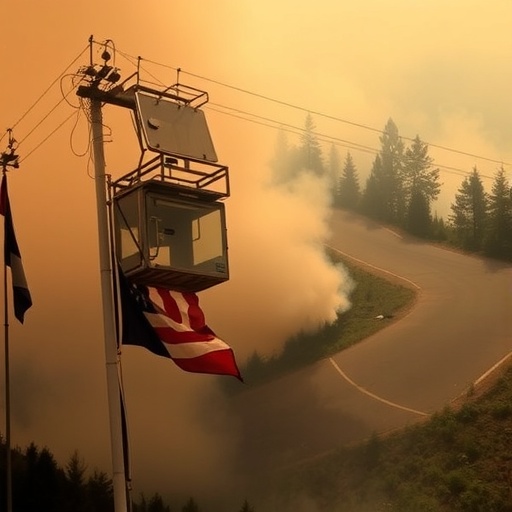
In recent years, the increasing frequency and intensity of wildland fires have captured global attention, not only due to their immediate destructive capacity but also their insidious effects on public health. A groundbreaking study published in the Journal of Exposure Science and Environmental Epidemiology sheds light on a previously under-explored dimension of wildland fire smoke: its potential impact on birth defects. Conducted in California, a state often besieged by devastating wildfires, this research integrates advanced environmental exposure modeling with comprehensive birth defect surveillance, signaling a pivotal advancement in environmental epidemiology.
Wildland fires unleash vast quantities of smoke containing a complex mixture of particulate matter, gases, and myriad chemical compounds. Among them, fine particulate matter (PM2.5) stands out for its ability to penetrate deep into the respiratory tract and enter systemic circulation. The study by Padula et al. meticulously quantifies prenatal exposure to wildland fire smoke and rigorously evaluates its association with a spectrum of congenital anomalies. By doing so, it addresses critical gaps in our understanding of how environmental insults during pivotal stages of embryogenesis may influence fetal development.
The researchers employed a sophisticated exposure assessment framework combining satellite-derived aerosol optical depth data, ground-based air quality measurements, and state-of-the-art spatiotemporal modeling. This multipronged methodology allowed them to generate high-resolution exposure estimates for pregnant individuals residing in California over a multi-year period. The precision offered by this approach is vital to disentangle the nuanced relationship between wildfire smoke exposure and birth outcomes, particularly insofar as these effects manifest during narrow developmental windows.
The study’s findings provoke profound concern. Elevated exposure to wildfire-derived PM2.5 during the first trimester was significantly correlated with increased risks of major structural birth defects, including cardiac malformations, orofacial clefts, and neural tube defects. These congenital anomalies represent a heterogeneous group of conditions that impose lifelong morbidity and mortality. This association underscores the pernicious nature of wildfire smoke, extending its threat well beyond respiratory and cardiovascular morbidity to encompass the most vulnerable stages of human development.
What sets this investigation apart is its meticulous control for confounding variables, such as maternal age, socioeconomic status, preexisting health conditions, and concurrent urban pollution exposures. By disentangling wildfire smoke from other sources of air pollution, the study elucidates the unique teratogenic potential intrinsic to wildland fire emissions. This methodological rigor enhances confidence in the causal inferences drawn, compelling public health authorities to recognize wildfire smoke as a modifiable environmental risk factor for adverse reproductive outcomes.
Furthermore, the article explores dose-response relationships, revealing that higher levels of smoke exposure portend greater risks. This gradient effect suggests a mechanistic link wherein the inhalation of toxicants triggers oxidative stress, inflammation, and epigenetic modifications that compromise normal embryonic morphogenesis. The complex interplay between environmental insults and genetic susceptibilities may further potentiate these outcomes, pointing to avenues for future molecular investigations.
Importantly, the research also situates its findings within a climate change framework. As global warming intensifies, the prevalence and scale of wildland fires have surged, expanding the geographic footprint of smoke exposure. Consequently, the burden of birth defects attributable to such environmental factors may escalate unless proactive mitigation and adaptation strategies are deployed. This temporal linkage amplifies the urgency for policymakers to integrate reproductive health considerations into wildfire management and air quality regulations.
The study’s data sources include California’s robust birth defect registry, which captures detailed phenotypic information validated by clinical review. The integration of this epidemiological dataset with high-fidelity exposure metrics underscores the power of combining environmental monitoring with health surveillance to unravel complex exposure-disease relationships. This interdisciplinary synergy exemplifies the cutting edge of exposomics research—a field dedicated to comprehensively characterizing environmental determinants of health across the lifespan.
Moreover, the investigators highlight disparities in exposure and outcomes, noting that socioeconomically disadvantaged communities and those with limited access to healthcare resources bear a disproportionate burden. This environmental justice dimension demands concerted efforts to ensure equitable protection and to tailor interventions that address the social determinants exacerbating vulnerability to wildfire smoke.
The ramifications of these findings extend beyond California, as regions across the globe confront escalating wildfire activity and concomitant air pollution episodes. Internationally, the implications for prenatal care protocols, public health advisories, and health system preparedness are profound. Heightened awareness and surveillance for pregnancies at risk could substantially mitigate morbidities associated with environmentally linked birth defects.
In detailing the chemical composition of wildland fire smoke, the study specifies that the mix includes polycyclic aromatic hydrocarbons, volatile organic compounds, and heavy metals—all of which possess known mutagenic and teratogenic properties. Understanding the toxicological pathways through which these compounds impact embryogenesis is essential for devising targeted prevention and remediation strategies.
Technological advancements, such as personal air quality monitors and biomarker assays, offer promising tools to refine exposure assessment further. The authors advocate for future longitudinal cohort studies integrating biospecimen analyses with environmental data to delineate mechanistic pathways at molecular levels. Such research will unravel the gene-environment interactions underlying susceptibility and inform precision medicine approaches tailored to environmental exposures.
Finally, the study calls for interdisciplinary collaborations between environmental scientists, epidemiologists, clinicians, and policymakers. Only through such integrated efforts can society develop holistic frameworks to confront the multifaceted health challenges posed by climate-driven disasters. Protecting maternal and fetal health in an era of escalating ecological disruptions will necessitate innovative science paired with forward-thinking public health strategies.
Padula and colleagues’ seminal work poignantly illustrates that the repercussions of wildland fires extend beyond immediate physical destruction and respiratory morbidity, penetrating to the sanctity of human development itself. As wildfires blaze with increasing ferocity fueled by a warming planet, the urgency to address these hidden reproductive hazards becomes ever more paramount. The intersection of environmental science and reproductive epidemiology illuminated by this study heralds a critical frontier in safeguarding future generations from the toxic legacy of smoke inhalation.
Cite Scienmag News
Russell Cooper. (April 15, 2026). Wildfire Smoke Linked to California Birth Defects. Scienmag. https://scienmag.com/wildfire-smoke-linked-to-california-birth-defects/
Russell Cooper. "Wildfire Smoke Linked to California Birth Defects." Scienmag, 15 April 2026, https://scienmag.com/wildfire-smoke-linked-to-california-birth-defects/. Accessed 5 September 2026.
Russell Cooper. "Wildfire Smoke Linked to California Birth Defects." Scienmag. April 15, 2026. https://scienmag.com/wildfire-smoke-linked-to-california-birth-defects/


