


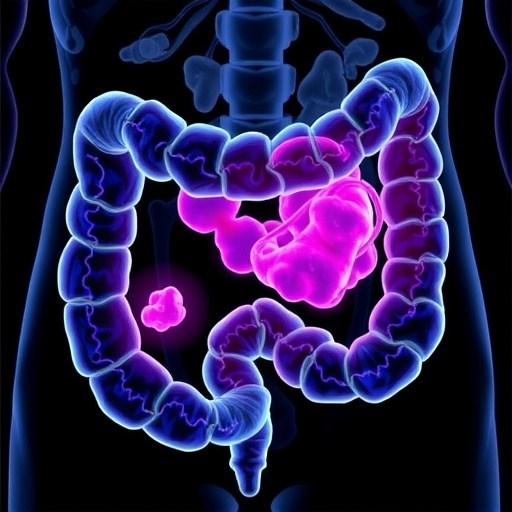
In a groundbreaking study published in Nature, researchers have unveiled the early cellular dynamics that underlie the emergence of malignancy in colorectal cancer (CRC). By leveraging advanced single-cell spatial transcriptomics, the team has precisely dissected the timeline and cellular origins of cancer-associated fibroblasts (CAFs) and oncofetal tumor cell states that coincide with the initial invasive stages of CRC. This intricate molecular mapping reveals that the transition from normal tissue to invasive cancer involves a complex interplay of both epithelial and stromal cell plasticity, challenging previous notions about tumor microenvironment formation and progression.
The study centers on 11 early-stage CRC specimens, encompassing critical timepoints before and after malignant transformation. These include intramucosal carcinomas, which represent lesions before invasive front formation, and two sequential invasive stages designated T1 sm1 and T1 sm3. Together, these samples allowed the authors to capture the earliest moments of malignancy with near single-cell resolution, analyzing a staggering 1.25 million cells across more than 6,000 gene probes. This wealth of data provided unprecedented insight into cellular populations that emerge concomitantly with tumor invasion.
Detailed transcriptomic analyses revealed that LAMC2-positive oncofetal tumor cells—an indication of reactivated fetal-like plasticity—and FAP-positive cancer-associated fibroblasts are absent at the intramucosal stage but begin to emerge immediately following malignant transformation. The progression from T1 sm1 to T1 sm3 shows a marked increase in these populations, positioning them at the invasive tumor front where they potentially orchestrate cancer progression. These observations were corroborated using immunofluorescence staining, reinforcing the spatial and temporal specificity of these key cell states near the muscularis mucosae.
A notable finding is the appearance of trophocyte-like CAFs, which first become evident following malignant transformation. Unlike their tissue-resident counterparts found solely in intramucosal carcinomas, these CAFs exhibit features strongly reminiscent of submucosal trophocytes yet are functionally distinct, illustrating a dynamic cellular reprogramming event induced by the evolving tumor microenvironment. These early CAF populations are characterized by differential expression profiles, including an MMP-negative cluster found earlier and an MMP-positive cluster emerging at more advanced invasive stages.
Spatial analyses further illuminated that these CAFs preferentially reside in close proximity to oncofetal tumor cells, suggesting a reciprocal, possibly synergistic relationship. This spatial co-localization coincides with locally elevated signaling pathways, particularly TGFβ and prostaglandins, both of which are well-known mediators of stromal activation and tumor progression. Such conserved signaling amplifications not only reinforce the functional engagement between CAFs and tumor cells but might also serve as critical therapeutic targets for interrupting early invasion.
Exploring the potential cellular origins of CAFs, the researchers noted abundant intermediate states between tissue-resident trophocytes and trophocyte-like CAFs, indicative of cellular transitioning rather than de novo recruitment or transformation from unrelated fibroblast lineages. This ontogenetic trajectory was further substantiated by integrating multiple existing single-cell RNA-sequencing datasets from over 100 CRC patients. Trajectory inference tools consistently pinpointed submucosal trophocytes as possessing the highest differentiation potential, validating their candidacy as progenitors of CAF populations in CRC.
The integrated analyses revealed that the diversity of fibroblast subtypes persists throughout CRC progression, from early-stage lesions through to advanced disease. While the proportional contributions of these subtypes shift—particularly an increase in CAF subsets during progression—the underlying fibroblast landscape remains phenotypically consistent, emphasizing a conserved pathogenic mechanism possibly exploitable across disease stages.
Crucially, this study positions the dissolution of the muscularis mucosae as a pivotal anatomical and functional event coinciding with the emergence of oncofetal plasticity in tumor cells. The authors postulate that this soft tissue barrier’s breakdown facilitates the infiltration and activation of stromal cells, thereby accelerating the reprogramming of both epithelial and mesenchymal compartments. This concerted plasticity potentially equips emerging tumor clones with proliferative, migratory, and immunomodulatory capabilities essential for successful invasion.
The implications of these findings are profound, as they shift the paradigm of CRC progression from a cancer cell-centric view toward a more integrated perspective that highlights early stromal-tumor crosstalk. Understanding the origin and evolution of CAFs opens new avenues for therapeutic intervention targeting the tumor microenvironment at its inception rather than in established, advanced tumors where stromal components become resistant or irreversibly altered.
Moreover, the identification of oncofetal tumor cells expressing embryonic markers such as LAMC2 illuminates a state of cellular plasticity reminiscent of developmental programs. This “oncofetal reprogramming” might confer phenotypic flexibility contributing to drug resistance and metastatic potential. Therapeutically targeting this plasticity could thus impair tumor adaptability, providing a novel angle for preventing progression and recurrence.
The comprehensive spatial mapping techniques employed in this study set a new standard for future cancer research. By integrating pseudo-temporal cell state analyses with spatial distribution data, the team expertly captured the dynamic interactions within the tumor microenvironment, overcoming limitations of traditional bulk sequencing or single timepoint sampling. This approach promises to unveil similarly nuanced insights across other cancer types and disease contexts.
Future research inspired by this study will likely delve deeper into the molecular signals orchestrating the transition of trophocytes to CAFs, the cues inducing oncofetal plasticity in epithelial cells, and how these interactions influence immune infiltration and therapy response. The involvement of TGFβ and prostaglandin pathways in these early processes highlights them as prime candidates for targeted modulation.
In summary, this landmark study elegantly depicts the co-emergence of oncofetal tumor cell states and CAF-like stromal phenotypes at the very inception of colorectal cancer invasion. It underscores the critical role of the submucosal niche in nurturing this plasticity and sets the foundation for therapies aimed at intercepting the earliest cellular aberrations in cancer progression. Such advances have the potential to revolutionize early diagnosis and preventive treatment strategies in colorectal and potentially other epithelial cancers.
Cite Scienmag News
Nathaniel Bowman. (April 15, 2026). Oncofetal Plasticity Emerges in Early Colorectal Cancer. Scienmag. https://scienmag.com/oncofetal-plasticity-emerges-in-early-colorectal-cancer/
Nathaniel Bowman. "Oncofetal Plasticity Emerges in Early Colorectal Cancer." Scienmag, 15 April 2026, https://scienmag.com/oncofetal-plasticity-emerges-in-early-colorectal-cancer/. Accessed 3 September 2026.
Nathaniel Bowman. "Oncofetal Plasticity Emerges in Early Colorectal Cancer." Scienmag. April 15, 2026. https://scienmag.com/oncofetal-plasticity-emerges-in-early-colorectal-cancer/


