


A Perspective explores lessons learned from recent deadly wildfires and proposes a strategy for managing wildfire risk. Wildfire risk and wildfire deaths are on the rise due to climate change, policies of fire suppression, and development in the wildland-urban interface. The August 8, 2023, fire that destroyed the historic town of Lahaina, Hawaii, claimed 98 lives, in part due to a failure to alert residents to the danger. In 2018, 104 lives were lost in a fire in Mati, Greece, for which there were also no alerts. For both incidents, Costas E. Synolakis and Georgios Marios Karagiannis argue that lives would have been saved had there been evacuation orders issued. In both cases, traffic was mismanaged, some victims perished in their cars, and some survivors who self-evacuated had to be rescued from nearby beaches. The authors propose a long-term strategy for integrating wildfire risk management into forest land management and note that large fires are often followed by investment in fire-fighting infrastructure, but not wildfire mitigation and prevention. Prevention and mitigation measures should be increased, the authors argue, including retrofitting buildings to meet or exceed building code standards, limiting development in the wildland-urban-interface, prescribed burning, fuel reduction, and forest thinning. The authors call for governments to work closely with the forest products industry to integrate land management and wildfire risk management as well as for a global system for reporting wildland-urban interface fires. In addition, public alert and warning systems need to be improved, along with evacuation plans, including plans for people with functional needs. The authors describe how scientists’ advocacy after the Mati and Maui catastrophes led to advances in each country’s wireless emergency alert systems. The authors argue that alerts should go out through multiple communication pathways including mobile and landline phones, radio, television, and highway variable message signs. According to the authors, authorities should also take advantage of new technologies, including machine learning, to forecast in real-time worst-case scenarios once fires start, along with Earth observation from satellites, to improve monitoring and predictive capabilities.

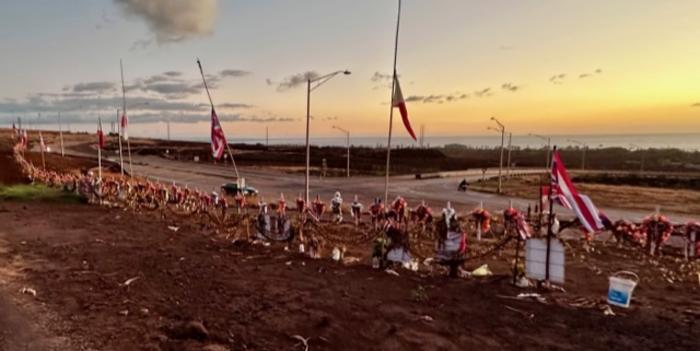
Credit: Costas Synolakis
A Perspective explores lessons learned from recent deadly wildfires and proposes a strategy for managing wildfire risk. Wildfire risk and wildfire deaths are on the rise due to climate change, policies of fire suppression, and development in the wildland-urban interface. The August 8, 2023, fire that destroyed the historic town of Lahaina, Hawaii, claimed 98 lives, in part due to a failure to alert residents to the danger. In 2018, 104 lives were lost in a fire in Mati, Greece, for which there were also no alerts. For both incidents, Costas E. Synolakis and Georgios Marios Karagiannis argue that lives would have been saved had there been evacuation orders issued. In both cases, traffic was mismanaged, some victims perished in their cars, and some survivors who self-evacuated had to be rescued from nearby beaches. The authors propose a long-term strategy for integrating wildfire risk management into forest land management and note that large fires are often followed by investment in fire-fighting infrastructure, but not wildfire mitigation and prevention. Prevention and mitigation measures should be increased, the authors argue, including retrofitting buildings to meet or exceed building code standards, limiting development in the wildland-urban-interface, prescribed burning, fuel reduction, and forest thinning. The authors call for governments to work closely with the forest products industry to integrate land management and wildfire risk management as well as for a global system for reporting wildland-urban interface fires. In addition, public alert and warning systems need to be improved, along with evacuation plans, including plans for people with functional needs. The authors describe how scientists’ advocacy after the Mati and Maui catastrophes led to advances in each country’s wireless emergency alert systems. The authors argue that alerts should go out through multiple communication pathways including mobile and landline phones, radio, television, and highway variable message signs. According to the authors, authorities should also take advantage of new technologies, including machine learning, to forecast in real-time worst-case scenarios once fires start, along with Earth observation from satellites, to improve monitoring and predictive capabilities.
Journal
PNAS Nexus
Article Title
Wildfire risk management in the era of climate change
Article Publication Date
7-May-2024
Cite Scienmag News
Sloane Callahan. (May 7, 2024). Wildfire risk management in the era of climate change. Scienmag. https://scienmag.com/wildfire-risk-management-in-the-era-of-climate-change/
Sloane Callahan. "Wildfire risk management in the era of climate change." Scienmag, 7 May 2024, https://scienmag.com/wildfire-risk-management-in-the-era-of-climate-change/. Accessed 4 September 2026.
Sloane Callahan. "Wildfire risk management in the era of climate change." Scienmag. May 7, 2024. https://scienmag.com/wildfire-risk-management-in-the-era-of-climate-change/

