

Thursday, July 16, 2026
Science
No Result
View All Result
  • Login
  • HOME
  • SCIENCE NEWS
  • CONTACT US
  • HOME
  • SCIENCE NEWS
  • CONTACT US
No Result
View All Result
Scienmag
No Result
View All Result
Home Science News Social Science

Wild chimps caught sharing naturally fermented ‘boozy’ fruit

April 21, 2025
in Social Science
Reading Time: 3 mins read
0
Wild chimps caught sharing naturally fermented ‘boozy’ fruit
67
SHARES
610
VIEWS
Share on FacebookShare on Twitter
ADVERTISEMENT
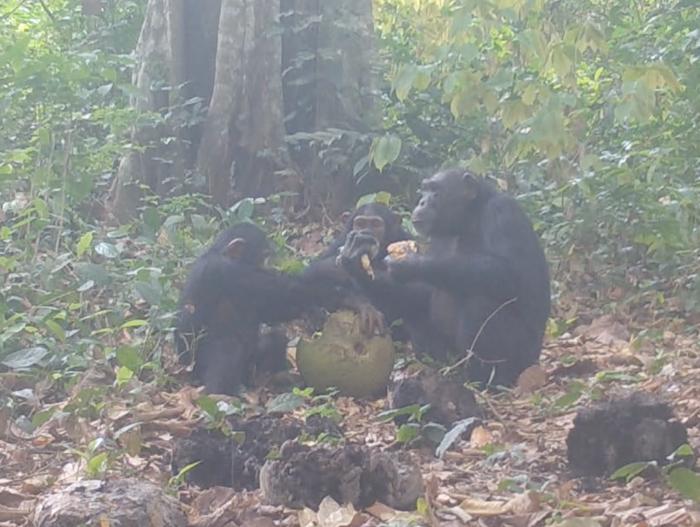
Chimpanzees sharing fruit

image: 

Chimpanzees sharing fruit


view more 

Credit: Bowland et al.

For the first time, wild chimpanzees have been pictured eating and sharing fruit containing alcohol.

A research team led by the University of Exeter set up cameras in Guinea-Bissau’s Cantanhez National Park.

Footage of chimps sharing fermented African breadfruit – confirmed to contain ethanol (alcohol) – raises fascinating questions about if and why chimps deliberately seek out alcohol.

Humans are believed to have consumed alcohol far back into our evolutionary history, with benefits for social bonding.

And the new study suggests our closest relatives might be doing something similar.

“For humans, we know that drinking alcohol leads to a release of dopamine and endorphins, and resulting feelings of happiness and relaxation,” said Anna Bowland, from the Centre for Ecology and Conservation at Exeter’s Penryn Campus in Cornwall.

“We also know that sharing alcohol – including through traditions such as feasting – helps to form and strengthen social bonds.

“So – now we know that wild chimpanzees are eating and sharing ethanolic fruits – the question is: could they be getting similar benefits?”

The researchers used motion-activated cameras, which filmed chimps sharing fermented fruits on 10 separate occasions.

Fruit shared by these chimps was tested for alcohol content. The highest level found was the equivalent of 0.61% ABV (Alcohol By Volume – a measure used in alcoholic drinks).

This is relatively low. But the researchers say it may be the “tip of the iceberg”, as 60-85% of chimps’ diet is fruit – so low levels of alcohol in various foods could add up to significant consumption.

The researchers stress that chimps are unlikely to get “drunk” – as this would clearly not improve their survival chances.

The impact of alcohol on chimps’ metabolism is unknown. But recent discoveries of a molecular adaptation that greatly increased ethanol metabolism in the common ancestor of African apes suggests eating fermented fruits may have ancient origins in species including humans and chimps.

“Chimps don’t share food all the time, so this behaviour with fermented fruit might be important,” said Dr Kimberley Hockings, also from the University of Exeter.

“We need to find out more about whether they deliberately seek out ethanolic fruits and how they metabolise it, but this behaviour could be the early evolutionary stages of ‘feasting’.

“If so, it suggests the human tradition of feasting may have its origins deep in our evolutionary history.”

To find out more about this research project, visit

Bowland’s work was funded by the Primate Society of Great Britain.

The paper, published in the journal Current Biology, is entitled: “Wild chimpanzees share fermented fruits.”


Journal

Current Biology

Article Title

Wild chimpanzees share fermented fruits

Article Publication Date

21-Apr-2025

Media Contact

Louise Vennells

University of Exeter

pressoffice@exeter.ac.uk

Office: 0044-139-272-2062

Journal
Current Biology
Funder
Primate Society of Great Britain

Journal

Current Biology

Article Title

Wild chimpanzees share fermented fruits

Article Publication Date

21-Apr-2025

Keywords


  • /Life sciences/Organismal biology/Animals/Vertebrates/Mammals/Primates/Nonhuman primates

  • /Social sciences/Social research

  • /Life sciences/Evolutionary biology/Evolution/Adaptive evolution

  • /Life sciences/Biochemistry/Metabolism

  • /Physical sciences/Chemistry/Chemical physics/Chemical properties/Chemical structure/Chemical bonding/Bond formation
Tags: alcohol consumption in primatesanimal behavior and alcoholCantanhez National Park researchchimpanzee feeding habitschimpanzees and social bondingethanol in African breadfruitevolutionary history of alcohol useimplications of alcohol consumption in wildlifeprimates and social interactionsUniversity of Exeter chimpanzee studywild chimpanzees sharing fermented fruitwildlife research methodologies
Share27Tweet17
Previous Post

Unveiling FMRP’s Dual Impact: Driving Tumor Progression and Therapy Resistance in Cancer Biology

Next Post

Transcranial Pulsed Current Stimulation Shows Promise for Enhancing Social Skills in Children with Autism

Related Posts

Endometriosis Shows Symptom Patterns Extending Far Beyond Pain
Social Science

Endometriosis Shows Symptom Patterns Extending Far Beyond Pain

July 16, 2026
Stirling Study Shows People Overestimate Legal Protections for Dogs
Social Science

Stirling Study Shows People Overestimate Legal Protections for Dogs

July 16, 2026
AI Tool Goes Beyond Translation, Creating New Languages
Social Science

AI Tool Goes Beyond Translation, Creating New Languages

July 16, 2026
Joint human-machine learning boosts noninvasive BCI performance
Social Science

Joint human-machine learning boosts noninvasive BCI performance

July 16, 2026
Adolescent Social Media Limits May Cut Harms but Shift Others, Experts Warn
Social Science

Adolescent Social Media Limits May Cut Harms but Shift Others, Experts Warn

July 15, 2026
Study Shows Time Online Shapes Outcomes, Not Just Content Exposure
Social Science

Study Shows Time Online Shapes Outcomes, Not Just Content Exposure

July 15, 2026
Next Post
Transcranial Pulsed Current Stimulation Shows Promise for Enhancing Social Skills in Children with Autism

Transcranial Pulsed Current Stimulation Shows Promise for Enhancing Social Skills in Children with Autism

  • Mothers who receive childcare support from maternal grandparents show more

    Mothers who receive childcare support from maternal grandparents show more parental warmth, finds NTU Singapore study

    27656 shares
    Share 11059 Tweet 6912
  • University of Seville Breaks 120-Year-Old Mystery, Revises a Key Einstein Concept

    1061 shares
    Share 424 Tweet 265
  • Bee body mass, pathogens and local climate influence heat tolerance

    682 shares
    Share 273 Tweet 171
  • Researchers record first-ever images and data of a shark experiencing a boat strike

    546 shares
    Share 218 Tweet 137
  • Groundbreaking Clinical Trial Reveals Lubiprostone Enhances Kidney Function

    531 shares
    Share 212 Tweet 133
Science

Embark on a thrilling journey of discovery with Scienmag.com—your ultimate source for cutting-edge breakthroughs. Immerse yourself in a world where curiosity knows no limits and tomorrow’s possibilities become today’s reality!

RECENT NEWS

  • Volcanic eruptions leave imprint on coupled reanalysis global overturning circulation
  • Residential Water Sources Predict Serum PFAS Levels in Contaminated Communities
  • Researchers Use Fast, Flat Simulations to Predict Outcomes in New Games
  • Climate Change Disproportionately Threatens Food Security in Small Island Developing States

Categories

  • Agriculture
  • Anthropology
  • Archaeology
  • Athmospheric
  • Biology
  • Biotechnology
  • Blog
  • Bussines
  • Cancer
  • Chemistry
  • Climate
  • Earth Science
  • Editorial Policy
  • Marine
  • Mathematics
  • Medicine
  • Pediatry
  • Policy
  • Psychology & Psychiatry
  • Science Education
  • Social Science
  • Space
  • Technology and Engineering

Subscribe to Blog via Email

Enter your email address to subscribe to this blog and receive notifications of new posts by email.

Join 5,146 other subscribers

© 2025 Scienmag - Science Magazine

Welcome Back!

Login to your account below

Forgotten Password?

Retrieve your password

Please enter your username or email address to reset your password.

Log In
No Result
View All Result
  • HOME
  • SCIENCE NEWS
  • CONTACT US

© 2025 Scienmag - Science Magazine

Discover more from Science

Subscribe now to keep reading and get access to the full archive.

Continue reading
