


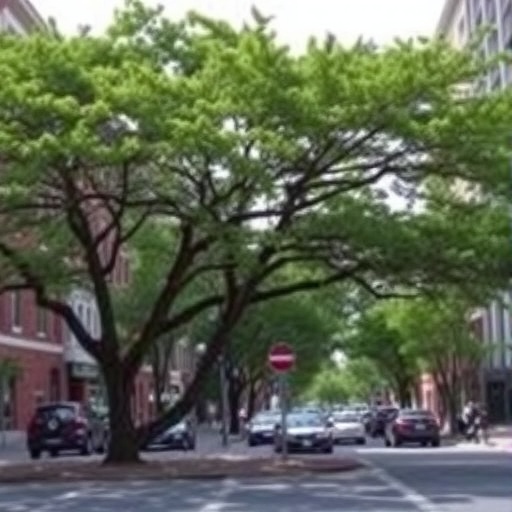
As trees vanish from urban neighborhoods, the loss may be affecting far more than a city’s appearance. A longitudinal study of Chicago has found that declining tree canopy was associated with rising mortality, while neighborhoods that gained canopy experienced fewer deaths from several major categories of illness. The relationship was strongest in the city’s hottest areas, where the disappearance of mature trees may intensify heat exposure and remove an important layer of public-health protection.
Researchers from Northwestern University analyzed changes in tree canopy and death rates across Chicago over an 11-year period, from 2011 through 2021. Their findings, published in GeoHealth, challenge the way urban greenery has often been studied. Earlier research typically compared mortality with the amount of tree cover present at a single point in time. The new analysis instead examined how changes in canopy from one year to the next corresponded with changes in mortality, offering a more dynamic view of how neighborhoods and their environments evolve.
The research team used annual satellite measurements to estimate the percentage of land covered by the leafy crowns of trees in every Chicago census tract. These data were combined with more than 220,000 death records obtained from the Illinois and Chicago Departments of Public Health. The scientists then developed a statistical model designed to separate the influence of changing tree canopy from other characteristics that differ between neighborhoods, including summer temperature, air pollution, income, population size and racial and ethnic residential segregation.
The analysis produced a notable distinction: the total amount of tree canopy in a neighborhood during any single year was not significantly associated with mortality. Instead, year-to-year changes appeared to matter. Increases in canopy were consistently linked with fewer deaths from cardiovascular disease, respiratory disease, several musculoskeletal conditions and mental health-related illnesses. Conversely, areas that lost canopy tended to experience higher mortality. Because the study is observational, it cannot prove that tree loss directly caused individual deaths, but the repeated pattern remained after the researchers accounted for numerous environmental and demographic factors.
The strongest disparities appeared across Chicago’s geography. Neighborhoods on the South and West sides generally experienced hotter summer conditions, greater absolute losses in tree canopy and higher mortality than other parts of the city. Communities near Lake Michigan tended to be cooler and had lower mortality, while areas near the Forest Preserves contained some of the city’s largest concentrations of trees and also showed relatively low mortality. These patterns suggest that the health value of urban trees may be especially important where heat exposure and other social and environmental risks overlap.
To identify these patterns, the researchers also used K-means clustering, a machine-learning technique that groups locations according to similarities in selected variables. In this case, neighborhoods were classified using tree canopy, temperature and mortality. The approach helped reveal clusters of communities facing combinations of high heat, shrinking tree cover and elevated death rates—places where tree preservation and expansion could potentially deliver the greatest benefits.
Trees can influence health through several biological and physical pathways. Their canopies shade roads, sidewalks and buildings, reducing the amount of solar radiation absorbed by urban surfaces. Through evapotranspiration, trees also release water vapor and cool the surrounding air. These effects can moderate urban heat islands, which occur when concrete, asphalt and other built surfaces store heat and keep cities warmer than nearby rural areas. Reduced heat exposure may be particularly important during heat waves, which are becoming more frequent and intense as human-caused climate change progresses.
Urban trees may provide additional benefits beyond temperature regulation. Vegetation can capture or intercept some airborne pollutants, reduce soil erosion, encourage walking and outdoor activity and create spaces that support social interaction. Exposure to greener environments has also been associated in previous studies with lower stress, anxiety and blood pressure. Together, these pathways could help explain why changes in canopy were linked to multiple disease categories rather than only heat-related deaths.
The findings also highlight why planting new saplings is not equivalent to protecting established trees. Young trees may require decades to develop the broad crowns needed to provide substantial shade and cooling. Mature trees, by contrast, can deliver those services immediately, but they can be lost rapidly to disease, severe storms, construction or unnecessary removal. Replacing a large tree with a newly planted sapling may therefore leave a neighborhood exposed for years while the replacement grows.
The Northwestern team modeled a scenario in which Chicago increased its tree canopy by approximately 0.03 percent each year, a change roughly equivalent to planting 14,000 trees annually. Their model estimated that this expansion could be associated with about 105 fewer deaths per year. The estimate is a projection rather than a guarantee, and the researchers emphasize that successful urban forestry would require more than planting campaigns. Long-term watering, maintenance, protection from damage and strategic placement in heat-vulnerable neighborhoods would all be necessary. The study’s central message is that trees should be treated not merely as aesthetic features, but as public-health infrastructure whose preservation may become increasingly vital in a warming city.
News Publication Date: 5-Aug-2026
Web References: https://doi.org/10.1029/2025GH001651
References: GeoHealth, DOI: 10.1029/2025GH001651
Cite Scienmag News
Courtney Benton. (August 6, 2026). Shrinking Urban Tree Shade Linked to Rising Mortality. Scienmag. https://scienmag.com/shrinking-urban-tree-shade-linked-to-rising-mortality/
Courtney Benton. "Shrinking Urban Tree Shade Linked to Rising Mortality." Scienmag, 6 August 2026, https://scienmag.com/shrinking-urban-tree-shade-linked-to-rising-mortality/. Accessed 3 September 2026.
Courtney Benton. "Shrinking Urban Tree Shade Linked to Rising Mortality." Scienmag. August 6, 2026. https://scienmag.com/shrinking-urban-tree-shade-linked-to-rising-mortality/


