


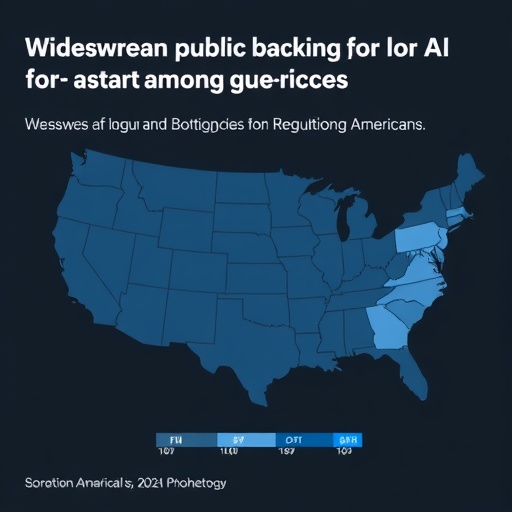
In a recent nationwide survey conducted by researchers at Johns Hopkins University, an intriguing paradox emerges in public attitudes toward artificial intelligence (AI): even among those who actively embrace and utilize AI technologies, there is a robust call for increased regulatory oversight. This comprehensive study, involving over 2,000 U.S. adults, offers a detailed window into the complex perceptions, trust levels, and expectations of AI across diverse demographic and ideological groups.
The survey reveals a deeply nuanced relationship between American citizens and AI, displaying a tripartite division in general sentiment. Approximately one-third of respondents hold a positive view of AI, an equal proportion express negative feelings, and the remaining third convey ambivalent or mixed attitudes. Notably, these views correlate significantly with usage patterns; skilled daily users express markedly higher approval, with 80% reporting favorable opinions, while those with minimal experience—having only engaged with AI sporadically—show a mere 24% positivity rate. This variance suggests that familiarity breeds both appreciation and critical awareness.
Age is another critical demographic factor shaping AI perceptions. Younger adults, particularly those between 18 and 29 years, tend to regard AI more favorably, with 41% expressing positive sentiments compared to a mere 18% among individuals aged 60 and above. However, this younger cohort also feels greater occupational pressure to incorporate AI into their workflows, with half of young working adults acknowledging such pressure, contrasted with about one-fifth of their older counterparts. These findings hint at generational shifts and emerging challenges in workplace adaptation to AI technologies.
Political affiliation appears less divisive than one might expect. Both Republicans and Democrats report comparable views on AI, underscoring the technology’s broad societal impact beyond partisan lines. This bipartisan consensus extends to the endorsement of “right to a human” legislation, which advocates for individuals’ ability to opt out of interactions with AI systems in critical domains. High percentages of support are evident in medical care (79%), legal proceedings (76%), and educational settings (74%), reflecting a clear public preference for human agency in decisions and interactions involving complex, personal matters.
The desire for enhanced AI regulation transcends these preferences, encompassing broader concerns about privacy, transparency, and informed consent. A substantial majority of Americans support mandatory disclosures when AI is involved in interactions, with 75% advocating for transparency that notifies users of AI presence. Equally compelling is the strong opposition to the exploitation of personal biometric data; 73% favor banning the use of facial and vocal information by AI systems without explicit permission. Furthermore, 68% call for labeling AI-generated visual and audio content, underscoring worries about misinformation and authenticity in digital media.
Trust in AI varies markedly depending on the task in question. When it comes to retrieving factual information, 67% of respondents express moderate to high trust. Artistic and musical creation also garners reasonable confidence, with 57% feeling comfortable with AI in this creative domain. Conversely, trust drastically diminishes in high-stakes or ethically sensitive tasks: 63% distrust AI for providing medical advice, 69% oppose its role in high school teaching, and a striking 81% reject AI involvement in judicial decision-making. Moreover, 76% resist relinquishing control to AI in driving, highlighting safety and accountability concerns.
The survey further highlights widespread apprehension regarding AI’s socioeconomic impacts. Around 60% of participants anticipate that AI advancements will exacerbate existing inequalities over the next decade, reflecting anxieties about uneven access to technology and the rewards it generates. This sentiment correlates with strong backing for a “digital dividend,” a policy proposal to redistribute wealth generated by AI through monthly payments to all American adults funded by taxing large technology corporations. This concept enjoys bipartisan support, with over half of Republicans, Democrats, and independents endorsing the idea.
When considering who will hold power in an AI-driven future, skepticism prevails. About 40% of Americans expect large technology companies to dominate this landscape, leveraging AI to further consolidate influence. Fewer than 10% believe individuals will gain the most power, while nearly 20% express concern that autonomous AI systems themselves may become central power brokers. These perceptions raise profound questions about governance, oversight, and the ethical deployment of AI at scale.
Dr. Christopher Honey, a computational cognitive neuroscientist at Johns Hopkins, underscored the unexpected breadth of support for regulation even among AI advocates. The findings suggest that familiarity with AI breeds not unqualified enthusiasm, but a sophisticated recognition of its risks and the necessity for safeguards. Echoing this, fellow neuroscientist Rolando Masís-Obando emphasized the value of this poll in capturing the evolving “national voice” as society grapples with AI’s promises and perils. The researchers intend to repeat this annual survey to track shifts in opinion over time.
The methodological rigor of the survey adds weight to these findings. Conducted in April and May, the polling efforts employed representative sampling techniques to capture a broad cross-section of the U.S. adult population. Questions spanned not only affective attitudes and trust metrics but also policy preferences and expectations for AI’s societal trajectory. The Johns Hopkins University Nexus Award provided essential funding support, enabling a methodical exploration of these pressing issues.
These insights arrive at a pivotal moment as policymakers, technologists, and the public deliberate on the governance of AI technologies. With rapidly advancing capabilities in machine learning, natural language processing, and autonomous systems, the tension between innovation and regulation grows more pronounced. This survey provides empirical evidence that public appetite for human-centered safeguards and transparent deployment is strong and widely shared, irrespective of political leanings or personal experience levels.
The findings will be formally presented at The Future of Our Realities 2026 conference, hosted at the Johns Hopkins Bloomberg Center in Washington, D.C., where experts will debate the implications for AI ethics, law, and society. As AI systems increasingly permeate healthcare, education, legal systems, and employment, understanding public sentiment is critical to crafting policies that balance technological benefits with societal values.
In sum, the Johns Hopkins study illuminates a complex landscape in which Americans recognize AI’s transformative potential but demand robust regulatory frameworks that preserve human dignity, privacy, and equity. This nuanced public perspective is a vital input for shaping the future development and deployment of AI, ensuring it serves the collective good while mitigating unintended harms.
News Publication Date: June 2024
Web References:
- Johns Hopkins Data Science and AI Institute
- The Future of Our Realities 2026 Conference
- Johns Hopkins University Nexus Awards
Keywords
Artificial intelligence, AI regulation, public opinion, AI trust, human-AI interaction, AI ethics, digital dividend, technology governance, computational cognitive neuroscience, AI transparency, AI privacy, AI societal impact
Cite Scienmag News
Denise Maddox. (June 15, 2026). Widespread Public Backing for AI Regulations Among Americans. Scienmag. https://scienmag.com/widespread-public-backing-for-ai-regulations-among-americans/
Denise Maddox. "Widespread Public Backing for AI Regulations Among Americans." Scienmag, 15 June 2026, https://scienmag.com/widespread-public-backing-for-ai-regulations-among-americans/. Accessed 4 September 2026.
Denise Maddox. "Widespread Public Backing for AI Regulations Among Americans." Scienmag. June 15, 2026. https://scienmag.com/widespread-public-backing-for-ai-regulations-among-americans/


