


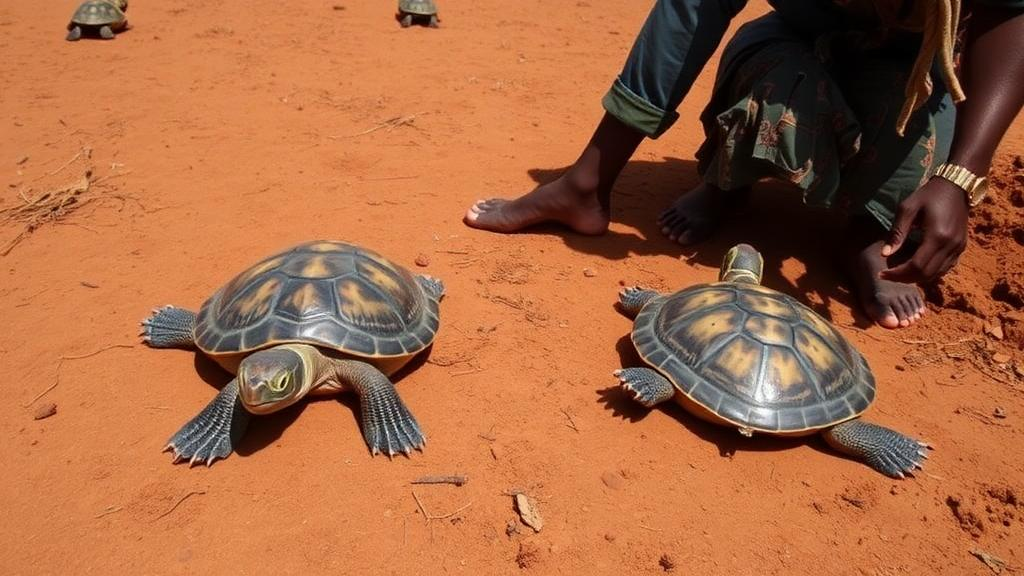
On the nesting beaches of Tanzania, a quiet experiment in human motivation has been running for more than two decades. Local men recruited from coastal villages have spent years patrolling for marine turtles, protecting eggs, and persuading neighbours to abandon the trade and consumption of turtle meat. What makes this case remarkable is not only the ecological outcome but the fact that many of these Conservation Officers kept working even when their modest monthly payments stopped arriving. A new study published in the journal Ambio argues that their persistence exposes a deep flaw in the way global conservation policy thinks about people: as rational actors who will participate only if the money is right.
The research, led by Lindsey West of Queen’s University Belfast with Tanzanian colleagues Isabellah Luhanga and Irene C. Mapunda and Robert D. Fish of Imperial College London, drew on semi-structured interviews with all 22 community Conservation Officers working across five coastal districts. These men, aged between 33 and 68 and mostly small-scale fishers, had participated in a community-based marine turtle conservation programme for periods ranging from six to twenty years, with a mean of sixteen. The programme began in 2001 as a partnership between a Tanzanian non-governmental organisation and communities around Mafia Island Marine Park, where rates of egg harvesting and the killing of nesting females were high. It later expanded to Kilwa, Kibiti, Mkuranga and Kigamboni, districts that host nesting by green turtles, Chelonia mydas, and hawksbill turtles, Eretmochelys imbricata, with up to 500 clutches laid along the coast each year.
The theoretical stakes are considerable. Global conservation policy has long been built on the assumption that local actors are driven primarily by economic motives, an assumption embedded in market-based instruments such as Payments for Ecosystem Services. In that framing, participants are constructed as self-interested calculators of costs and benefits. Yet conservation is an inherently social, cultural and political process, and the authors point out that economic theories struggle to explain why anyone would protect a species that delivers no direct livelihood benefit. Marine turtles are precisely such a species: they are a global conservation priority threatened by exploitation, bycatch, pollution, coastal development and climate change, but they do not put food on the table for the men who guard them.
The study grounded its analysis in Self-determination Theory, the influential psychological framework that distinguishes intrinsic motivation, arising from the inherent satisfaction of an activity, from extrinsic motivation, performed for separable rewards. According to the theory, motivation becomes self-endorsed when three psychological needs are met: autonomy, competence and relatedness. The researchers also drew on the concept of relational values, values that emerge from human-nature interactions and from human relationships involving nature, expressed as care, reciprocity and responsibility. Using thematic analysis, they coded the interview transcripts both deductively, against seven features of relational values identified in the literature, and inductively, allowing new themes to emerge from the narratives themselves.
The findings on initial participation were strikingly consistent. The Conservation Officers signed up because the programme’s goals aligned with values they already held. Instrumental concerns mattered: they had watched fish catches decline and feared for families and friends dependent on fisheries. One officer explained his decision bluntly, saying that if the environment was not protected it would mean death, and that comparing the fish of the past with the present convinced him to get inside and fight. Moral values were equally powerful. Several described a sense that turtles, as living beings with the same survival needs as humans, deserved defence as fellow creatures. Some recalled the distress of watching turtles publicly slaughtered for meat and oil in their youth, memories that generated empathy and a desire to alleviate suffering.
Bequest values and place attachment completed the motivational picture. The officers spoke of inheriting a healthy marine environment from ancestors and felt a duty to pass it on, haunted by the near-disappearance of the dugong, a marine mammal once regularly sighted in Tanzanian waters and now extremely rare. One participant said the prospect of his children having to travel far to see a dugong pained him greatly, and he feared the same fate for turtles. Because most had been born, raised and married in the villages where they worked, their sense of place was profound, and it was reinforced by turtle behaviour itself: females return to the same nesting beaches season after season, creating an unmistakable bond between the animals and a specific village. Local knowledge of coasts, turtles and community personalities gave the officers a feeling of competence, and their decision to apply, sometimes against peer pressure, reflected genuine autonomy.
Over the following two decades, the researchers found, motivation evolved and became increasingly relational. The practice of care for turtles deepened into reciprocal bonds; one officer admitted to sleeping on the beach while a turtle nested so he could escort it safely back to the ocean, and recalled the act fondly rather than as a burden. The officers also grasped the ecological role of turtles in maintaining coral reefs and seagrass meadows that support inshore fisheries, understanding that where these creatures thrive, fish will follow. From this care grew a stewardship identity, captured in one officer’s declaration that the job was already in his blood and in his soul, and that he did not care whether he was paid. Participation also forged new friendships within the officer network, which evolved into a community of practice built on shared work and mutual support.
Social recognition proved to be a decisive engine of persistence. Community members came to see the officers as environmental knowledge holders, reporting nesting turtles and eggs at risk, and the officers took pride in the visible acceptance of their work. Their regular, if small, conservation payments even functioned as social capital, enabling access to credit at local shops and allowing generous contributions to village fundraising. Trust translated into influence: officers were consulted on financial matters, community projects and village leadership, some were elected to local government positions, and alliances formed with police and district officials. The authors interpret this social standing through a Foucauldian lens, as power that exists only in relational interactions rather than as a personal possession, a valued and unexpected benefit that participants were strongly motivated to maintain.
Persistence came despite real hostility. Some villagers continued to trade and consume turtle meat covertly, littering beaches with carcasses to demonstrate that the officers could not enforce control. Officers endured verbal abuse, threats, and pressure from some village leaders, including reported attempts to remove them from their positions. They responded with what the authors describe as performative participation, maintaining humility and friendliness while recognising that they could not win everyone over. Notably, when payments became irregular between 2014 and 2015 due to funding problems, the officers continued their work regardless. The authors suggest that financial uncertainty may even have protected their intrinsic motivation from being crowded out, and may have signalled to communities that rewards are not a prerequisite for stewardship.
The study’s implications reach far beyond Tanzanian beaches. The authors caution that over-reliance on monetary incentives risks undermining the very relationships that sustain long-term participation, and they argue that motivation should be understood as a relational, continually unfolding process rooted in dynamic ties among nature, people and place, rather than a static cognitive state. They acknowledge limitations: all participants were men, reflecting structural barriers that keep women out of formal conservation roles, and the sample is subject to survivorship bias since it captures only those who stayed. Even so, the message is clear. Conservation programmes designed around payments alone may miss the deeper wellsprings of human commitment, including trust, reciprocity, care and collective responsibility. Where policymakers learn to recognise and nurture these relational values, they may find that the most durable guardians of biodiversity are not bought, but made through belonging.
Subject of Research: Motivations for long-term participation in community-based marine turtle conservation in Tanzania
Article Title: Evolving motivations for participation in community-based conservation: A relational perspective
Article References: West, L., Luhanga, I., Mapunda, I. C., & Fish, R. D. (2026). Evolving motivations for participation in community-based conservation: A relational perspective. Ambio. https://doi.org/10.1007/s13280-026-02491-y
Image Credits: AI Generated
DOI: 10.1007/s13280-026-02491-y
Keywords: community-based conservation, marine turtles, motivation, relational values, Tanzania, Self-determination Theory, stewardship, intrinsic motivation, payments for ecosystem services, place attachment, social capital, coastal communities
Cite Scienmag News
Margaret Porter. (October 1, 2026). Why Turtle Guardians Keep Going: Money Is Not What Sustains Conservation in Tanzania. Scienmag. https://scienmag.com/why-turtle-guardians-keep-going-money-is-not-what-sustains-conservation-in-tanzania/
Margaret Porter. "Why Turtle Guardians Keep Going: Money Is Not What Sustains Conservation in Tanzania." Scienmag, 1 October 2026, https://scienmag.com/why-turtle-guardians-keep-going-money-is-not-what-sustains-conservation-in-tanzania/. Accessed 4 October 2026.
Margaret Porter. "Why Turtle Guardians Keep Going: Money Is Not What Sustains Conservation in Tanzania." Scienmag. October 1, 2026. https://scienmag.com/why-turtle-guardians-keep-going-money-is-not-what-sustains-conservation-in-tanzania/


