


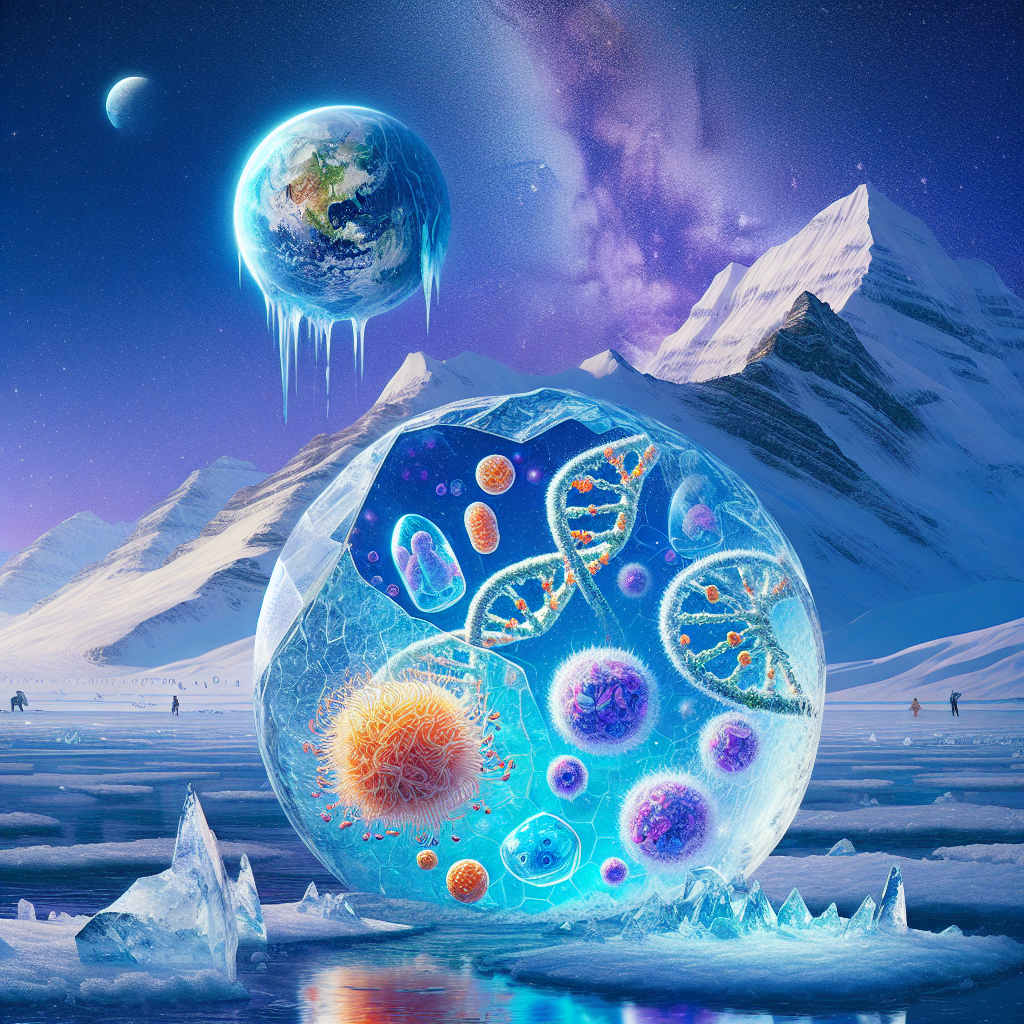
For a billion years, single-celled eukaryotes ruled the planet. Then around 700 million years ago during Snowball Earth — a geologic era when glaciers may have stretched as far as the Equator — a new creature burst into existence: the multicellular organism.
For a billion years, single-celled eukaryotes ruled the planet. Then around 700 million years ago during Snowball Earth — a geologic era when glaciers may have stretched as far as the Equator — a new creature burst into existence: the multicellular organism.
Why did multicellularity arise? Solving that mystery may help pinpoint life on other planets and explain the vast diversity and complexity seen on Earth today, from sea sponges to redwoods to human society.
Common wisdom holds that oxygen levels had to hit a certain threshold for single cells to form multicellular colonies. But the oxygen story doesn’t fully explain why multicellular ancestors of animals, plants, and fungi appeared simultaneously, and why the transition to multicellularity took more than 1 billion years.
A new paper in Proceedings of the Royal Society B shows how specific physical conditions of Snowball Earth — especially ocean viscosity and resource deprivation — could have driven eukaryotes to turn multicellular.
“It seems almost counterintuitive that these really harsh conditions, this frozen planet, could actually select for larger, more complex organisms, rather than causing species to go extinct or reduce in size,” says former SFI Undergraduate Complexity Researcher William Crockett, corresponding author on the paper and Ph.D. student at MIT.
Using scaling theories, the authors found that a hypothetical early animal ancestor (reminiscent of swimming algae that eat prey instead of photosynthesizing) would swell in size and complexity under Snowball Earth pressures. By contrast, a single-celled organism that moves and feeds via diffusion, like a bacterium, would grow smaller.
“The world is different after Snowball Earth because there’s a new form of life on the planet. One of the central questions of evolution is how do you go from nothing on a planet to things like us, and to societies? Is all of that an accident? We think it’s not luck: there are ways to predict these major transitions,” says senior author and SFI Professor Christopher Kempes.
The study shows how the iced-over oceans during Snowball Earth would have blocked sunlight, reducing photosynthesis and thus draining the sea of nutrients. Bigger organisms that processed more water had a better chance of eating enough to survive. Once the glaciers melted, these larger organisms could expand further.
The model reflects the latest paleontological research, building on work by two additional co-authors, former SFI Omidyar Postdoctoral Fellow Jack Shaw and Carl Simpson, a scientist at the University of Colorado, Boulder.
“Our study offers hypotheses of ancestor organism features to hunt for in the fossil record,” says Crockett.
The paper also presents new tools for investigating physical effects on organism physiology, a boon for future research.
“We provide a useful framework for people to interpret Earth’s past, understand modern ecology, and study organism physiology in the lab,” says Kempes.
Journal
Proceedings of the Royal Society B Biological Sciences
Article Title
Physical constraints during Snowball Earth drive the evolution of multicellularity
Article Publication Date
26-Jun-2024
Cite Scienmag News
Drew Townsend. (June 26, 2024). Why the harsh Snowball Earth kick-started our earliest multicellular ancestors: new study. Scienmag. https://scienmag.com/why-the-harsh-snowball-earth-kick-started-our-earliest-multicellular-ancestors-new-study/
Drew Townsend. "Why the harsh Snowball Earth kick-started our earliest multicellular ancestors: new study." Scienmag, 26 June 2024, https://scienmag.com/why-the-harsh-snowball-earth-kick-started-our-earliest-multicellular-ancestors-new-study/. Accessed 4 September 2026.
Drew Townsend. "Why the harsh Snowball Earth kick-started our earliest multicellular ancestors: new study." Scienmag. June 26, 2024. https://scienmag.com/why-the-harsh-snowball-earth-kick-started-our-earliest-multicellular-ancestors-new-study/


