


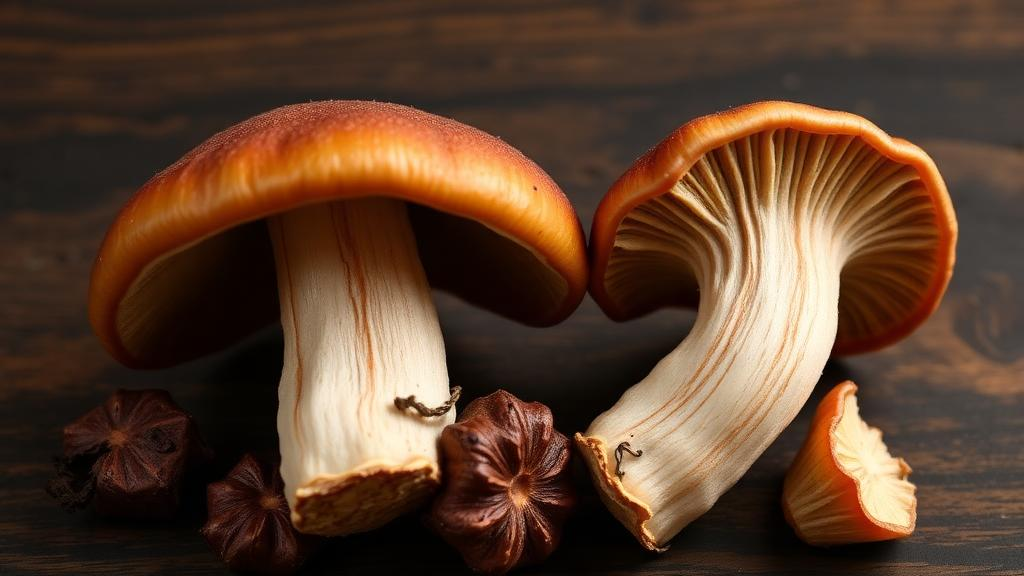
Boletes — the prized family of mushrooms that includes the legendary porcini — have long commanded attention in kitchens and markets around the world, yet the question of why one species tastes earthy and rich while a close relative falls flat has remained largely a matter of folklore. A new study published in npj Science of Food by Chen Zhong, Jie-Qing Li, and Yuan-Zhong Wang has now dismantled that mystery at the molecular level, combining advanced mass spectrometry, infrared spectroscopy, and machine learning to map precisely which chemicals separate a delicious bolete from a mediocre one. The work offers the most comprehensive chemical portrait of bolete flavor to date, and its findings could reshape how the mushroom trade grades, authenticates, and values its most coveted products.
The research team set out with a deceptively simple question: how much of the flavor difference between bolete species is written in their chemistry? To answer it, they analyzed five bolete species using a battery of complementary analytical techniques. Taste-related metabolites — amino acids and organic acids — were profiled with a targeted metabolomics strategy based on ultra-performance liquid chromatography coupled with electrospray tandem mass spectrometry, known as UPLC-ESI-MS/MS. Aroma compounds were captured through widely targeted volatilomics using headspace solid-phase microextraction gas chromatography-mass spectrometry, or HS-SPME-GC-MS, a technique that allows volatile molecules floating above the mushroom flesh to be trapped on a fiber and then separated and identified with high sensitivity. Infrared spectra were recorded with attenuated total reflectance Fourier-transform infrared spectroscopy, ATR-FTIR for short, which measures how the sample’s molecular bonds absorb infrared light and produces a chemical fingerprint of the whole tissue.
The scale of the resulting dataset is striking. Across the five species, the researchers identified 68 amino acid metabolites, 57 organic acids, and a remarkable 773 volatile compounds. That sheer volume of chemical information is precisely why the team turned to chemometrics — statistical modeling methods designed to extract meaningful patterns from complex multivariate data. Using orthogonal partial least squares discriminant analysis, abbreviated OPLS-DA, together with variable importance in projection scores and two flavor-dilution metrics known as taste activity value and relative odor activity value, the researchers sifted through hundreds of candidates to find the compounds that actually drive the sensory differences between species rather than merely varying at random.
The screening converged on a compact set of chemical culprits. On the taste side, five key differential flavor-active compounds emerged: fumaric acid, glycine, arginine, aspartic acid, and lysine. These molecules are far from arbitrary choices. Aspartic acid and glycine are classic contributors to the savory umami and sweet notes prized in edible fungi, while arginine and lysine are essential and semi-essential amino acids that modulate overall taste balance. Fumaric acid, an intermediate of cellular energy metabolism, contributes sourness and acidity. Their differential abundance across species means that the fundamental taste architecture of a bolete is largely set by which of these molecules dominates its flesh.
The aroma story proved even more intricate. Six key aroma-active compounds were pinpointed: a furanone derivative identified as 3(2H)-furanone, dihydro-2-methyl-; three substituted pyrazines — 2-ethyl-3,5-dimethylpyrazine, 2,3-diethyl-5-methylpyrazine, and a third pyrazine variant; the ethyl ester of 3-methylbutanoic acid; benzeneacetaldehyde; and the green, fatty-smelling aldehyde (Z,Z)-3,6-nonadienal. Pyrazines are notorious for imparting roasted, nutty, and earthy notes, which helps explain the deep, forest-floor character that gourmets associate with premium porcini. The unsaturated aldehyde nonadienal, meanwhile, evokes fresh cucumber and green aromas at vanishingly low concentrations, and benzeneacetaldehyde carries a honeyed, floral sweetness. Together, this six-molecule ensemble functions as the olfactory signature that distinguishes one bolete species from another.
To understand where these differences come from, the team performed metabolic pathway analysis, which maps identified metabolites onto known biochemical networks. The analysis pointed to two central pathways as the engines of flavor divergence: the tricarboxylic acid cycle, or TCA cycle, and the urea cycle. The TCA cycle is the cell’s central metabolic hub, and its intermediates include organic acids such as fumaric acid that directly shape sourness and acidity. The urea cycle governs nitrogen metabolism and the interconversion of amino acids such as arginine. Differences in how actively these pathways run in each species — likely shaped by each fungus’s genetics, ecology, and growing conditions — cascade upward into the taste and aroma profiles that mushroom hunters and chefs perceive on the plate.
Perhaps the most futuristic element of the study is its attempt to connect aroma chemistry to human perception at the receptor level. Using molecular docking, a computational technique that predicts how small molecules fit into the binding pockets of proteins, the researchers tested whether the key aroma compounds could interact with olfactory receptors. The results showed that the key aroma compounds exhibited strong binding affinity to the olfactory receptor OR1A1, a human receptor known to respond to a range of food-relevant odorants. This suggests that the compounds flagged by the statistical screens are not just chemically abundant but are also plausibly capable of triggering human smell perception, strengthening the case that they are genuine drivers of the bolete aroma experience.
Beyond explaining flavor, the study delivers a practical tool with immediate commercial implications. ATR-FTIR spectroscopy is fast, inexpensive, and requires minimal sample preparation compared with the chromatographic methods used to build the reference dataset. The researchers exploited this by training a deep learning model — a hybrid convolutional neural network combined with a long short-term memory network, or CNN-LSTM — to predict key flavor component concentrations directly from infrared spectra. The hybrid architecture is well suited to the task: the convolutional layers extract local spectral features, while the LSTM layers capture sequential dependencies across the spectrum. The model achieved accurate and stable quantitative prediction, with coefficients of determination of at least 0.95 and relative predictive deviation values exceeding 4, thresholds generally regarded as excellent for analytical prediction models.
The implications ripple outward from the laboratory. Because the CNN-LSTM model can estimate key flavor components rapidly and reliably, the approach could allow buyers and regulators to grade bolete lots by predicted flavor rather than by appearance alone, and to detect species substitution — a persistent problem in the wild mushroom trade, where visually similar species command wildly different prices. The same spectroscopic-plus-machine-learning pipeline could in principle be adapted to other prized foods, from truffles to fermented teas, wherever flavor quality currently resists objective measurement. The study’s authors note that the work establishes both the chemical basis of flavor divergence among bolete species and a reliable, rapid detection method for flavor evaluation and species identification.
There is also a broader scientific payoff. By tying flavor differences to specific metabolic pathways, the study provides a framework for understanding how fungal metabolism translates into human sensory experience — a question that sits at the intersection of biochemistry, ecology, and food science. As wild-harvested mushrooms face pressure from climate change and habitat loss, knowing which species harbor the richest flavor chemistry, and being able to verify that chemistry quickly, may prove essential for both conservation-minded foraging and the economic survival of the communities that depend on the bolete harvest. What was once the exclusive judgment of the trained palate can now, it seems, be read in a spectrum.
Subject of Research: Chemical basis of flavor differences among bolete mushroom species analyzed by metabolomics, volatilomics, spectroscopy, and machine learning
Article Title: Effect of species on the flavor profile of boletes: insights from GC-MS, LC-MS, ATR-FTIR spectroscopy and chemometrics
Article References: Zhong, C., Li, J.-Q., & Wang, Y.-Z. (2026). Effect of species on the flavor profile of boletes: insights from GC-MS, LC-MS, ATR-FTIR spectroscopy and chemometrics. npj Science of Food. https://doi.org/10.1038/s41538-026-01187-7
Image Credits: AI Generated
DOI: 10.1038/s41538-026-01187-7
Keywords: boletes, porcini, flavor chemistry, metabolomics, GC-MS, ATR-FTIR, chemometrics, volatile compounds, amino acids, TCA cycle, molecular docking, CNN-LSTM
Cite Scienmag News
Bethany Barker. (October 10, 2026). Why Some Porcini Taste Better Than Others: Chemistry Cracks the Bolete Flavor Code. Scienmag. https://scienmag.com/why-some-porcini-taste-better-than-others-chemistry-cracks-the-bolete-flavor-code/
Bethany Barker. "Why Some Porcini Taste Better Than Others: Chemistry Cracks the Bolete Flavor Code." Scienmag, 10 October 2026, https://scienmag.com/why-some-porcini-taste-better-than-others-chemistry-cracks-the-bolete-flavor-code/. Accessed 10 October 2026.
Bethany Barker. "Why Some Porcini Taste Better Than Others: Chemistry Cracks the Bolete Flavor Code." Scienmag. October 10, 2026. https://scienmag.com/why-some-porcini-taste-better-than-others-chemistry-cracks-the-bolete-flavor-code/


