


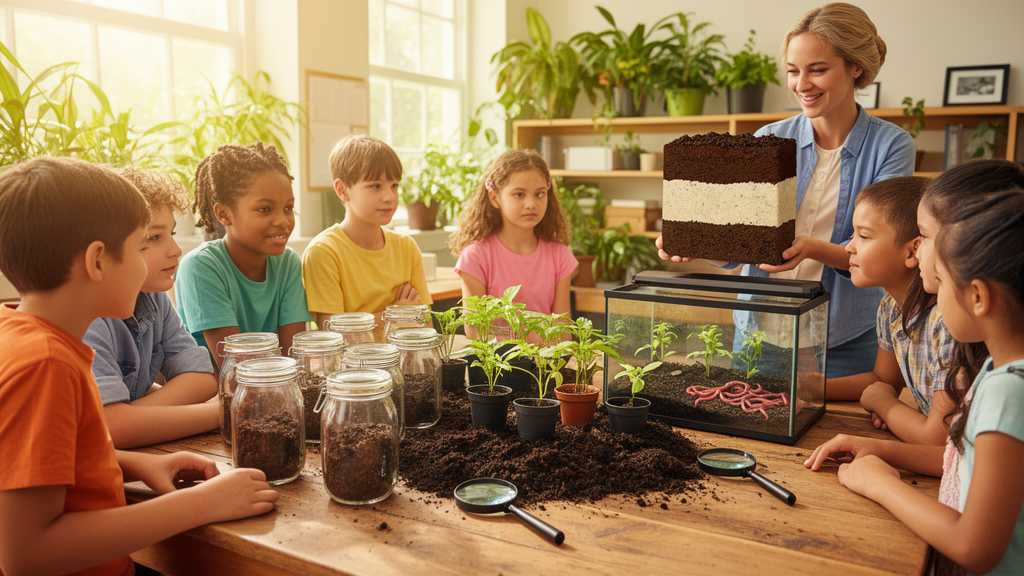
Soil rarely gets the spotlight it deserves. It is the medium that grows nearly all of our food, the habitat for an astonishing share of Earth’s biodiversity, a regulator of water cycles, and one of the planet’s largest carbon reservoirs. Yet according to a new editorial published in the Spanish Journal of Soil Science, the study of soil remains strikingly marginal in school curricula around the world, and the scientific community is calling for a fundamental rethink of how soil science is taught, from the earliest years of primary school through advanced university study. The editorial, written by Cristina Lull, Héctor Moreno, and Luis Roca of the Universitat Politècnica de València and the Universitat de València, accompanies a Special Issue dedicated to teaching and researching in soil science, and it argues that soil literacy is no longer a niche academic concern but an urgent global priority tied directly to food security, climate regulation, and social equity.
The authors ground their argument in a principle that has been on the books for more than half a century. The European Soil Charter of 1972 stated that soil conservation principles must be fully included in teaching programs at all levels as an element of environmental education, at primary, secondary, and university levels alike. Despite that long-standing recommendation, the editorial notes that soil is virtually absent from school curricula in many regions, and that future schoolteachers frequently receive no training in the subject at all. The result is a generational gap in understanding: students who never learn about soil degradation processes or conservation measures grow into adults, and sometimes into policymakers and educators, who lack the conceptual tools to address one of the planet’s most consequential natural resources.
Part of the problem, the editorial argues, lies in the training of teachers themselves. Not all teachers at primary and secondary levels possess in-depth knowledge of soil, and without knowledge, confidence, and motivation, even the most dedicated educator will struggle to convey the fascination and importance of the soil resource. The editorial highlights an approach developed by a researcher at the University of Lorraine, described in a contribution to the Special Issue, that uses project-based learning to close this gap. Future primary school teachers, enrolled in a multidisciplinary bachelor’s degree in education, design and implement an educational activity on soil in an elementary school classroom. By building and delivering a lesson themselves, these students explore soil science hands-on while simultaneously learning how to teach it, a dual outcome that conventional lecture-based training rarely achieves.
The emotional dimension of soil teaching emerges in the editorial’s references to the widely cited article The Joy of Teaching Soil Science, in which soil scientist Megan Balks describes the joy, and serious responsibility, of watching some students awaken to the fascination, intrinsic beauty, and importance of the soil resource. That awakening, the editorial suggests, is precisely what good soil education should aim for. The teacher’s role is to provide a solid foundation, spark curiosity, and equip students with conceptual and methodological tools that allow them to delve deeper on their own: asking questions, analyzing data, and applying soil science to real agricultural and environmental problems. In other words, the goal is not rote memorization of soil taxonomy but the cultivation of a generation capable of independent scientific reasoning about the ground beneath their feet.
At the university level, the editorial identifies a different but equally pressing challenge: aligning soil science with sustainability. A contribution from researchers including scientists at Sultan Qaboos University in Oman argues that soil science curricula should be redesigned from a sustainability perspective, transforming soil from a mere technical physical medium into a form of natural capital and a dynamic agent of sustainable transformation. The authors draw on case studies from the Bachelor of Science in Soil Sciences at Sultan Qaboos University and from Moscow State University, and they propose a forward-looking curriculum built on systems thinking and real-world engagement. Their framework incorporates integrative approaches such as One Health, Soil Security, and the Pedometrics Challenges, and it highlights pedagogical innovations including inquiry-based learning, structured debates, and community projects designed to foster interdisciplinary thinking among students.
The stakes of this curricular reform are quantifiable. Soils contribute directly to at least 14 of the 17 United Nations Sustainable Development Goals, spanning food security, water purification, climate regulation, and biodiversity. Despite this extraordinary breadth of influence, the editorial emphasizes that soil’s importance is not explicitly recognized in the SDG framework itself, which reinforces the need for transformative education worldwide. Luisa Reyes-Sánchez, writing from the perspective of the International Union of Soil Sciences, argues that the deterioration of soil resources generates environmental, social, and economic problems that cascade into poverty, inequality, and resource conflicts. In her view, national soil science societies and the IUSS carry a moral obligation to promote soil protection through education and public awareness, precisely because these are the key tools for achieving the SDGs.
Reyes-Sánchez’s contribution goes beyond rhetoric to propose a concrete methodological shift. It is not enough, she argues, to transmit technical knowledge; educators must cultivate values, attitudes, and environmental awareness about soil from an early age, using a systemic approach in which soil serves as the integrating element across different disciplines. The IUSS has adopted two main priorities: halting soil degradation and focusing educational efforts on children and young people, who will become the future stewards of this resource. To pursue those goals, the union advocates training students, scientists, and teachers to communicate science in accessible ways, professionalizing the teaching of soil science, integrating digital technologies, and promoting the participation of governments, educational institutions, and civil society.
The most visible expression of that agenda is The IUSS Goes to School, a project launched in 2019 with the objective of bringing soil science directly to children and young people through educational materials, activities, and digital resources. Its avenues of dissemination have included children’s stories, cultivation fact sheets developed by scientists, educational books published in several languages, organized competitions, and collaboration with international organizations such as the Food and Agriculture Organization of the United Nations. The project exemplifies the editorial’s central claim that soil science must move out of the laboratory and into everyday culture if society is to develop the practical understanding needed for responsible soil management. Reyes-Sánchez’s conclusion is a direct call to action: scientists and educators must move from words to action and actively engage in the education of new generations.
There are signs that momentum is building. The editorial credits the International Decade of Soils, proclaimed by the IUSS for 2015 through 2024, with producing a significant rise in awareness of soil health, and notes that a wave of educational and outreach projects aimed at improving soil literacy received funding during that period. Among them are LOESS and CURIOSOIL, alongside initiatives such as PREPSOIL, which works to encourage teachers to incorporate soil-related topics into their teaching by identifying and promoting innovative examples of soil education. The editorial also points to a growing literature on soil science education across multiple countries, and to a book, Soil Sciences Education: Global Concepts and Teaching, that outlines the concepts, philosophy, and key principles for designing soil curricula from preschool through adult learning.
The editorial closes with a forward-looking assessment: although a considerable body of literature on soil science education now exists, much remains to be done to raise awareness across all sectors of society. Promoting sustainable lifestyles among young people, the authors argue, entails responsible and sustainable soil management, and it will help ensure that future generations understand why soil must be cared for. Soil science education, they note, is evolving alongside new teaching methodologies, recent advances in the discipline, and the integration of artificial intelligence in schools and universities, a convergence that demands rigorous educational research. What emerges from the Special Issue as a whole is a coherent vision: soil science should no longer be treated as a technical sub-discipline tucked into agricultural faculties, but as a strategic catalyst for a sustainable planet, taught early, taught well, and taught everywhere.
Subject of Research: Soil science education and curriculum reform across primary, secondary, and university levels
Article Title: Editorial: Teaching and researching in soil science
Article References: Lull, C., Moreno, H., & Roca, L. (2026). Editorial: Teaching and researching in soil science. Spanish Journal of Soil Science, 16, Article 16650. https://doi.org/10.3389/sjss.2026.16650
Image Credits: AI Generated
Keywords: soil science, soil education, curriculum reform, sustainability, SDGs, teacher training, International Union of Soil Sciences, soil literacy, project-based learning, natural capital, soil health, education
Cite Scienmag News
Violet Maxwell. (October 15, 2026). Why Soil Belongs at the Center of Every Classroom, From Primary School to University. Scienmag. https://scienmag.com/why-soil-belongs-at-the-center-of-every-classroom-from-primary-school-to-university/
Violet Maxwell. "Why Soil Belongs at the Center of Every Classroom, From Primary School to University." Scienmag, 15 October 2026, https://scienmag.com/why-soil-belongs-at-the-center-of-every-classroom-from-primary-school-to-university/. Accessed 15 October 2026.
Violet Maxwell. "Why Soil Belongs at the Center of Every Classroom, From Primary School to University." Scienmag. October 15, 2026. https://scienmag.com/why-soil-belongs-at-the-center-of-every-classroom-from-primary-school-to-university/


