


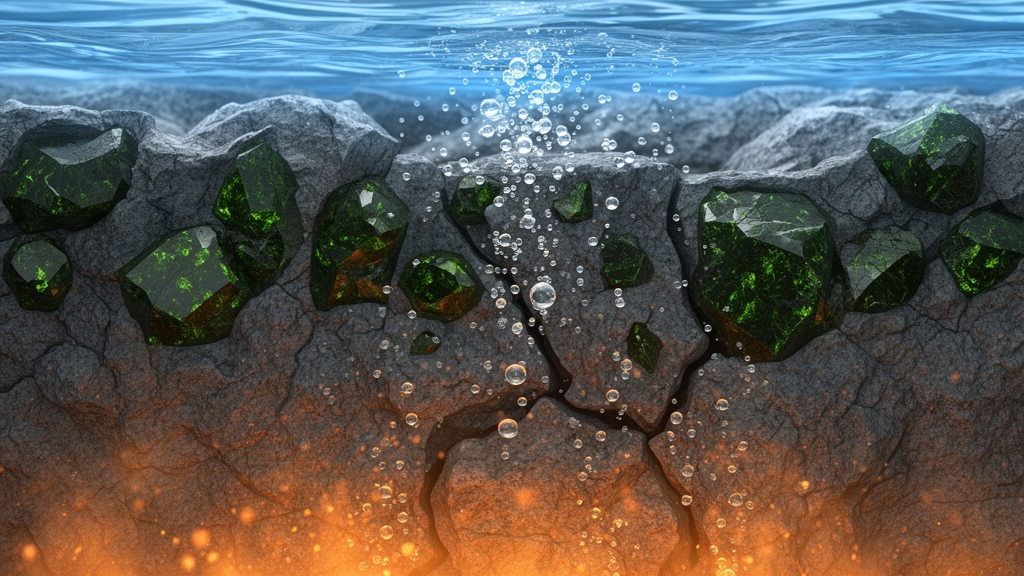
Deep beneath the seafloor and within mountain belts made of dark, iron-rich rock, water slowly reacts with minerals to produce hydrogen gas, a process that has quietly fueled microbes for billions of years and now sits at the center of a hunt for naturally occurring clean energy. A team at Texas A&M University has published a combined experimental and modeling study that systematically maps which rocks, temperatures, pressures, and fluid chemistries generate the most hydrogen during these water-rock reactions, offering a practical screening guide for the emerging geological hydrogen industry.
The research, led by Raghda Emera and colleagues at the Harold Vance Department of Petroleum Engineering, focuses on serpentinization, the hydrothermal alteration of ultramafic rocks such as peridotite and dunite. When olivine, the dominant mineral in these rocks, reacts with water at elevated temperatures, ferrous iron is oxidized to ferric iron, and molecular hydrogen is released as a byproduct. The process has long been documented at mid-ocean ridge hydrothermal fields such as Lost City and Rainbow, but translating that natural phenomenon into a predictable, engineered energy resource has remained stubbornly difficult.
One of the study’s clearest messages concerns the identity of the reacting mineral itself. Olivine is a solid solution between a magnesium-rich end member, forsterite, and an iron-rich end member, fayalite. Prior thermodynamic work suggested that iron-rich olivine generates two to ten times more hydrogen per mole than magnesium-rich varieties, but direct experimental isolation of this effect had been lacking. The Texas A&M group ran controlled experiments on pure fayalite, pure forsterite, and an equal mixture of the two under identical conditions of 100 degrees Celsius, 33 bar, and near-neutral pH, removing all confounding variables.
The results were striking. Pure fayalite produced the highest hydrogen yields of any powdered sample, roughly five times more than a natural peridotite and more than double the yield of the 50-50 mixture. Pure forsterite, by contrast, generated no detectable hydrogen at the experimental temperature. The team’s calibrated kinetic models, which combine thermodynamic equilibrium calculations with Arrhenius-type rate laws, matched the laboratory data closely, with a maximum relative error of just 0.14. When the model was pushed to hypothetical compositions, a rock containing 61.5 percent fayalite produced nearly three times the hydrogen of a natural peridotite with 21 percent fayalite, confirming that iron availability is the single strongest lever on hydrogen generation.
Temperature ranked second in importance. Sensitivity simulations showed that raising temperature from 50 to 100 degrees Celsius increased simulated hydrogen generation roughly fourfold for pure fayalite, with smaller gains for mixed compositions. In the core-scale model, doubling the temperature from 100 to 200 degrees Celsius nearly doubled the peak hydrogen concentration, shifting the peak to around day three instead of days seven to nine. This steep dependence follows classic Arrhenius kinetics, in which the rate-limiting olivine dissolution step carries an activation energy of 60 to 80 kilojoules per mole, enough to produce a tenfold rate increase for roughly every 40 degrees Celsius of warming.
The pressure and pH results were more nuanced, and in some cases counterintuitive. Laboratory batch experiments appeared to show less hydrogen in the gas phase at higher pressures, but the authors traced this to an experimental artifact: pressurizing the reactor with nitrogen diluted the headspace and pushed more hydrogen into the dissolved phase. Back-calculations accounting for the nitrogen inventory still indicated a genuine decline in yield at the highest pressures in the batch tests, while the kinetic models, which free the chemistry from those artifacts, showed a modest positive effect of pressure. The team emphasizes that pressure is a secondary control compared to mineralogy and temperature.
pH effects turned out to depend on pressure, a coupling that single-variable experiments often miss. At 35 bar, the moderately alkaline pH of 8.5 consistently outperformed pH 9.5, reaching 431 ppm hydrogen at 28 days versus just 59 ppm. At 70 bar, the ranking flipped early in the experiment before converging, and pH 10.5 performed worst throughout. The authors suggest that higher alkalinity suppresses hydrogen generation under these conditions, likely by limiting mineral dissolution or promoting passivating coatings of secondary minerals on reactive surfaces.
Perhaps the most consequential finding involves scale. The team compared the powdered batch experiments with a flow-through experiment on a fractured core of Twin Sisters dunite, a nearly pure olivine rock from Washington State containing 92.3 percent olivine. The core was split, propped open with a roughly one-millimeter fracture, and flooded with synthetic brine at 100 degrees Celsius while effluent gas was analyzed continuously by micro gas chromatography. Hydrogen rose to a peak near day seven and then declined, mirroring the model closely during the first eight days but diverging sharply afterward, with relative errors eventually exceeding 700 percent.
That divergence is scientifically revealing rather than a failure. In powdered systems with abundant, uniform mineral-fluid contact, reaction kinetics control the outcome. In fractured intact rock, transport takes over: serpentinization products such as chrysotile and magnetite precipitate on reactive surfaces, the roughly 40 to 44 percent solid volume expansion of serpentinization can occlude fracture apertures, and flow may channel away from unreacted mineral. The authors identify evolving reactive surface area, permeability feedback, and geomechanical deformation as the highest-priority additions to future models before laboratory numbers can be trusted at reservoir scale.
For the nascent geological hydrogen sector, the practical takeaway is concrete: exploration and stimulation programs should prioritize screening formations for fayalite, or iron-rich olivine content, as the dominant predictor of hydrogen yield, while remembering that the kinetically accessible maxima implied by powdered experiments require open, stimulated flow conditions to approach underground. The study, published in Frontiers in Geochemistry and partly funded by the U.S. Department of Energy’s ARPA-E program, provides a controlled dataset and a validated modeling framework that together mark a significant step toward making Earth’s own hydrogen factory predictable.
Subject of Research: Hydrogen generation from water-rock reactions in ultramafic rocks
Article Title: Experiments and geochemical modeling of hydrogen generation during water–rock reactions: effects of mineralogy and physicochemical conditions
Article References: Emera, R., Angelina, N. M., Gyaubea Matey-Korley, V., Isah, A., & Okoroafor, E. R. (2026). Experiments and geochemical modeling of hydrogen generation during water–rock reactions: effects of mineralogy and physicochemical conditions. Frontiers in Geochemistry, 4, Article 1913188. https://doi.org/10.3389/fgeoc.2026.1913188
Image Credits: AI Generated
DOI: 10.3389/fgeoc.2026.1913188
Keywords: geological hydrogen, serpentinization, olivine, fayalite, forsterite, ultramafic rocks, geochemical modeling, reactive transport, Arrhenius kinetics, mineralogy, hydrothermal reactions, pH
Cite Scienmag News
Faith Mcneil. (October 15, 2026). Iron-Rich Olivine Emerges as the Key to Making Hydrogen Underground. Scienmag. https://scienmag.com/iron-rich-olivine-emerges-as-the-key-to-making-hydrogen-underground/
Faith Mcneil. "Iron-Rich Olivine Emerges as the Key to Making Hydrogen Underground." Scienmag, 15 October 2026, https://scienmag.com/iron-rich-olivine-emerges-as-the-key-to-making-hydrogen-underground/. Accessed 15 October 2026.
Faith Mcneil. "Iron-Rich Olivine Emerges as the Key to Making Hydrogen Underground." Scienmag. October 15, 2026. https://scienmag.com/iron-rich-olivine-emerges-as-the-key-to-making-hydrogen-underground/


