


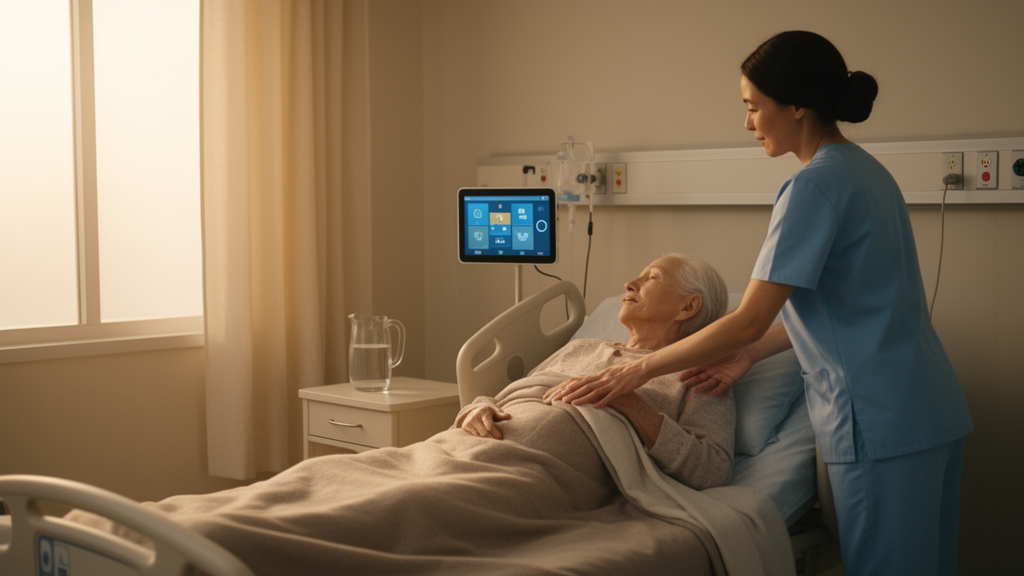
Walk into a modern smart hospital ward and you will find a curious piece of technology bolted beside nearly every bed: an interactive digital terminal known as a Smart Bedside Station, or SBS. These bedside systems promise hospitalized patients direct access to health information, transparent expense records, laboratory reports, nurse call functions, and even entertainment, all from a screen within arm’s reach. The vision is seductive. Instead of waiting for a nurse to explain a medication or hunting down a bill, patients could theoretically engage with their own care whenever they wish. Yet a new qualitative study from Lanzhou University researchers, published in the Journal of General Internal Medicine, reveals a sobering reality: the technology is often switched on but rarely switched into patients’ daily routines, and the single most powerful driver of actual use is not the software at all. It is the nurse standing at the bedside.
The research team, led by Junfang Shi, Zeyu Li, and Peifen Ma of the School of Nursing at Lanzhou University and the Second Hospital of Lanzhou University, set out to systematically map why some patients embrace these bedside terminals while others abandon them. Their approach was deliberately grounded in evidence rather than speculation. In September 2024, the researchers conducted semi-structured interviews with thirteen hospitalized inpatients aged 22 to 73 years, nine men and four women, all of whom had prior experience using the Smart Bedside Station system at their hospital. Participants were recruited through purposive sampling, meaning the team deliberately selected patients with direct hands-on experience of the technology rather than relying on convenience. To structure the inquiry, the researchers turned to one of the most influential frameworks in technology adoption research: the Unified Theory of Acceptance and Use of Technology, or UTAUT.
UTAUT, first formalized by Venkatesh and colleagues in 2003, distills decades of technology acceptance research into four core constructs that predict whether a person will actually use a new system. Performance expectancy captures the belief that the technology will help the user accomplish something valuable. Effort expectancy reflects how easy the user perceives the system to be. Social influence describes the pressure or encouragement a user feels from important others, such as clinicians or family members. Facilitating conditions encompass the environmental supports, training, and infrastructure that make use possible. The Lanzhou team used these constructs to design their interview guide and then applied a hybrid thematic analysis, combining deductive coding against the UTAUT framework with inductive coding that allowed unexpected themes to surface from the raw interview data. What emerged was a remarkably detailed picture of the psychology of bedside technology adoption: ten distinct facilitators and fifteen distinct barriers to system use.
The facilitators tell a clear story about what makes patients reach for the bedside screen. Eleven of the thirteen participants first learned about the system from nurses, with only two discovering it through self-exploration, and nurse instruction and encouragement emerged as a dominant social influence driving initial engagement. Trustworthy educational videos delivered through the terminal supported performance expectancy, giving patients confidence that the health information they were watching was clinically reliable rather than internet noise. Transparent access to personal expenses and medical reports strengthened the perception that the system offered real, tangible value. Convenient call functions and entertainment options rounded out the appeal. Meanwhile, a simple interface reduced effort expectancy, making the system feel approachable even to patients who were not technologically confident. In UTAUT terms, the system’s clinical utility, nursing guidance, and environmental supports were doing the heavy lifting of adoption.
But the barriers, fifteen of them, reveal why sustained use collapses so quickly. The most fundamental obstacle was limited perceived added value: many patients simply saw the bedside terminal as redundant when they already carried a personal smartphone capable of similar functions. Treatment-time constraints meant that hospital schedules packed with medications, procedures, and rounds left little cognitive or temporal room for exploring a new interface. Information and feature overload overwhelmed users who confronted too many options at once. Delayed or lagging updates frustrated patients who expected the responsiveness of consumer technology. Interface misperception led some users to misunderstand what the system could actually do. And perhaps most tellingly, fear of misoperation or unintended charges made patients hesitant to touch anything at all, worried that a wrong tap might trigger a fee or disrupt their care. Older age and lower educational attainment further compounded these frictions, echoing a well-documented digital divide in eHealth research.
The usage statistics embedded in the study underscore how shallow engagement often was. Use was short-term for most participants, and only 15.4 percent of the sample reported using the system for more than thirty days. This is a critical finding for anyone designing patient-facing hospital technology. Initial exposure, often brokered by a nurse during admission, was sufficient to spark curiosity, but without perceived added value beyond the patient’s own phone, and without system reliability and workflow compatibility, that curiosity rarely matured into habitual use. The pattern mirrors findings from other health information technology evaluations, including mixed-method studies of health information exchange in England and qualitative research on digital devices for home use, where technology acceptance hinges on the same balance of usefulness, ease, social endorsement, and environmental support.
What makes this study technically important is its theoretical mapping. By anchoring facilitators and barriers to the four UTAUT constructs, the researchers transformed anecdotal patient complaints into a structured framework that hospital administrators and software designers can act upon. Nurse instruction and encouragement map to social influence, suggesting that nursing workflows should formally incorporate bedside system onboarding rather than leaving it to chance. Trustworthy video education and transparent expense access map to performance expectancy, indicating that content quality and data transparency are not cosmetic features but core adoption drivers. A simple interface maps to effort expectancy, reinforcing the principle that patient-facing clinical systems must be radically simpler than consumer apps. Facilitating conditions, from training to system maintenance, emerged as the environmental scaffolding that determines whether any of the other drivers can operate at all.
The barriers, mapped against the same framework, expose the cognitive and workflow burdens that constrain adoption. Information overload and feature overload suggest that designers should resist the temptation to pack every possible function into the bedside terminal, a lesson consistent with research on information retention in first-time hearing aid users, where multimedia education outperformed dense verbal counseling. Fear of misoperation and unintended charges points to a trust problem that requires explicit reassurance, perhaps through clear on-screen confirmation of free versus paid functions. Lagging updates and system frictions indicate that facilitating conditions were not fully met, meaning that maintenance, content freshness, and technical support are as important as interface design. Treatment-time constraints remind us that patient engagement technology must fit within the rhythms of clinical care, not compete against them.
The implications ripple outward to the broader smart hospital movement. As hospitals worldwide invest in digital transformation, from electronic health records to IoT-enabled patient monitoring platforms, the Lanzhou findings offer a cautionary technical lesson: hardware installation is not adoption. A bedside terminal bolted to a wall is merely infrastructure; adoption requires nursing guidance, perceived clinical utility, cognitive simplicity, and system reliability. The researchers conclude that addressing barriers and enhancing system features is essential to improve patient engagement and satisfaction, ultimately facilitating wider adoption of Smart Bedside Station systems in smart hospitals. For a field racing to digitize the patient experience, the message is clear. The most important interface in a smart ward is not the screen at all. It is the conversation between a nurse and a patient, and the technology that survives will be the technology that nurse chooses to recommend.
Subject of Research: Facilitators and Barriers of Using Smart Bedside Station Systems Among Hospitalized Patients: A Qualitative Study Based on UTAUT
Article Title: Facilitators and Barriers of Using Smart Bedside Station Systems Among Hospitalized Patients: A Qualitative Study Based on UTAUT
Article References: Shi, J., Li, Z., Dai, Y., Chen, X., Yang, L., Wang, X., & Ma, P. (2026). Facilitators and Barriers of Using Smart Bedside Station Systems Among Hospitalized Patients: A Qualitative Study Based on UTAUT. Journal of General Internal Medicine. https://doi.org/10.1007/s11606-026-10663-5
Image Credits: AI Generated
DOI: 10.1007/s11606-026-10663-5
Keywords: smart bedside station, UTAUT, patient engagement, smart hospital, health information technology, qualitative research, Facilitators, Barriers, Smart, Bedside, Station, Systems
Cite Scienmag News
Ophelia Keating. (October 17, 2026). Why Patients Ignore Smart Bedside Terminals: Nurses Hold the Key. Scienmag. https://scienmag.com/why-patients-ignore-smart-bedside-terminals-nurses-hold-the-key/
Ophelia Keating. "Why Patients Ignore Smart Bedside Terminals: Nurses Hold the Key." Scienmag, 17 October 2026, https://scienmag.com/why-patients-ignore-smart-bedside-terminals-nurses-hold-the-key/. Accessed 17 October 2026.
Ophelia Keating. "Why Patients Ignore Smart Bedside Terminals: Nurses Hold the Key." Scienmag. October 17, 2026. https://scienmag.com/why-patients-ignore-smart-bedside-terminals-nurses-hold-the-key/


