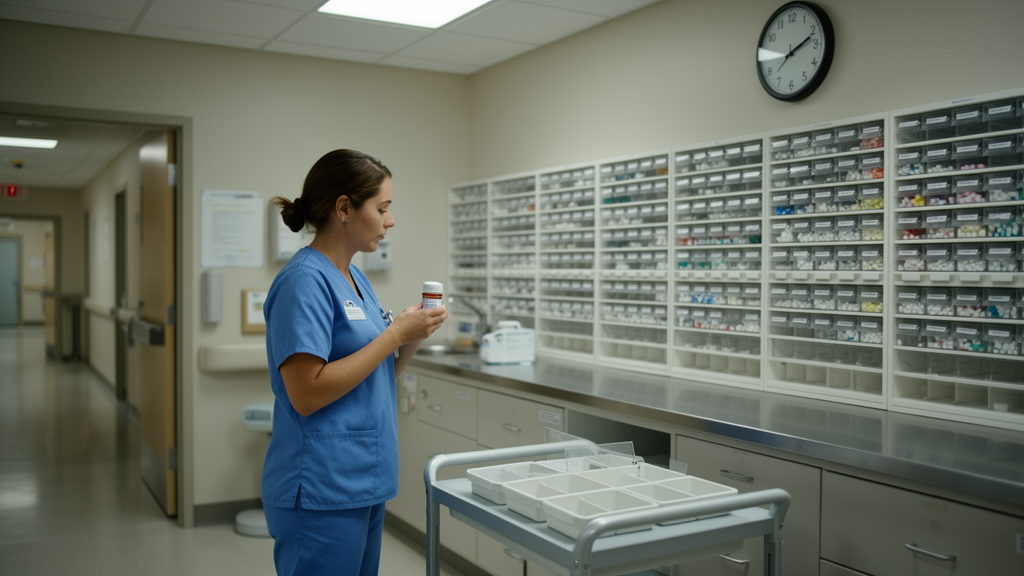
Every day in hospitals around the world, patients miss doses of medications they were supposed to receive. Sometimes a pill is delayed by an hour; sometimes it is never given at all. These incidents, known as delayed or omitted medication events, are among the most frequently reported types of medication errors in both retrospective analyses and observational studies of hospital care. While it is tempting to blame individual carelessness, a new interview study from Norway suggests the reality is far more complicated, pointing instead to a tangled web of organizational, human, patient-related, and technological factors that conspire to make doses disappear from the medication round.
The study, published in BMC Health Services Research by Malin Holte of the University of Bergen and Nord University together with colleagues at the Western Norway Hospital Pharmacy Trust, set out to understand why these omissions happen from the perspective of the people who administer most hospital medications: nurses. Rather than combing through incident report databases, the researchers went straight to the front line, conducting nine semi-structured interviews with nurses working on medical, surgical, and psychiatric wards across three Norwegian hospitals. Participants were recruited through purposive sampling, a technique designed to capture informants with direct, relevant experience of the phenomenon under investigation.
Methodologically, the team took a two-step analytical approach. The verbatim transcripts were first analyzed using systematic text condensation, an inductive method for thematic analysis that allows patterns to emerge from the data without imposing pre-existing categories. The themes that surfaced were then mapped deductively onto the International Classification for Patient Safety, or ICPS, a framework developed by the World Health Alliance for Patient Safety to standardize how the global health community talks about hazards, incidents, and contributing factors. This hybrid strategy gave the researchers both the richness of nurses’ own accounts and a common conceptual language for identifying where targeted interventions might work.
The analysis yielded four main categories of contributing factors: staff-related, patient-related, organizational, and external. What struck the researchers most was that organizational factors dominated the conversation. Nurses described how tasks were organized and distributed, how workload surged and ebbed across shifts, how collaboration between professions functioned or faltered, and how workplace culture and feedback loops shaped whether errors were caught or repeated. In other words, the system in which nurses work appeared to be a more powerful driver of omission incidents than any individual lapse.
Staff-related issues formed a second cluster, and here the interviews revealed the everyday compromises of clinical practice. Nurses admitted to procedural deviations, such as failing to check whether a patient had actually taken a medication that had been left at the bedside, or consciously prioritizing which medications to administer when a shift became overwhelmingly busy. These are not acts of negligence in the caricatured sense; they are triage decisions made under time pressure, where the consequences of a delayed dose are invisible compared with the immediate demands of a deteriorating patient or a ringing call bell. The study illustrates how rational prioritization in the moment can quietly produce the very incidents that safety systems later record as errors.
Patient-related factors added another layer of complexity. Health conditions such as swallowing difficulties can make tablet administration impossible at the scheduled time, forcing delays or requiring alternative formulations that may not be readily available. When a patient cannot swallow, the responsibility for obtaining and administering a liquid or alternative form of the drug can become unclear, and the dose may simply fall through the cracks. This finding connects directly to one of the more striking organizational observations in the study: confusion among staff about who is responsible for administering non-tablet dosage forms, such as injections, infusions, and oral liquids, where the neat division of labor around pill rounds breaks down.
External factors, though less prominent than organizational ones, exposed how technology intended to improve safety can inadvertently create new failure modes. Nurses reported that medication administration records were not always fully displayed on smaller screens, meaning that critical information about what a patient should receive could be hidden from view during the medication round. Digital tools and equipment limitations of this kind are a classic example of what human factors researchers call automation- or interface-induced error: the system works, but only under assumptions about screen size, display layout, and workflow that do not always hold on a busy ward.
Mapping these findings onto the ICPS framework did more than tidy the results into boxes. It contextualized the contributing factors and highlighted where interventions are most likely to succeed. Because organizational factors emerged as the most prominent theme, the authors argue that improving organization and the underlying systems in response to incident reports is the key lever for reducing medication omission incidents and enhancing patient safety. This aligns with a foundational principle of modern patient safety thinking: humans err predictably, and resilient systems are designed with that predictability in mind rather than expecting flawless individual performance.
The study also carries a methodological lesson for the field. Incident reporting systems, which many hospitals rely on to detect medication errors, capture only what staff choose to report, and they rarely explain why an incident occurred. Interview studies like this one complement quantitative data by surfacing the lived logic of the medication round, including the informal workarounds, the ambiguous responsibilities, and the quiet prioritizations that never make it into a report. By combining nurses’ narratives with an internationally recognized classification framework, the Norwegian team has produced a roadmap that other hospitals can adapt when investigating their own omission incidents.
The implications reach well beyond Norway. Patient safety is a global health challenge, and delayed or omitted medications are among the most common medication errors reported worldwide. The picture that emerges from this study is of a multifactorial problem that cannot be solved by exhorting nurses to be more careful. Instead, hospitals must examine how tasks are allocated, how workload is managed, how responsibility for non-standard dosage forms is assigned, how digital systems present critical information, and how feedback from incident reports flows back into practice. Where those systems are improved, the invisible failures of the medication round become visible, and visible failures can finally be fixed.
Subject of Research: Causes of delayed or omitted medication administration incidents in Norwegian hospital wards
Article Title: Causes of incidents of delayed or omitted medications – an interview study
Article References: Causes of incidents of delayed or omitted medications – an interview study. (n.d.). https://doi.org/10.1186/s12913-026-15856-6
Image Credits: AI Generated
DOI: 10.1186/s12913-026-15856-6
Keywords: patient safety, medication errors, medication omission, nursing, hospital wards, incident reporting, ICPS framework, workload, digital health tools, health services research, Norway, qualitative interviews
Cite Scienmag News
Ophelia Keating. (October 14, 2026). Why Hospital Medications Go Missing: Nurses Reveal the Hidden Causes of Omitted Doses. Scienmag. https://scienmag.com/why-hospital-medications-go-missing-nurses-reveal-the-hidden-causes-of-omitted-doses/
Ophelia Keating. "Why Hospital Medications Go Missing: Nurses Reveal the Hidden Causes of Omitted Doses." Scienmag, 14 October 2026, https://scienmag.com/why-hospital-medications-go-missing-nurses-reveal-the-hidden-causes-of-omitted-doses/. Accessed 14 October 2026.
Ophelia Keating. "Why Hospital Medications Go Missing: Nurses Reveal the Hidden Causes of Omitted Doses." Scienmag. October 14, 2026. https://scienmag.com/why-hospital-medications-go-missing-nurses-reveal-the-hidden-causes-of-omitted-doses/