


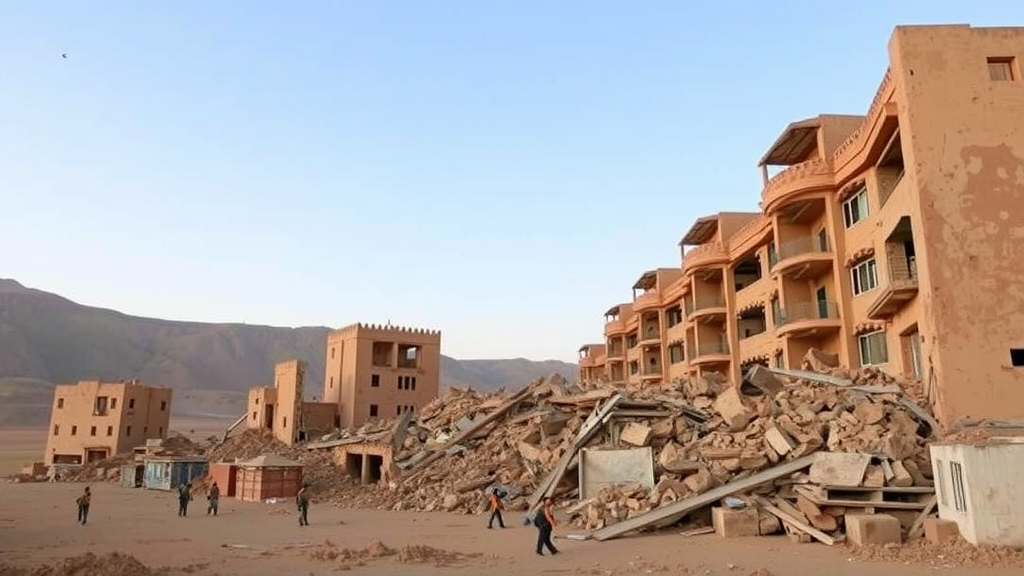
When a magnitude 6.8 earthquake tore through Morocco’s High Atlas mountains on 8 September 2023, it did not discriminate between modern and traditional construction, but the consequences were starkly different. In the rural provinces of Al Haouz and Taroudant, where much of the housing stock is built from earth, the shaking proved catastrophic. According to data from the Moroccan Ministry of the Interior cited by researchers, the earthquake killed 1,684 people in Al Haouz province and 979 in Taroudant province. A new study published in the Bulletin of Earthquake Engineering now dissects exactly why so many earthen buildings failed, combining field surveys of damaged structures with geotechnical investigations of the hardest-hit areas, and proposes practical construction guidelines intended to make adobe, rammed earth, and stone buildings survivable in future events.
The research, led by laila TAOUFIQ of Ibn Zohr University and Universiapolis in Agadir, together with Mehdi Harrak, Mimoun Chourak, and Fatima Ezzahra Arrakhiz, set out to identify the root causes of structural failure rather than simply cataloguing the destruction. Earthen buildings constitute a substantial portion of the rural housing stock in the affected High Atlas region, and their vulnerability has long been recognized by earthquake engineers. Morocco does have a seismic regulation specifically for earthen constructions, known as RPCT11, adopted by decree in 2013, but the study’s findings suggest that both the regulation and everyday building practice fell short of what the Al Haouz earthquake demanded. The team frames its work as a direct contribution to seismic risk reduction strategy and to the revision and update of RPCT11 itself.
Field observations revealed a consistent pattern of damage across the affected villages. The most common failures included cracks and outright collapse of masonry walls, the fall of roofs and floors, out-of-plane failure in which walls toppled bodily outward or inward perpendicular to their surface, and failures originating at the foundation level. Each of these modes tells a mechanical story. Unreinforced earthen walls are strong in compression but weak in tension and shear, so when ground shaking imposes lateral forces, the walls crack along diagonal planes or separate at corners. Once the box-like integrity of the building is lost, walls acting as independent vertical cantilevers have little resistance left, and out-of-plane collapse follows, often bringing heavy timber-and-earth roofs down with them.
The authors attribute the observed damage to a combination of factors rather than a single cause. Structural deficiencies ranked high: many buildings lacked the wall-to-wall and wall-to-roof connections that allow a structure to behave as a unified three-dimensional frame during shaking. Material limitations compounded the problem, since unfired earth has inherently modest strength, and moisture content, clay mineralogy, and compaction quality all influence how much load an earthen wall can carry. Weak connections between roofing systems and supporting walls meant that roofs could detach and fall as rigid masses, a particularly lethal failure mode. Finally, unfavorable topographical and geotechnical conditions amplified ground motion in some locations, placing certain buildings on ground that shook harder and longer than adjacent sites.
To understand these site effects and soil-structure interactions, the team investigated geotechnical parameters in the most severely affected areas. Such investigations typically involve characterizing the soils on which buildings rest, including particle size distribution, plasticity limits determined through Atterberg tests, and compaction characteristics measured by Proctor testing, all of which appear in the study’s reference framework of Moroccan and international standards. Soft or loose soils can amplify seismic waves and lengthen the duration of strong shaking, while steep mountain slopes in the High Atlas can concentrate motion near ridge crests. When vulnerable earthen structures sit on amplifying ground, the demand placed on already weak walls can exceed their capacity by a wide margin, which helps explain the localized severity of collapse observed in some villages.
The earthquake itself was an unusual and sobering event for Moroccan seismology. Scientific work cited by the study describes the rupture as intraplate reverse faulting within the High Atlas mountain belt, with a deep transpressive fault accommodating the shortening of the African plate’s interior. The event, sometimes referred to as the Adassil earthquake, occurred on a steep reverse fault in the deep crust, and rapid source characterization confirmed its magnitude at 6.8. Morocco’s earthquake catalog, which extends back more than a millennium, records destructive events in the region, but the 2023 earthquake struck a mountainous rural zone where building vulnerability, rather than ground motion alone, controlled the death toll.
What distinguishes the new study is its constructive response to the failure evidence. Based on their findings, the researchers propose a guideline for the construction of buildings made of adobe, rammed earth, and stone, the three dominant earthen and semi-earthen technologies of the region. Adobe involves sun-dried mud bricks laid in mud mortar, rammed earth consists of moist soil compacted in layers within formwork, and stone masonry uses locally quarried rock, often with weak mud mortar in rural practice. The recommendations aim to enhance the seismic resilience of all three building types and to improve protection for both people and their cultural heritage, a dual goal that reflects the region’s extraordinary legacy of earthen architecture, from kasbahs to vernacular village houses.
The engineering logic behind such guidelines draws on a broad international literature that the study situates itself within. Research following earthquakes in Nepal, Turkey, Peru, Italy, and Greece has repeatedly shown that simple, low-cost measures can transform the survival prospects of unreinforced masonry and earthen buildings. Horizontal seismic bands or ring beams at wall tops and floor levels tie the structure together and prevent walls from separating; corner and junction reinforcement resists cracking at the weakest points; and roof lightening reduces the inertial forces and the deadly falling mass. Experimental work on adobe walls strengthened with timber ring beams, on rammed earth reinforced with natural fibers such as coir and bamboo, and on stone masonry retrofitted with reinforced mortar coatings all point toward interventions that remain affordable and culturally acceptable in rural communities.
Material science offers another layer of improvement. Studies of stabilized earth blocks show that small additions of cement or lime can raise strength and durability, though researchers caution that excessive stabilization undermines the environmental advantages that make earthen construction attractive in the first place. Rammed earth’s mechanical behavior is sensitive to moisture content and compaction energy, and modern testing standards now allow engineers to characterize earthen materials with the same rigor applied to conventional construction materials. The Moroccan context is particularly well studied: earlier characterization of soils from the Haouz plain and from oases in southeastern Morocco has documented the suitability of local earth for construction, provided that grading, plasticity, and stabilization are controlled. The new guidelines translate this accumulated knowledge into rules that builders on the ground can actually follow.
The stakes extend beyond Morocco. Earthen construction houses a substantial fraction of the world’s rural population, and as climate change intensifies interest in low-carbon building materials, earth is enjoying renewed attention as a sustainable alternative to fired brick and concrete. The Al Haouz earthquake demonstrated in the starkest terms that sustainability and safety must advance together: a building material with excellent embodied-energy credentials is of little value if it collapses in a moderate earthquake. By documenting failure mechanisms systematically and feeding the results into the revision of RPCT11, the Moroccan team offers a template for other earthquake-prone countries with rich earthen building traditions. The goal, as the authors put it, is to enhance seismic resilience and improve protection for both people and their cultural heritage, ensuring that the architecture of the High Atlas can continue to house generations without becoming their grave.
Subject of Research: Seismic failure mechanisms and resilience improvement of earthen buildings after the 2023 Al Haouz earthquake in Morocco
Article Title: Analysis of failure mechanisms in earthen buildings after the 2023 Al Haouz earthquake in Morocco and improvement solutions
Article References: TAOUFIQ, L., Harrak, M., Chourak, M., & Arrakhiz, F. E. (2026). Analysis of failure mechanisms in earthen buildings after the 2023 Al Haouz earthquake in Morocco and improvement solutions. Bulletin of Earthquake Engineering. https://doi.org/10.1007/s10518-026-02693-5
Image Credits: AI Generated
DOI: 10.1007/s10518-026-02693-5
Keywords: Al Haouz earthquake, Morocco, earthen buildings, adobe, rammed earth, stone masonry, seismic vulnerability, out-of-plane failure, geotechnical investigation, RPCT11, High Atlas, cultural heritage
Cite Scienmag News
Violet Maxwell. (September 27, 2026). Why Earthen Buildings Collapsed in Morocco’s 2023 Al Haouz Earthquake. Scienmag. https://scienmag.com/why-earthen-buildings-collapsed-in-moroccos-2023-al-haouz-earthquake/
Violet Maxwell. "Why Earthen Buildings Collapsed in Morocco’s 2023 Al Haouz Earthquake." Scienmag, 27 September 2026, https://scienmag.com/why-earthen-buildings-collapsed-in-moroccos-2023-al-haouz-earthquake/. Accessed 4 October 2026.
Violet Maxwell. "Why Earthen Buildings Collapsed in Morocco’s 2023 Al Haouz Earthquake." Scienmag. September 27, 2026. https://scienmag.com/why-earthen-buildings-collapsed-in-moroccos-2023-al-haouz-earthquake/


