


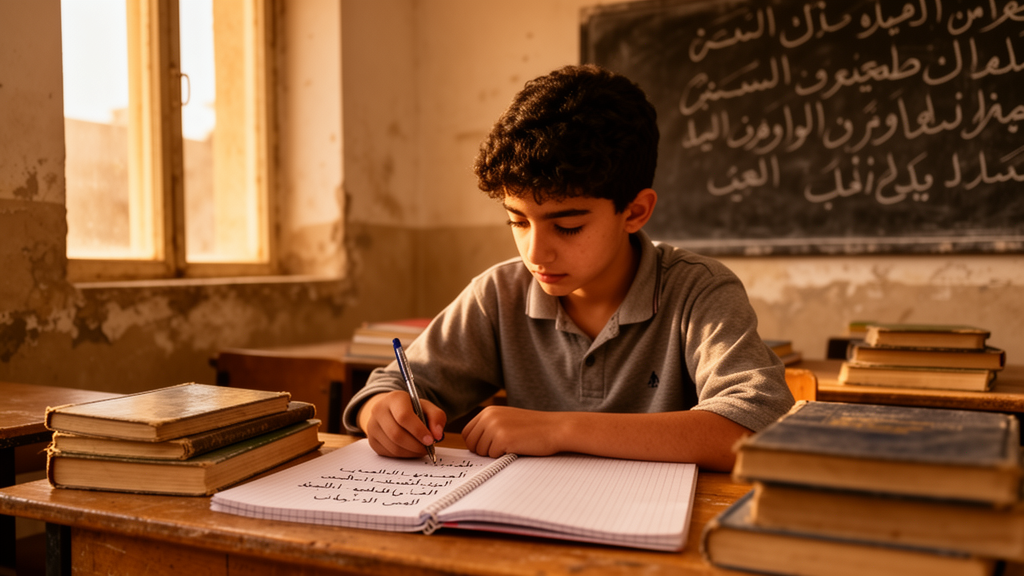
When refugee families return home after years of displacement, the assumption is often that children will simply pick up where they left off. A new study published in PLOS One challenges that assumption in a striking way. Researchers followed Syrian middle-school students who had spent several years in Turkish-medium schools in Türkiye and then returned to Arabic-medium classrooms in Syria after voluntary return. Far from experiencing a smooth linguistic homecoming, the students encountered what the authors describe as a reverse academic transition, one marked by profound difficulties with academic Arabic, conceptual transfer between languages, written production, and unfamiliar assessment practices. The findings suggest that return migration is not the end of an educational journey but the beginning of a distinct and demanding new phase.
The research team, led by Sevda Dolapcioglu with Yunus Emre Akbana, İlayda Uzun, and Gülten Koşar, used an exploratory qualitative design to capture the students’ experiences. Data were collected through a seven-item open-ended written questionnaire administered to 15 middle-school students who had received several years of formal schooling in Türkiye. The researchers then applied qualitative content analysis to identify recurring themes across the responses. This approach allowed the team to examine how returnee students experience the linguistic, academic, social, and psychosocial dimensions of re-entering an education system taught in a language they may read and speak at home but have rarely used for academic work.
One of the study’s central insights concerns the nature of bilingual development in displacement. Children who attend school in a host country typically develop strong conversational skills in the host language while their literacy in the home language may stagnate or develop unevenly. For Syrian students in Türkiye, this meant that everyday Turkish could be fluent while academic Arabic, the register required for science, mathematics, literature, and formal writing, remained underdeveloped. When these students returned to Syria, they faced textbooks, teacher explanations, and examinations conducted almost entirely in formal Arabic. The gap between conversational competence and academic language proficiency, a distinction long recognized in bilingual education research, became the central obstacle to their reintegration.
The content analysis revealed that the students’ struggles extended well beyond vocabulary. Participants reported difficulty with conceptual transfer, the process of carrying ideas and subject knowledge learned in one language of instruction into another. A student who understood a mathematical procedure in Turkish, for example, might struggle to name its components, follow an Arabic explanation, or reproduce the reasoning in written Arabic. Written production emerged as a particularly acute challenge, since formal Arabic demands different orthographic, grammatical, and rhetorical conventions than spoken dialects. The students also described in-class assessment practices that felt unfamiliar and, in their perception, unclear, compounding the sense that their prior learning did not translate directly into success in the new system.
Crucially, the study argues that these difficulties cannot be attributed to individual deficits alone. The researchers found that the students’ challenges were shaped by a web of structural factors: uneven Arabic literacy development, curriculum misalignment between the Turkish and Syrian systems, pedagogical practices that participants perceived as more teacher-directed than the instruction they had experienced in Türkiye, limited peer interaction in the new classrooms, and assessment practices that students found hard to interpret. In other words, the mismatch was systemic. The curriculum, the teaching style, the social dynamics, and the evaluation methods all changed at once, and no bridging mechanism existed to help students navigate the transition.
The psychosocial dimension added another layer of complexity. Participants described re-migration-related distress, difficulty concentrating in class, and increased family responsibilities that competed with their studies. Return migration, even when voluntary and long-awaited, is itself a stressful life event. Families often return to communities that have changed, to homes that may be damaged, and to economic uncertainty. For adolescents, these pressures arrive at precisely the moment when academic demands intensify. The study’s findings indicate that psychosocial strain and academic struggle reinforce each other, making it harder for students to engage with the very linguistic and curricular challenges they face.
By conceptualizing return as a distinct educational phase, the researchers contribute to broader discourses on refugee education and bilingualism. Most existing research examines refugee students’ adaptation in host countries, following their progress as they learn a new language and adjust to a new curriculum. The reintegration phase after voluntary return has remained underexplored, and this study helps fill that gap. The Turkish case is significant because Türkiye hosted one of the largest Syrian refugee populations in the world, and hundreds of thousands of students passed through Turkish schools. As returns accelerate, the question of how these children re-enter Arabic-medium schooling becomes a matter of educational policy with implications far beyond a single border.
The implications the authors draw are concrete. They underscore the critical need for academic Arabic bridging programs that explicitly target the register of schooling rather than everyday conversation. They call for background-sensitive assessment frameworks that take a student’s prior schooling into account rather than measuring them against peers who never left the system. They advocate psychosocially responsive pedagogies that recognize the emotional weight of return, and school-based psychosocial support services that address distress before it undermines learning. Each recommendation follows directly from the themes that emerged in the content analysis, giving the findings practical weight for ministries, schools, and teachers working with returnee populations.
For the international education community, the study reframes a common narrative. The story of refugee education is usually told as a one-way journey of integration into a host society. This research shows that the return leg of that journey deserves equal attention, and that linguistic recovery is not automatic simply because a child is going back to a country where the official language matches their heritage. Academic language is learned in classrooms, through sustained instruction and literacy practice, and years spent in another language of instruction create real gaps that persist after the return flight lands. Recognizing return as its own educational transition, with its own pedagogical demands, is the first step toward designing support that actually works.
The study also carries a message about how educational systems measure success. When a returnee student underperforms on an Arabic examination, the easy interpretation is that the student failed to keep up. The evidence from this research points in the opposite direction: the students arrived with valuable multilingual resources and prior academic knowledge, but the receiving system offered no structured pathway for those assets to transfer. The struggles documented here reflect institutional and contextual mismatches rather than individual shortcomings. As voluntary returns continue, the researchers’ call for bridging programs, sensitive assessment, and psychosocial support offers a blueprint for turning a hidden challenge into a manageable transition, one classroom at a time.
Subject of Research: Linguistic and academic re-adaptation of Syrian returnee students to Arabic-medium schooling after voluntary return from Türkiye
Article Title: The hidden challenges of return migration: Linguistic and academic re-adaptation of Syrian students to the Arabic Education System
Article References: Dolapcioglu, S., Akbana, Y. E., Uzun, İ., & Koşar, G. (2026). The hidden challenges of return migration: Linguistic and academic re-adaptation of Syrian students to the Arabic Education System. PLOS One, 21(10), e0361042. https://doi.org/10.1371/journal.pone.0361042
Image Credits: AI Generated
DOI: 10.1371/journal.pone.0361042
Keywords: return migration, Syrian students, refugee education, academic Arabic, bilingualism, Türkiye, PLOS One, qualitative study, educational reintegration, psychosocial support, curriculum misalignment, language proficiency
Cite Scienmag News
Gavin Prescott. (October 18, 2026). When Syrian Students Return Home, the Hardest Lesson Is Their Own Language. Scienmag. https://scienmag.com/when-syrian-students-return-home-the-hardest-lesson-is-their-own-language/
Gavin Prescott. "When Syrian Students Return Home, the Hardest Lesson Is Their Own Language." Scienmag, 18 October 2026, https://scienmag.com/when-syrian-students-return-home-the-hardest-lesson-is-their-own-language/. Accessed 18 October 2026.
Gavin Prescott. "When Syrian Students Return Home, the Hardest Lesson Is Their Own Language." Scienmag. October 18, 2026. https://scienmag.com/when-syrian-students-return-home-the-hardest-lesson-is-their-own-language/


