


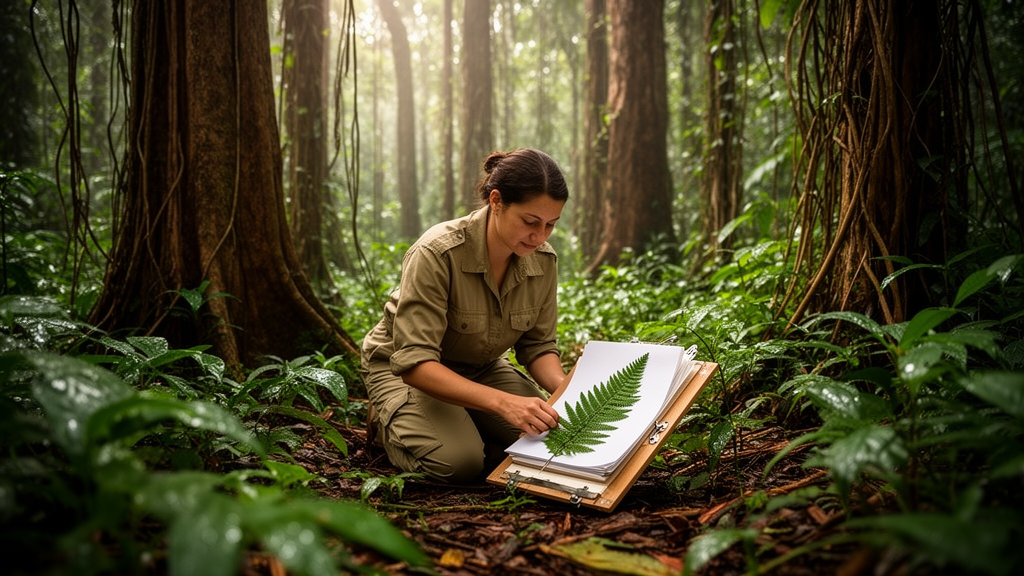
The Democratic Republic of the Congo, home to the second-largest continuous rainforest on Earth, has long been a critical yet under-documented reservoir of global biodiversity. A new comprehensive checklist published in the journal PhytoKeys provides the first up-to-date, taxonomically reliable inventory of the country’s vascular plant flora. This extensive compilation, based on literature reviews, online databases, and herbarium collections, records 10,260 species belonging to 246 families. The inventory is a crucial step toward addressing the urgent need for accurate biodiversity data in tropical Africa, where such inventories remain highly incomplete despite the region’s immense ecological significance.
The study reveals that the DRC’s flora is dominated by angiosperms, which account for 9,859 of the total species, or approximately 96% of the recorded flora. Gymnosperms are sparsely represented, a pattern typical of tropical Africa, while pteridophytes, including lycophytes and monilophytes, make up less than 4% of the total. The five largest families in the checklist are Fabaceae, which comprises 11.8% of the specific richness, followed by Rubiaceae at 6.7%, Asteraceae at 6.6%, Poaceae at 6.1%, and Orchidaceae at 5.6%. This taxonomic spectrum mirrors broader patterns observed across tropical Africa, although certain families like Rubiaceae and Orchidaceae are notably overrepresented in the DRC compared to the sub-Saharan average.
One of the most striking findings of the checklist is the high level of endemism in the country. A total of 1,099 species are identified as strict endemics, representing 10.7% of the total flora. This places the DRC second only to Tanzania in terms of the number of endemic species among tropical mainland African countries. The geographic distribution of these endemics is highly uneven, with significant concentrations in the eastern and southeastern regions, particularly in the Kivu and Katanga provinces. These areas are recognized as bioquality hotspots, characterized by a high proportion of rare species and high floristic turnover per unit area.
The presence of introduced species in the DRC is also documented in the checklist, with 461 species recorded outside of cultivation, accounting for 4.5% of the total flora. This proportion is comparable to many other tropical African countries but is lower than in nations like Chad and Mozambique. Families such as Solanaceae, Brassicaceae, and Amaranthaceae stand out for their higher-than-average proportions of introduced species, a trend often linked to the economic use and domestication of plants. The checklist notes that the number of introduced species is significantly correlated with the number of native species across families, reflecting the global pattern of naturalization driven by human activity.
In terms of growth forms, herbs are the most frequent life form in the DRC’s vascular flora, representing 54% of all species. This is followed by subshrubs at 17%, trees at 14.5%, climbers at 10%, and epiphytes at 4%. The study highlights a significant difference in the life form spectrum among endemics, native non-endemics, and introduced species. Herbs and subshrubs are overrepresented among endemics, likely due to the taxonomic assemblage of endemic species, which includes a high proportion of herbaceous families. In contrast, introduced species are markedly biased toward herbaceous forms and short-lived species with high reproductive capacity, a pattern well-documented globally.
The conservation status of the DRC’s flora is a cause for concern, as the IUCN Red List assessment was retrieved for only 2,633 species, or 25.7% of the total. Of these, two species are classified as extinct, and 448 are assigned to a threat category, including 36 Critically Endangered, 184 Endangered, and 228 Vulnerable species. Among the endemic species, 184 have been evaluated, with 133, or 73%, considered extinct or threatened. The two extinct species are narrow endemic metallophytes from copper-rich soils in Haut-Katanga, which were destroyed by mining activities. The study emphasizes the urgent need for a comprehensive assessment of the conservation status of all recorded species, particularly endemics, to inform effective conservation planning.
The checklist also underscores the severe under-sampling of the DRC’s flora, with the number of herbarium gatherings per square kilometer far below the recommended minimum. The largest herbarium collection for the DRC is housed at the Meise Botanic Garden in Belgium, which holds close to 500,000 vascular plant records. Despite this, the country remains one of the least-explored territories in Africa in terms of its flora, with exploration efforts heavily concentrated around major cities and the Albertine Rift mountains. New species continue to be described based on material collected in the DRC, indicating that the total number of vascular plant species in the country will likely increase in the coming years.
The production of this checklist was facilitated by the availability of online resources, including digitized specimen data and taxonomic backbone information from global facilities such as the World Flora Online and the World Checklist of Vascular Plants. The study involved extensive validation by taxonomic and floristic specialists, ensuring that the occurrence of almost all species is confirmed by direct or indirect reference to a herbarium specimen. This rigorous approach to data collection and validation provides a solid foundation for future floristic and taxonomic research in the DRC, addressing the gaps identified in the country’s National Biodiversity Strategy and Action Plan.
In conclusion, this comprehensive inventory highlights the exceptional species richness and endemism of the DRC, underscoring its critical importance for the conservation of botanical diversity in tropical Africa. The study calls for intensified botanical exploration, particularly in poorly documented regions, and taxonomic revision of insufficiently known groups. A comprehensive assessment of the conservation status of all recorded species is urgently needed, with a priority on endemic species, to build on existing efforts such as the Red List of endemic and near-endemic trees. Improved understanding of the spatial patterns of endemic plant diversity will be essential to inform conservation planning and prioritization efforts in the face of ongoing threats such as deforestation, mining, and political instability.
Subject of Research: A checklist of the vascular plants of the Democratic Republic of the Congo
Article Title: A checklist of the vascular plants of the Democratic Republic of the Congo
Article References: Meerts, P., Ballings, P., Barberá, P., Bauters, K., Beentje, H., Cheek, M., Couvreur, T. L. P., Damen, T. H. J., de Almeida, R. F., De Block, P., de la Estrella, M., Dessein, S., Engledow, H., Fischer, E., Gautier, L., Haigh, A., Harris, D. J., Hetterscheid, W., Jongkind, C. C. H., … Zuloaga, F. (2026). A checklist of the vascular plants of the Democratic Republic of the Congo. PhytoKeys, 277, 1-23. https://doi.org/10.3897/phytokeys.277.193807
Image Credits: AI Generated
DOI: 10.3897/phytokeys.277.193807
Keywords: checklist, vascular, plants, Democratic, Republic, Congo, scientific research
Cite Scienmag News
Margaret Porter. (October 18, 2026). New Checklist Maps Congo’s 10,260 Vascular Plant Species. Scienmag. https://scienmag.com/new-checklist-maps-congos-10260-vascular-plant-species/
Margaret Porter. "New Checklist Maps Congo’s 10,260 Vascular Plant Species." Scienmag, 18 October 2026, https://scienmag.com/new-checklist-maps-congos-10260-vascular-plant-species/. Accessed 18 October 2026.
Margaret Porter. "New Checklist Maps Congo’s 10,260 Vascular Plant Species." Scienmag. October 18, 2026. https://scienmag.com/new-checklist-maps-congos-10260-vascular-plant-species/


