


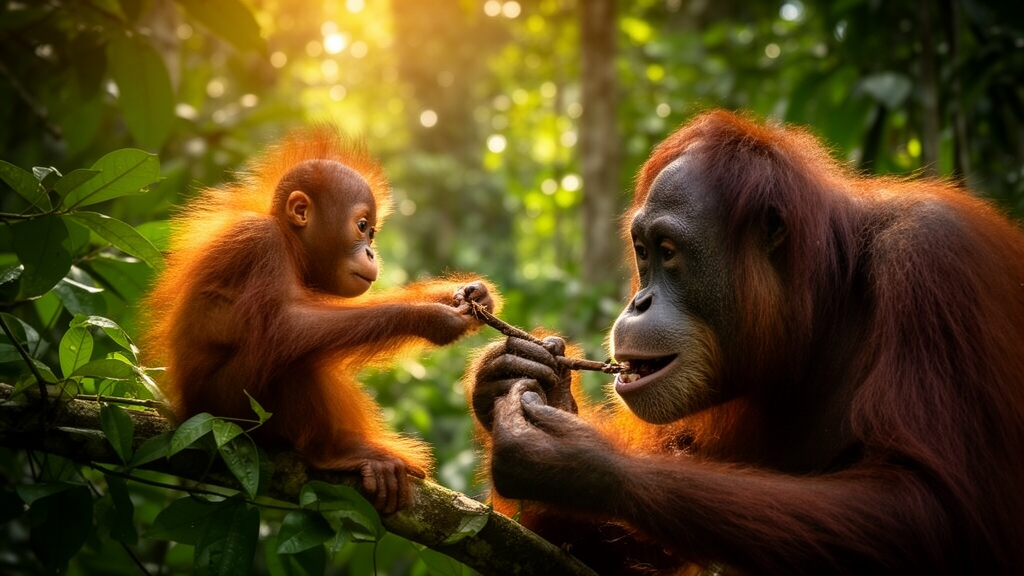
In the tangled rainforests of Sumatra, a young orangutan spends up to eight years glued to its mother’s side, watching her every move with an intensity that scientists are only now beginning to quantify. A landmark new study published in the journal Science has revealed that this extended apprenticeship is far more than simple dependence: it is one of the richest examples of cultural inheritance ever documented in the animal kingdom, with young orangutans acquiring the overwhelming majority of their ecological knowledge not through trial and error, but through careful, sustained observation of their mothers.
The research, led by scientists at the University of St Andrews in collaboration with the Max Planck Institute of Animal Behavior in Germany, drew on long-term data collected at the Suaq Balimbing monitoring station in Indonesia. Over twelve years of field study, the team accumulated nearly 7,000 records of juvenile experiences during 4,700 hours of dawn-to-dusk observations, creating an unprecedented window into how wild orangutans actually learn to survive in one of the planet’s most demanding environments.
The scale of the challenge facing a young orangutan is staggering. Before it can wean and forage independently, a juvenile must master the extraction of approximately 250 different dietary items from the rainforest, many of which demand precise techniques, and some of which require the use of simple tools. Orangutans hold the record among mammals for the length of maternal care, with youngsters remaining with their mothers for eight years or more before achieving full independence. This prolonged childhood, the new research suggests, is not merely a period of slow physical development but an intensive educational phase during which a substantial cultural heritage is transmitted from mother to offspring.
To measure this transfer of knowledge, the researchers distinguished between two complementary modes of learning. Instances in which young orangutans closely peered at the details of their mothers’ behaviours were recorded as indicators of social learning, while episodes in which juveniles explored their world independently were logged as individually driven learning. Every infant differed markedly from its peers in how frequently it engaged in each mode, allowing the team to assess how these learning styles shaped the eventual competence of each individual.
The most striking finding emerged from an analysis of how long an episode of attentive peering continued to influence a juvenile’s subsequent behaviour. By tracking how much time passed before a youngster’s own explorations began to deviate from the effects of the social information it had absorbed, the researchers discovered that the answer was, on average, as long as two and a half hours. This remarkable persistence of social influence translates into a profound conclusion: young orangutans acquire five to six times more knowledge from their mothers and other conspecifics than from their own purely independent explorations.
This study represents the first investigation of cultural inheritance in a wild animal to assess the totality of social and individual learning that goes into building the full repertoire of behaviour needed for independent adult life. Rather than treating social and individual learning as competing alternatives, the team found that the two modes worked powerfully in tandem. Juveniles who showed the highest rates of both forms of learning achieved independence with the most comprehensive dietary profiles, entering adulthood with the broadest and most complete ecological skill sets.
The converse was equally revealing. When both social and individual learning rates were low, individuals ended up with the lowest diet breadth, and the difference between the highest and lowest learners amounted to a three-fold variation in the diversity of foods they could competently exploit. This finding carries significant implications for understanding how variation in cultural transmission might shape individual survival prospects, and potentially even reproductive success, in long-lived species with slow life histories.
Co-author Professor Andrew Whiten from the School of Psychology and Neuroscience at the University of St Andrews emphasised the evolutionary significance of the findings. According to Whiten, the extent of cultural and individual learning observed during these apes’ long childhoods suggests that this pattern, which humans clearly share with orangutans, has origins stretching all the way back to the common ancestors of humans and orangutans, many millions of years ago. The implication is that the interplay between watching and doing, between absorbing the accumulated wisdom of previous generations and testing that knowledge through personal experience, may be a deeply ancient feature of the great ape lineage rather than a uniquely human invention.
The methodological rigour of the study deserves particular attention. By systematically coding thousands of individual observations across more than a decade, the researchers were able to move beyond anecdotal reports of ape culture and quantify, with statistical precision, the relative contributions of social and individual learning to the development of ecological competence. The finding that social information continues to shape a juvenile’s exploratory behaviour for hours after a single observation episode suggests that peering at mothers is not a fleeting curiosity but a genuine mechanism of knowledge acquisition, one that primes and guides subsequent independent exploration rather than replacing it.
Looking ahead, the team plans to extend the analysis beyond diet breadth to determine whether greater learning also translates into improved energy intake, and ultimately into measurable differences in survival and reproduction. If it does, the implications extend far beyond orangutans: they would suggest that cultural inheritance, the passing of learned knowledge from one generation to the next, is not merely a fascinating behavioural quirk but a genuine adaptive force with real consequences for fitness in the wild. For now, the mothers of Suaq continue their patient, eight-year tutelage, unaware that they are providing some of the strongest evidence yet that culture, in its deepest sense, runs far deeper in the animal kingdom than we ever imagined.
Subject of Research: Cultural inheritance and the interaction of social and individual learning during juvenile development in wild orangutans
Article Title: Copying mother: The surprising depth of culture shaping young orangutans’ lives
Article References: Copying mother: The surprising depth of culture shaping young orangutans’ lives. (n.d.). Original publication
Image Credits: AI Generated
DOI: Not provided
Keywords: orangutans, social learning, cultural inheritance, Sumatra, animal culture, maternal care, juvenile development, foraging skills, diet breadth, primatology, Science journal, ecological competence
Cite Scienmag News
Drew Townsend. (October 18, 2026). Orangutan Childhoods Reveal a Deeper Culture Than We Ever Imagined. Scienmag. https://scienmag.com/orangutan-childhoods-reveal-a-deeper-culture-than-we-ever-imagined/
Drew Townsend. "Orangutan Childhoods Reveal a Deeper Culture Than We Ever Imagined." Scienmag, 18 October 2026, https://scienmag.com/orangutan-childhoods-reveal-a-deeper-culture-than-we-ever-imagined/. Accessed 18 October 2026.
Drew Townsend. "Orangutan Childhoods Reveal a Deeper Culture Than We Ever Imagined." Scienmag. October 18, 2026. https://scienmag.com/orangutan-childhoods-reveal-a-deeper-culture-than-we-ever-imagined/


