


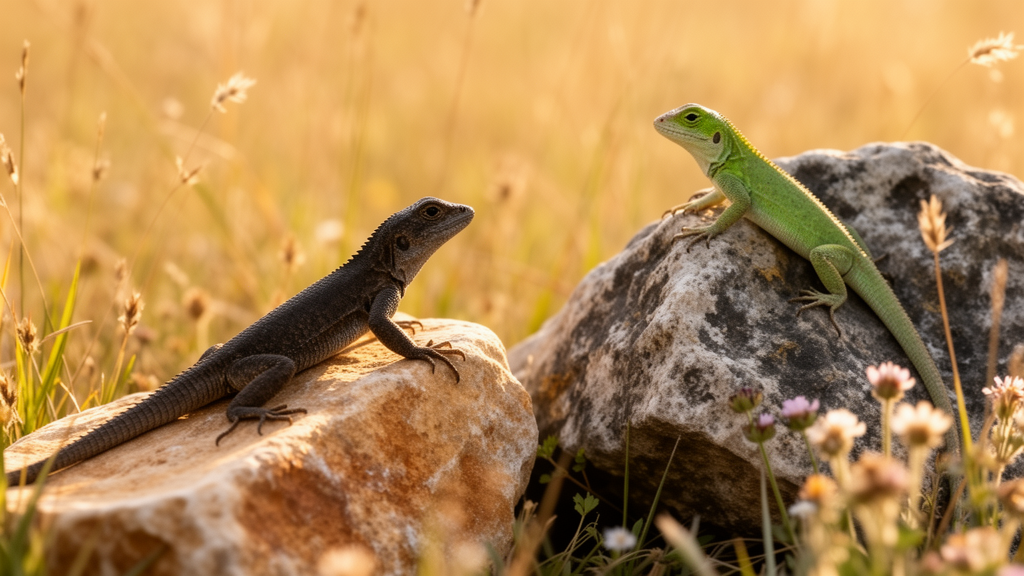
Two closely related lizard species coexisting in the hot and dry southwestern foothills of Bulgaria have been found to employ distinct thermal strategies to survive in their shared habitat. A new study published in Herpetozoa provides detailed insights into the thermal ecology of the Balkan Green Lizard (Lacerta trilineata) and the European Green Lizard (Lacerta viridis), highlighting how these reptiles manage their body temperatures under natural conditions. The research, conducted in the western foothills of the Pirin Mountains, addresses a significant knowledge gap in understanding how sympatric lacertid species differentiate their thermal preferences to minimize competition and optimize physiological performance.
As ectotherms, lizards rely heavily on external environmental sources to regulate their body temperature, a process critical for foraging, locomotion, and reproduction. The study recorded in situ body, air, and substrate temperatures, along with humidity and UV radiation, for 190 individuals across two sites in 2023 and 2024. The findings reveal that both species maintain body temperatures significantly higher than the surrounding air and substrate temperatures, confirming active behavioral thermoregulation. However, the European Green Lizard exhibited statistically higher body and substrate temperatures compared to the Balkan Green Lizard, particularly among adult males.
The divergence in thermal preferences likely reflects the different ecological niches occupied by the two species. Lacerta viridis, a more generalist species found in cooler and more diverse environments, appears to adopt a more active thermoregulation strategy to maintain higher body temperatures. In contrast, Lacerta trilineata, which inhabits drier and hotter areas, may regulate its body temperature at a lower level to avoid the risks of overheating and dehydration. This distinction is crucial for predicting how these species will respond to increasing temperatures in hot and dry habitats, a trend exacerbated by global climate change.
Within each species, sex and age also play significant roles in thermal management. For Lacerta trilineata, statistically significant differences in substrate temperature were found only between immatures and females, with females selecting higher temperatures. In Lacerta viridis, significant differences were observed between immatures and males in all temperature parameters, with males trending toward higher values, and between immatures and females in air temperature. These intraspecific variations suggest that males, who are often more active during the reproductive season, require higher metabolic rates and thus higher body temperatures to optimize their physiological functions.
The study also examined the relationship between body temperature and environmental factors, finding a positive correlation between lizard body temperature and both air and substrate temperatures. The correlation with air temperature was more pronounced in both species, indicating that lizards may rely more on behavioral adjustments in response to air temperature fluctuations than on substrate temperature. This suggests that microhabitat selection, such as basking in open areas or seeking shelter under rocks, is a primary mechanism for maintaining optimal body temperatures. The lack of significant correlation between body size and body temperature further supports the idea that behavioral thermoregulation is more influential than passive thermal effects.
UV radiation and humidity were also measured, but no significant differences were found between the two species or among sex and age groups in terms of UV exposure. However, the study notes that UV radiation plays a vital role in lizard physiology, including vitamin D3 synthesis, which is essential for calcium metabolism and reproductive success. While excessive UV can lead to overheating or skin damage, lizards appear to balance sun exposure with shade-seeking behaviors to mitigate these risks. The absence of significant humidity differences, except for a slight trend in adult males of Lacerta trilineata, suggests that water preservation strategies may not be the primary driver of thermal behavior in this context, though further research is needed to fully understand the impact of humidity on lizard ecology.
The implications of these findings extend beyond local ecology, offering valuable baseline data for predicting species responses to climate change. As environmental temperatures rise, reptiles face increased challenges in thermoregulation, which can reduce their time for activity, feeding, and reproduction. The ability of Lacerta viridis and Lacerta trilineata to maintain distinct thermal strategies under syntopy provides a model for understanding how closely related species can coexist in changing environments. This research underscores the importance of long-term monitoring of lizard populations in hot and dry habitats to assess the long-term impacts of climate change on their survival and distribution.
By filling a gap in the thermal ecology data for Bulgarian lizards, this study contributes to a broader understanding of reptilian adaptations to environmental stress. The detailed analysis of body, air, and substrate temperatures, along with humidity and UV radiation, provides a comprehensive picture of the thermal landscape these lizards navigate. As climate change continues to alter temperature and precipitation patterns, such studies are essential for developing conservation strategies that protect vulnerable species. The findings highlight the intricate balance lizards strike between maximizing physiological performance and avoiding thermal stress, a balance that will be increasingly critical in the face of a warming world.
Ultimately, the thermal ecology of Lacerta viridis and Lacerta trilineata in southwestern Bulgaria serves as a microcosm of the broader challenges facing ectothermic species globally. The distinct thermal strategies observed in these lizards offer insights into the mechanisms of coexistence and adaptation in shared habitats. As researchers continue to explore the impacts of climate change on reptile populations, studies like this one provide the foundational data needed to predict and mitigate potential declines. The resilience of these species in the face of environmental variability will be a key factor in determining their future in the changing climate of the Mediterranean region.
Subject of Research: On the thermal ecology of two coexisting lizard species (Reptilia, Lacertidae) in a hot and dry area of Bulgaria
Article Title: On the thermal ecology of two coexisting lizard species ( Reptilia , Lacertidae ) in a hot and dry area of Bulgaria
Article References: Vacheva, E., Stanchev, N., Krastev, G., Dyugmedzhiev, A., & Naumov, B. (2025). On the thermal ecology of two coexisting lizard species (Reptilia, Lacertidae) in a hot and dry area of Bulgaria. Herpetozoa, 38, 103-116. https://doi.org/10.3897/herpetozoa.38.e151988
Image Credits: AI Generated
DOI: 10.3897/herpetozoa.38.e151988
Keywords: thermal, ecology, coexisting, lizard, species, Reptilia, Lacertidae, area, Bulgaria, scientific research
Cite Scienmag News
Gavin Prescott. (October 18, 2026). Lizards in Bulgaria Reveal Distinct Thermal Strategies. Scienmag. https://scienmag.com/lizards-in-bulgaria-reveal-distinct-thermal-strategies/
Gavin Prescott. "Lizards in Bulgaria Reveal Distinct Thermal Strategies." Scienmag, 18 October 2026, https://scienmag.com/lizards-in-bulgaria-reveal-distinct-thermal-strategies/. Accessed 18 October 2026.
Gavin Prescott. "Lizards in Bulgaria Reveal Distinct Thermal Strategies." Scienmag. October 18, 2026. https://scienmag.com/lizards-in-bulgaria-reveal-distinct-thermal-strategies/


