


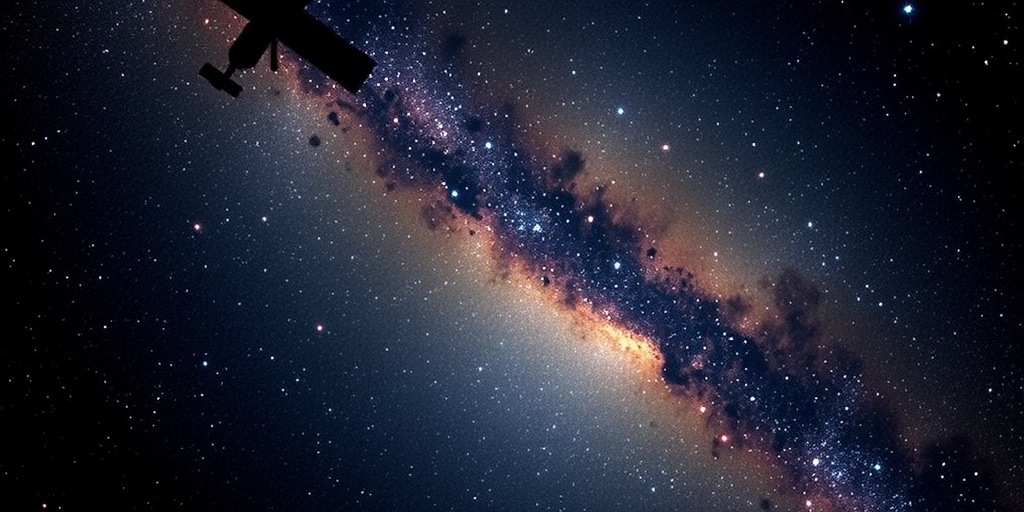
Sagittarius C presents one of the most extraordinary environments within the Milky Way Galaxy, located approximately 200 light-years from the supermassive black hole that resides at the galaxy’s core. This region is marked by massive clouds of interstellar gas and dust, which over countless years have undergone gravitational collapse, leading to the formation of thousands of stars. This mesmerizing nursery of stellar birth is not only visually stunning but plays a crucial role in understanding the conditions found in the early universe.
Recent observations from NASA’s James Webb Space Telescope have unveiled Sagittarius C with a level of detail previously unattainable, providing invaluable insights into the dynamics at play within this stellar nursery. The study led by astrophysicist John Bally from the University of Colorado Boulder, along with Samuel Crowe from the University of Virginia and Rubén Fedriani from the Instituto de Astrofísica de Andalucía, marks a significant advancement in our understanding of star formation within such intense environments.
One of the intriguing findings from their research is the identification of powerful magnetic field lines that weave through Sagittarius C, creating prominent filaments of hot hydrogen gas that resemble strands of spaghetti. This fascinating phenomenon suggests that these magnetic fields may act as a bottleneck, inhibiting the pace at which new stars are born within this already dense region of interstellar matter. It raises questions about the fundamental processes governing star formation and the role of magnetic forces in shaping these cosmic structures.
Bally emphasizes the significance of this region, noting that its extreme conditions resemble those found in the young universe. The Central Molecular Zone (CMZ), which encompasses Sagittarius C, is known for its high density of interstellar gas, yet it produces fewer new stars than theoretical models had predicted. This discrepancy prompts a closer examination of the interplay between gravity and magnetism in stellar nurseries, leading to a reevaluation of our understanding of star birth in the galaxy.
The study has broader implications for our comprehension of stellar evolution, as it sheds light on the violent dynamics of star formation as well as the subsequent evolution of star clusters. Notably, regions like the Orion Nebula, often cited as the closest stellar nursery to Earth, exhibit a different appearance compared to Sagittarius C, hinting at the influence of surrounding magnetic environments on the process of star formation.
Moreover, as newly formed stars begin to emit significant radiation, they can severely impact their surrounding environment. This radiation can push away the gas and dust necessary for future star formation, thus leading to a cyclical pattern where the birth of new stars ultimately sets the stage for the decline of their own formation. Consequently, understanding how such processes unfold in hotspots like Sagittarius C can provide insights into the lifecycles of stars and the fate of molecular clouds.
Interestingly, the presence of filaments within Sagittarius C was an unexpected discovery, adding another layer of complexity to our understanding of this region. These bright structures, made of plasma and rich in charged particles, highlight the unique nature of Sagittarius C compared to other star-forming regions. While the Orion Nebula appears smoother due to its relatively weaker magnetic environment, Sagittarius C’s intricate patterns underscore the substantial influence of magnetic forces at play in its formation.
Researchers have long hypothesized that the CMZ should be a prolific region for star formation, yet observations reveal a tangible gap between expectation and reality. The strong magnetic forces present in the CMZ may well counteract the gravitational forces that typically drive the collapse of molecular clouds, thus providing an explanation for the lower-than-expected rates of new star formation in this dense region.
Another important aspect of the new study is the examination of the protostars forming within Sagittarius C. The research highlights a detailed understanding of how these young stars interact with their environment by emitting radiation and blowing away gas and dust, further complicating the star formation process. Understanding these interactions is crucial to deciphering the lifecycle of stars and the architectural layout of stellar nurseries throughout the galaxy.
As this research evolves, it becomes clear that Sagittarius C’s stellar nursery is nearing the twilight of its life. While it is currently home to a multitude of new stars, it is anticipated that many of these stars will expend the resources of their host molecular cloud within several hundred thousand years. Such an impending transformation raises significant questions about the sustainability of star formation in environments like Sagittarius C and its capacity to generate future generations of stars.
In conclusion, the revelations about Sagittarius C illustrate the complex interplay of magnetism and star formation within the Milky Way. The findings not only illuminate a specific aspect of our galactic neighborhood but also echo the broader narratives of star birth and death that permeate the cosmos. The research stands as a testament to human curiosity and our relentless pursuit of knowledge about the universe we inhabit, all while inviting further exploration into the regions that harbor the seeds of stellar life.
Keywords
Sagittarius C, Milky Way Galaxy, star formation, supermassive black hole, magnetic fields, interstellar gas, James Webb Space Telescope, Central Molecular Zone, protostars, molecular clouds, Orion Nebula, stellar nurseries.
Cite Scienmag News
Grant Pearson. (April 2, 2025). Webb Telescope Reveals Stunning Images and Insights from One of the Milky Way’s Most Extreme Environments. Scienmag. https://scienmag.com/webb-telescope-reveals-stunning-images-and-insights-from-one-of-the-milky-ways-most-extreme-environments/
Grant Pearson. "Webb Telescope Reveals Stunning Images and Insights from One of the Milky Way’s Most Extreme Environments." Scienmag, 2 April 2025, https://scienmag.com/webb-telescope-reveals-stunning-images-and-insights-from-one-of-the-milky-ways-most-extreme-environments/. Accessed 6 September 2026.
Grant Pearson. "Webb Telescope Reveals Stunning Images and Insights from One of the Milky Way’s Most Extreme Environments." Scienmag. April 2, 2025. https://scienmag.com/webb-telescope-reveals-stunning-images-and-insights-from-one-of-the-milky-ways-most-extreme-environments/


