


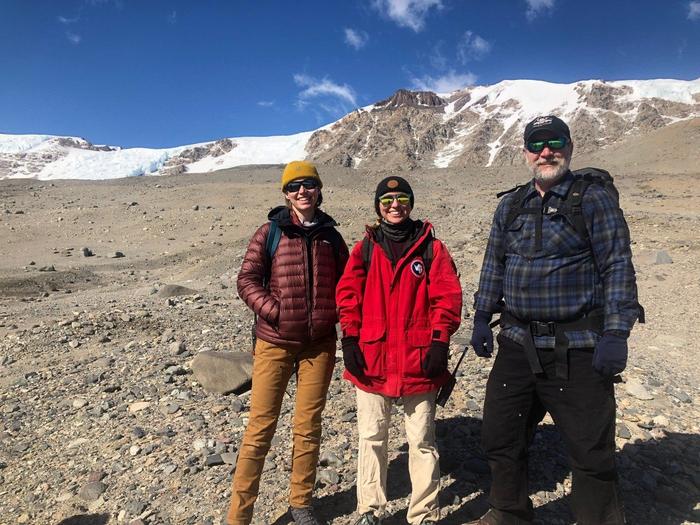
The McMurdo Dry Valleys of Antarctica live up to their name. The region is one of the driest places on Earth — mountains form a wall around the valleys and prevent melting glacier water from intruding, humidity is extremely low, and no rain was documented in the valleys between the 1960s and the early 2020s.

Credit: Photo courtesy of J.E. “Jeb” Barrett.
The McMurdo Dry Valleys of Antarctica live up to their name. The region is one of the driest places on Earth — mountains form a wall around the valleys and prevent melting glacier water from intruding, humidity is extremely low, and no rain was documented in the valleys between the 1960s and the early 2020s.
So when Virginia Tech biological sciences Professor J.E. “Jeb” Barrett learned of a March 2022 day in the McMurdo Dry Valleys that the thermometer rocketed to more than 70 degrees Fahrenheit above its average, he thought examining the extreme weather change would be revealing.
In a paper published Aug. 5 in the American Geophysical Union journal Earth’s Future, Barrett and colleagues reported findings indicating that the March 2022 “weather whiplash” led to record-high death rates for invertebrate organisms that count on surviving winter in an “inactive freeze-dried state.”
The event that triggered Barrett’s work happened on March 18, 2022. On that day, a subtropical river of air in the atmosphere swept over Antarctica, creating an almost instant heat wave on a continent that had already begun freezing into the dark polar night of winter. The temperature jump in the McMurdo Dry Valleys that March paralleled that of the past few days when an Antarctica heat wave has alarmed scientists and others.
“Unfortunately, atmospheric scientists expect more weather anomalies like this in Antarctica,” Barrett said. “Studying the impact of the March 2022 event can help us predict how the ecosystem and creatures in it will respond to future climate changes.”
The McMurdo Dry Valleys are especially valuable for scientific research because they may be the only place in Antarctica that have a three-decade-long record of meteorology, stream flow, and soil organisms.
The extreme climate of the McMurdo Dry Valleys limits the organisms that can live there to microscopic or nearly microscopic animals such as rotifers, tardigrades, and nematodes. In March in Antarctica, the equivalent of autumn in the Northern Hemisphere, these animals are transitioning into a dry, frozen status that is critical to their ability to survive the coldest months of the year.
Barrett and the team took advantage of multispectral satellite images to determine how much the March 18 spike in temperatures melted the frozen ground. They examined satellite shots from before March 18, then looked for areas that had darkened on the images immediately after the warm weather.
“Only two things could have resulted in the darker images that we saw: shadows from cloud cover or mountainous topography or the addition of water from melting ice,” Barrett said.
Once they eliminated the possibility of shadows on the satellite images, Barrett and other researchers knew the unusually hot day had resulted in a rapid, massive thaw. The valleys had been swamped. Anything near the surface would no longer be frozen.
In December 2022, researchers collected soil from areas within the valleys and counted the number of live or dead invertebrates. They found a mortality rate of more than 50 percent in areas that had wetted up during the March 2022 event. The only other cases of a mortality rate nearing that have occurred during experiments exploring extreme “freeze-thaw treatments.”
“Our findings from this weather event should be eye-opening for us all,” Barrett said. “As we’ve seen in Southwest Virginia recently as well as in many other U.S. communities, the weather can now change like the flip of a switch. Rapid changes to the environment are difficult for microscopic animals, and they are challenging for people, animals, and plants as well.”
Journal
Earth s Future
Article Title
Response of a Terrestrial Polar Ecosystem to the March 2022 Antarctic Weather Anomaly
Article Publication Date
5-Aug-2024
Cite Scienmag News
Sloane Callahan. (August 8, 2024). Weather ‘whiplash’ in Antarctica may help predict effects of future climate change. Scienmag. https://scienmag.com/weather-whiplash-in-antarctica-may-help-predict-effects-of-future-climate-change/
Sloane Callahan. "Weather ‘whiplash’ in Antarctica may help predict effects of future climate change." Scienmag, 8 August 2024, https://scienmag.com/weather-whiplash-in-antarctica-may-help-predict-effects-of-future-climate-change/. Accessed 3 September 2026.
Sloane Callahan. "Weather ‘whiplash’ in Antarctica may help predict effects of future climate change." Scienmag. August 8, 2024. https://scienmag.com/weather-whiplash-in-antarctica-may-help-predict-effects-of-future-climate-change/

