


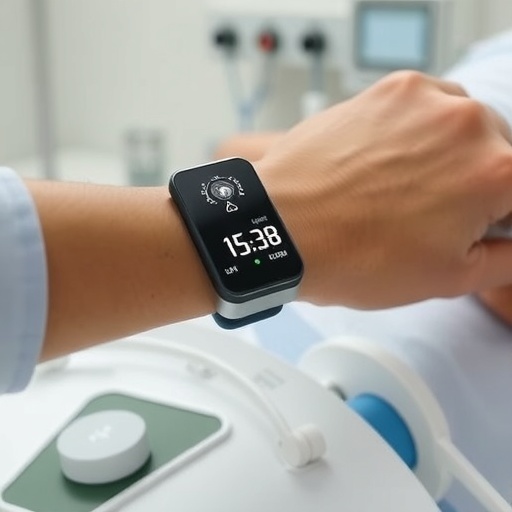
A pair of wearable sensors combined with an artificial intelligence system has produced continuous blood-pressure waveforms that closely resemble those recorded by arterial catheters, according to an early study by researchers at Johns Hopkins University. The technology, tested initially in 28 intensive care patients, could eventually offer clinicians a less invasive way to track one of the most important—and most difficult to continuously measure—vital signs.
The system, called MOSAIC, is designed to address a longstanding problem in critical care. Patients in intensive care units can experience sudden and dangerous changes in blood pressure, sometimes within minutes. A pressure that rises too high may increase the risk of stroke, heart attack, and kidney injury, while a pressure that falls too low can reduce blood flow to the brain and other vital organs. Detecting these changes early is often essential, but the current method for doing so continuously requires placing a catheter directly inside an artery.
Arterial lines provide highly detailed, beat-by-beat measurements and are widely regarded as the clinical reference standard for continuous blood-pressure monitoring. Yet inserting an arterial catheter is an invasive procedure. The catheter can cause bleeding, clot formation, infection, or damage to the artery, and it restricts a patient’s movement. The line must also be carefully maintained and monitored by clinical staff. These drawbacks mean that continuous arterial monitoring is generally reserved for patients whose condition is serious enough to justify the risks.
Conventional arm cuffs avoid those risks but introduce a different limitation: they measure blood pressure only intermittently. A cuff inflates periodically, records a pressure reading, and then remains inactive until the next measurement. That approach can miss rapid fluctuations between readings. It also tends to interrupt sleep, limit movement, and provide clinicians with isolated numbers rather than a continuous picture of how pressure changes from one heartbeat to the next.
MOSAIC uses two small sensors to capture the physiological signals needed to estimate blood pressure without entering the bloodstream. One sensor is positioned on the chest to record the heart’s electrical activity, similar to an electrocardiogram. The second is placed on a finger, where it detects changes in blood volume as pulses of blood move through the circulation. This optical or pulse-related signal provides information about the timing and shape of blood flow. Together, the signals describe how electrical activation of the heart relates to the arrival and movement of blood through the body.
The system then sends those measurements to a deep-learning model. Rather than producing only a single systolic and diastolic value, the algorithm reconstructs a blood-pressure waveform, a continuously changing curve that represents pressure over time. The waveform contains information about each heartbeat, including the rise and fall of arterial pressure and the timing of pulse transmission. In principle, this gives clinicians a richer view of cardiovascular changes than a sequence of occasional cuff readings.
The researchers trained and evaluated the system by comparing its reconstructed waveforms with measurements from arterial catheters already being used in patients at Johns Hopkins Hospital. In the initial group of 28 intensive care patients, the signals generated by MOSAIC closely matched the waveforms recorded by the invasive lines. The result does not yet establish that the wearable system can replace arterial catheters in routine care, but it indicates that signals collected from the skin may contain enough information for artificial intelligence to estimate arterial pressure with clinically meaningful detail.
The technical challenge is substantial because blood pressure is influenced by many factors, including heart rhythm, vascular resistance, blood volume, body position, temperature, medications, and movement. The relationship between a pulse detected at the finger and pressure inside a major artery can change from person to person and over time. A deep-learning model can identify complex patterns in the electrical and pulse signals that are difficult to capture with a simple equation, but its performance must remain reliable across different patients, illnesses, skin conditions, sensor placements, and levels of physical activity.
“We reconstruct waveform data in a way that’s meaningful, accurate, reliable and, most importantly, non-invasive,” said senior author Robert Stevens, chief of the Division of Informatics, Integration, and Innovation at Johns Hopkins Medicine. Lead author Carl Harris, a biomedical engineering doctoral student, said the team was seeking an alternative to arterial lines because of their risks of bleeding, clotting, and infection.
The investigators are now testing MOSAIC in a larger cohort of intensive care patients. That next phase will be important because a study of 28 people cannot fully capture the range of physiological conditions encountered in critical care. Larger validation studies will need to determine how accurately the system performs during severe infection, shock, irregular heart rhythms, rapid changes in medication, low blood flow to the extremities, and patient movement. Researchers will also need to establish how the algorithm behaves when sensor signals are noisy or temporarily interrupted.
If the technology continues to perform well, its uses could extend beyond intensive care. A non-invasive continuous monitor could allow clinicians to follow patients in regular hospital wards without transferring them to an intensive care unit simply because they need closer blood-pressure observation. It might also enable earlier recognition of deterioration in patients who are recovering from surgery or serious illness, while allowing them greater freedom to move than an arterial catheter permits.
The researchers also envision a future in which people with hypertension wear similar sensors for extended periods outside the hospital. High blood pressure is among the world’s most common health conditions and a major contributor to cardiovascular disease, stroke, and kidney damage. Current home monitoring usually relies on occasional cuff measurements, which can be useful but may not reveal how pressure changes during work, exercise, sleep, stress, or ordinary daily activity. Continuous data could show patterns that are invisible in isolated readings and might help physicians adjust treatment more precisely.
That possibility resembles the transformation brought by wearable glucose monitors, which allow people with diabetes to observe changes in blood sugar throughout the day rather than relying only on occasional tests. Continuous blood-pressure monitoring could eventually provide a similar window into cardiovascular health, although the comparison should be treated cautiously. Blood-pressure measurement is technically complex, and a device intended for medical decisions must demonstrate accuracy and reliability across a wide population before it can be used broadly.
The system could also help researchers study blood pressure in healthy people. Most detailed blood-pressure data currently come from patients who are already ill or undergoing medical procedures. Less is known about how pressure changes in people as they commute, work, exercise, sleep, and interact with their environment. Long-term wearable monitoring could reveal previously overlooked patterns and improve understanding of how everyday behavior and stress affect cardiovascular risk.
For now, MOSAIC remains an investigational technology rather than a replacement for the arterial line. Its encouraging first test shows that wearable sensors and artificial intelligence can reproduce invasive blood-pressure waveforms with surprising fidelity, but larger studies and rigorous clinical validation are still required. If those studies confirm the initial results, the technology could shift continuous blood-pressure monitoring away from the artery and toward the skin, bringing real-time cardiovascular information to more patients in hospitals and, eventually, at home.
Web References: Johns Hopkins University research announcement; https://www.sciencedirect.com/science/article/abs/pii/S0010482526004257
References: Computers in Biology and Medicine, DOI: 10.1016/j.compbiomed.2026.111861
Keywords
Wearable sensors, artificial intelligence, deep learning, blood pressure, continuous monitoring, arterial line, intensive care, hypertension, biomedical engineering, cardiovascular health
Cite Scienmag News
Denise Maddox. (August 17, 2026). Wearable Sensors and AI May Enable Continuous ICU Blood Pressure Monitoring. Scienmag. https://scienmag.com/wearable-sensors-and-ai-may-enable-continuous-icu-blood-pressure-monitoring/
Denise Maddox. "Wearable Sensors and AI May Enable Continuous ICU Blood Pressure Monitoring." Scienmag, 17 August 2026, https://scienmag.com/wearable-sensors-and-ai-may-enable-continuous-icu-blood-pressure-monitoring/. Accessed 3 September 2026.
Denise Maddox. "Wearable Sensors and AI May Enable Continuous ICU Blood Pressure Monitoring." Scienmag. August 17, 2026. https://scienmag.com/wearable-sensors-and-ai-may-enable-continuous-icu-blood-pressure-monitoring/


