


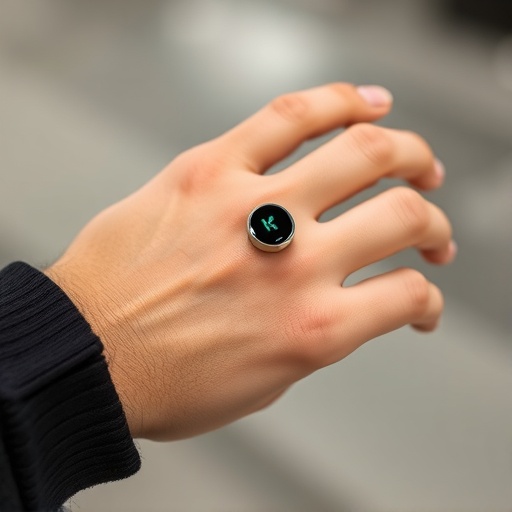
Engineers at the University of California San Diego have built what they describe as a first-of-its-kind integrated smart ring designed for daily biochemical monitoring. Unlike consumer wearables that primarily measure physical signals such as motion or heart rate, the device targets molecular information directly from human sweat, aiming to create a richer, continuously updated view of health-related chemistry.
The ring can track up to four biomarkers at once and, in its full demonstrated panel, targets glucose, ketones, vitamin C, uric acid, lactate, and alcohol. The work is reported in a new paper in Nature Communications, from a team led by Joseph Wang, professor in UC San Diego’s Jacobs School of Engineering.
A key challenge for sweat-based sensors is reliably collecting enough liquid for analysis without discomfort. The researchers use a technique pioneered by first author Tamoghna Saha, where sweat is passively drawn through the skin via osmosis. Instead of requiring exercise or an active pumping mechanism, the process relies on a soft osmotic hydrogel that creates a pressure gradient to pull fluid from the skin painlessly.
Once sweat reaches the ring, an electrochemical sensor array analyzes the collected samples. To translate electrical responses into meaningful concentrations, the prototype relies on repeated measurements to generate subject-specific calibration factors. This personalization is intended to improve accuracy for trends over time, rather than only producing one-off readings.
In trials involving healthy volunteers and people with type 1 diabetes, the ring’s glucose signals closely followed those from commercial continuous glucose monitors (CGMs). Meanwhile, ketone measurements showed strong agreement with readings from commercial blood ketone meters, suggesting the approach can capture multiple metabolite dynamics relevant to diet and disease.
The prototype is fully integrated, combining low-power electronics, flexible sensing components, and a rechargeable power source in a ring-sized footprint. Power comes from a flexible zinc-silver oxide battery designed to support up to 12 hours between charges, while data are transmitted wirelessly to a smartphone app for viewing and interpretation.
Study authors emphasize that simultaneous biomarker monitoring could help people make faster, better-informed decisions about insulin dosing, nutrition, and lifestyle adjustments. The ability to observe glucose and ketones at the same time is positioned as particularly useful for diabetes management.
For now, the device remains a prototype, but it demonstrates an important shift toward “molecular” wearable monitoring—moving from correlates of health toward biochemical markers that could directly reflect metabolic state.
Subject of Research:
Smart ring for daily biochemical monitoring via sweat-based electrochemical sensing
Article Title: A fully integrated smart ring for daily biochemical monitoring
News Publication Date: 23-Jul-2026
Web References: https://www.nature.com/articles/s41467-026-75980-z
References: 10.1038/s41467-026-75980-z
Image Credits: David Baillot/UC San Diego Jacobs School of Engineering
Keywords
smart ring, sweat biomarkers, glucose, ketones, electrochemical sensor, osmotic hydrogel, wearable diagnostics, Nature Communications
Cite Scienmag News
Denise Maddox. (July 27, 2026). Wearable ring monitors glucose and ketones in sweat simultaneously. Scienmag. https://scienmag.com/wearable-ring-monitors-glucose-and-ketones-in-sweat-simultaneously/
Denise Maddox. "Wearable ring monitors glucose and ketones in sweat simultaneously." Scienmag, 27 July 2026, https://scienmag.com/wearable-ring-monitors-glucose-and-ketones-in-sweat-simultaneously/. Accessed 4 September 2026.
Denise Maddox. "Wearable ring monitors glucose and ketones in sweat simultaneously." Scienmag. July 27, 2026. https://scienmag.com/wearable-ring-monitors-glucose-and-ketones-in-sweat-simultaneously/


